A Friday enquiry arrives while the events team is setting a room. The coordinator intends to reply after the show-round, then gets pulled into a staffing issue. By Monday, the couple has compared several venues, the corporate organiser has filled the date elsewhere, and the original message is buried beneath routine correspondence. The venue may still be the right choice, but the process has made it difficult to say yes.
Learning how to convert more wedding and event enquiries into confirmed bookings starts with treating every enquiry as a live commercial opportunity. The strongest venues don't rely on attractive rooms or a lower price alone. They respond quickly, qualify consistently, present a clear choice, follow up with purpose, and remove friction from acceptance and payment. A benchmark from the MIA 2023 UK insight report recorded an average event conversion rate of 42%, with an average enquiry value of £30,927. That makes process discipline a revenue issue, not an administrative preference.
Table of Contents
- Why Wedding and Event Enquiries Go Cold
- Capturing and Qualifying Every Enquiry
- Building an Enquiry Pipeline You Can Trust
- Writing Proposals That Win and the Follow-Up Cadence
- Show-Rounds, Online Acceptance and Deposit Flows
- Measuring What Matters Across the Funnel
- Scaling the Playbook With CreventaFlow and Creventa
Why Wedding and Event Enquiries Go Cold
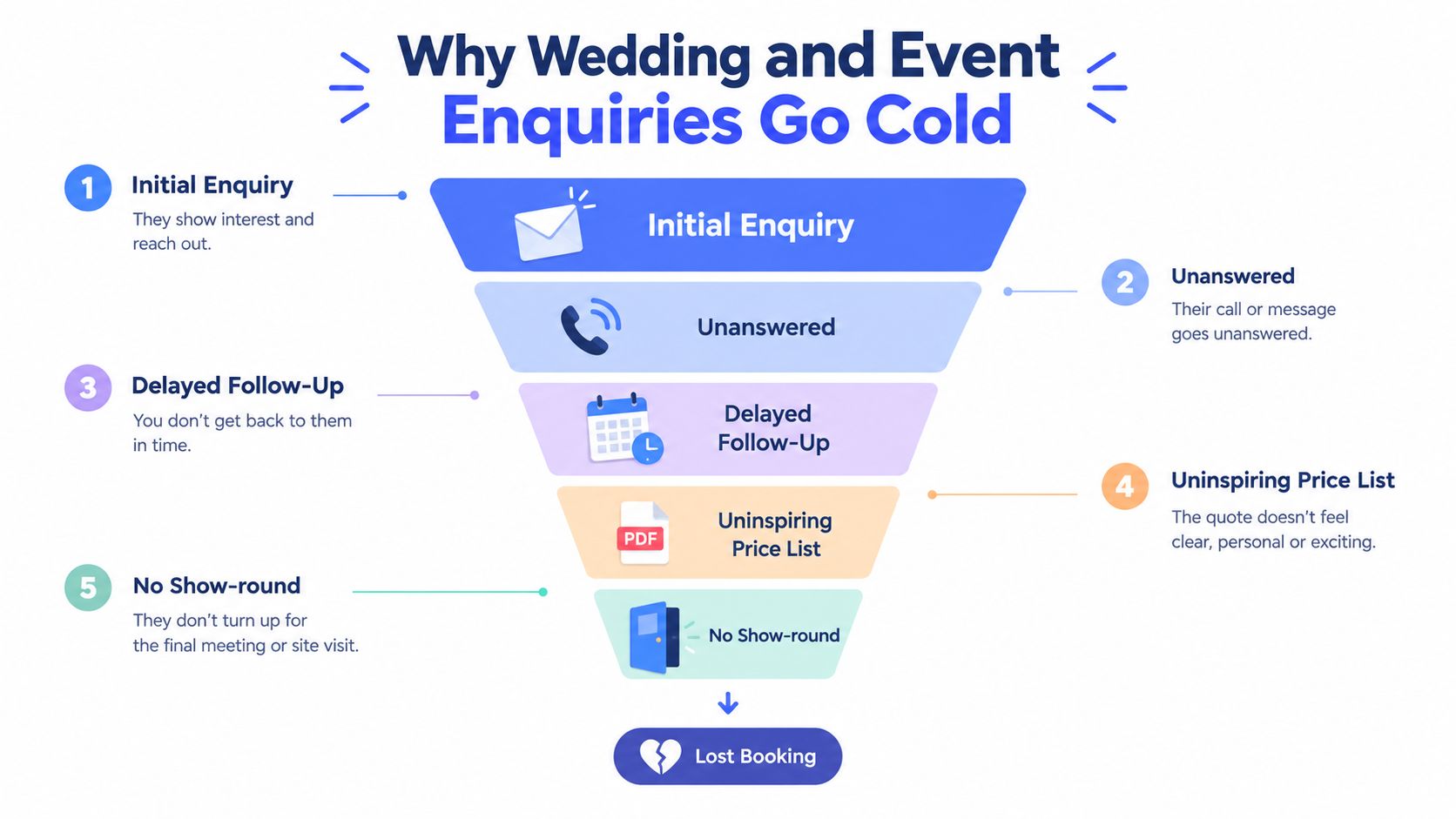
A venue coordinator arrives on Monday and finds three warm enquiries from the previous Friday unanswered. Two proposals are sitting unread in a colleague's outbox, and a provisional hold expired overnight without anyone contacting the client. Nobody intended to lose those bookings. The team lacked a visible owner, a response standard, and a defined next action.
The failure usually happens before price becomes the objection. A late reply gives the buyer time to move on. A generic message makes the venue feel interchangeable. A proposal with no clear decision path leaves the client wondering what happens next. An unowned date hold creates internal uncertainty and external frustration.
Wedding decisions move particularly quickly. A 2026 UK wedding-industry report found that 79% of couples book their venue within four weeks of first contact and 92% within two months, while 41% expect a response within 48 hours. Only 7% expect a same-day response, but that shouldn't be read as permission to wait. The booking window is short, and the first response establishes whether your team feels organised enough to manage the day itself. See the UK wedding venue enquiry benchmark for the underlying figures.
The margin is lost in small gaps
Industry reporting on UK event enquiries found proposal follow-up at around 4 hours for roughly half of enquiries and 8 hours for about 60%, while mystery-shopper work found that only 65% of handlers gave enough confidence to book. The BVA BDRC meetings and events report also describes a sharp drop-off as first-response time moves from minutes to hours.
The commercial cost isn't only the booking that disappears. Sales staff spend time reconstructing conversations, checking availability again, rewriting proposals, and chasing information that should have been captured at the start. A disciplined funnel protects both revenue and working time.
Use this as the operating principle:
Practical rule: Every enquiry needs a named owner, a next action, and a date by which that action must happen.
If you want to review the intake process itself, this guide on managing event enquiries at a venue provides a useful operational reference. The remedy isn't complicated software on day one. An inbox, a shared sheet, and a consistent response routine can fix much of the leakage. The important step is making the process visible and repeatable.
Capturing and Qualifying Every Enquiry
Before an enquiry reaches a salesperson's personal inbox, capture enough information to decide who should respond, how quickly, and with what offer. A name and preferred date aren't enough for a hotel wedding team handling ceremony space, bedrooms, catering, room turns, and competing holds.
Record the event type, preferred date, alternate dates, guest-count range, budget band, ceremony or reception requirement, catering style, accommodation needs, decision timeframe, and enquiry source. Each field changes the sales approach. A flexible midweek celebration deserves different availability suggestions from a fixed-date Saturday wedding. A corporate organiser seeking a quick quote needs a different follow-up from a couple still choosing between ceremony formats.
A copy-ready intake form
Paste this into an email template, shared sheet, or enquiry form:
- Event type: Wedding, private celebration, meeting, dinner, party, or other
- Preferred date:
- Alternative dates:
- Guest numbers: Minimum and expected maximum
- Budget: Total or per-person expectation, if known
- Format: Ceremony, reception, dinner, meeting, overnight stay
- Catering: Seated meal, buffet, canapés, drinks package, or undecided
- Accommodation: Rooms required, if applicable
- Decision makers: Names and relationship to the booking
- Decision date: When does the client need to choose?
- Source: Website, phone, email, listing site, social message, referral, or walk-in
- Immediate next step: Availability check, call, show-round, or proposal
Don't use qualification as a reason to delay the first acknowledgement. Send a useful confirmation immediately, then gather missing information during the first call or reply.
A simple scorecard
A score helps the team triage rather than treating every enquiry as equally urgent. The purpose isn't to reject lower-scoring leads. It's to give the hottest opportunities the fastest personal attention, while keeping every record alive.
| Criterion | Score 1 (Cold) | Score 3 (Warm) | Score 5 (Hot) |
|---|---|---|---|
| Date flexibility | One fixed date only | A small date range | Several workable dates |
| Budget fit | Unclear or materially below offer | Possible fit after discussion | Clear fit with scope |
| Decision authority | Researching for someone else | Influences the decision | Decision maker involved |
| Guest count match | Outside practical capacity | Possible with adjustment | Fits the room and service model |
| Urgency | No decision timeframe | Choosing in due course | Wants a call, visit, or proposal promptly |
A lightweight framework for getting meeting-ready leads with Lead Printer can help teams think about qualification as readiness, not merely contact capture. Keep the same fields across phone, web form, email, social DMs, wedding listing sites, and walk-ins. The online booking software for events should reflect one intake process, not create separate silos for each channel.
Building an Enquiry Pipeline You Can Trust
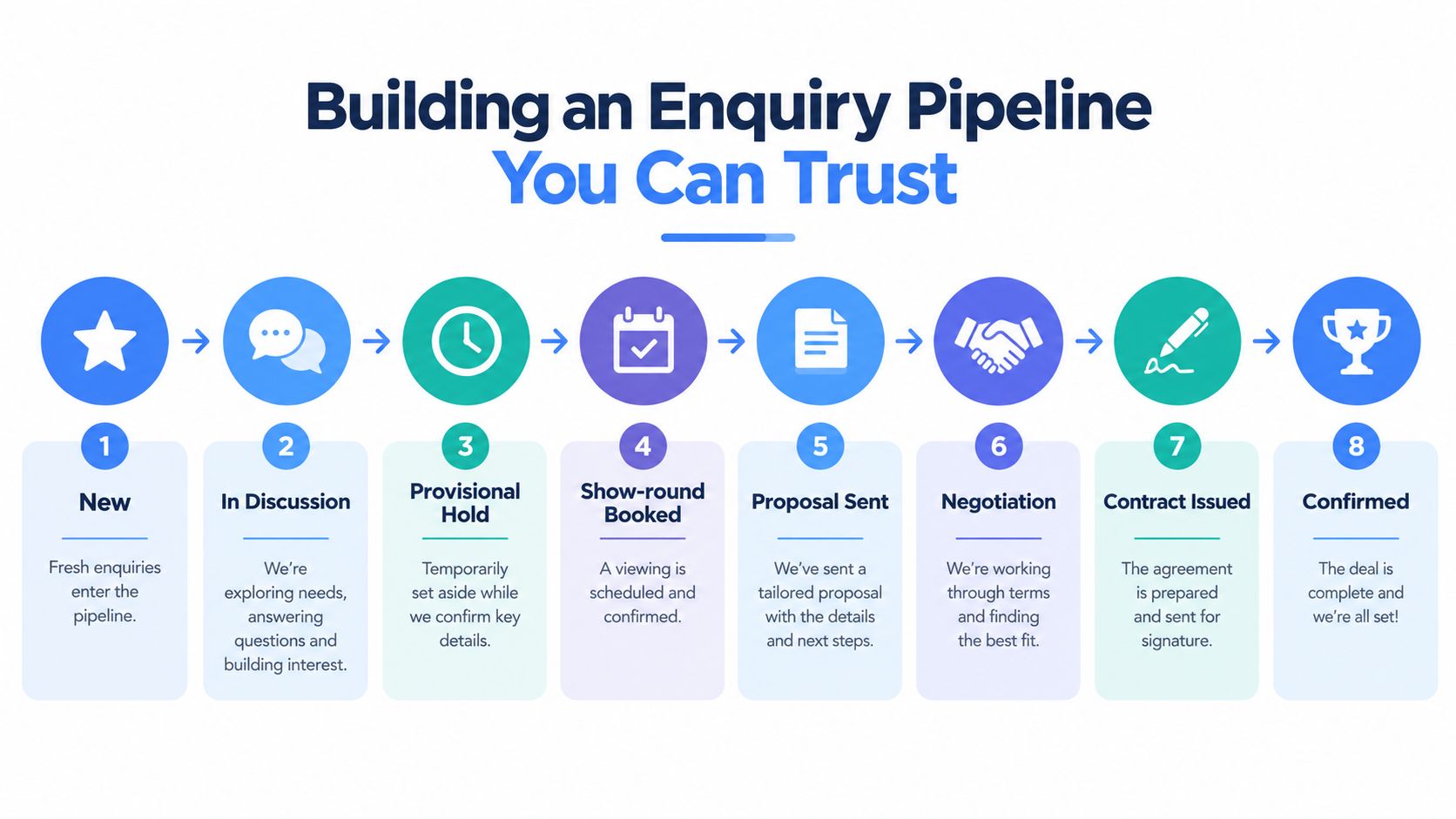
A pipeline works when every stage has one meaning. “In progress” is not a stage. It hides whether the team is waiting for a reply, preparing a proposal, arranging a visit, or seeking a signature.
Use these stages:
- New: The enquiry is received and acknowledged. The owner is the assigned sales or events lead.
- In Discussion: The team is gathering requirements or discussing availability. The owner records the next contact.
- Provisional Hold: A suitable date is held with a written expiry. The owner monitors the release point.
- Show-round Booked: A visit is scheduled, with attendees and agenda recorded.
- Proposal Sent: A complete, dated proposal has been delivered to the decision maker.
- Negotiation: The client has raised specific questions or requested amendments.
- Contract Issued: The agreement and payment instructions have been sent.
- Confirmed: The contract is accepted and the required deposit is received.
- Lost or On Hold: The reason is recorded, such as date, budget, venue fit, or no decision.
Give every stage an exit rule
A record should never remain in a stage without an artefact or action. New requires an acknowledgement. In Discussion requires a logged conversation and next date. Proposal Sent requires the actual proposal and its expiry. Contract Issued requires a tracked acceptance and deposit status.
For provisional holds, choose a fair written period of 7 to 14 days, depending on demand and event complexity. The message can be direct:
“We can place a provisional hold on the date until [date]. This doesn't prevent you from considering other venues, and it doesn't guarantee the booking until the contract is accepted and the deposit is received. We'll contact you before the hold expires, then release the date if we haven't agreed an extension.”
The exact expiry matters because a peak date has an opportunity cost. Contact the client before release, record the outcome, and re-offer the date promptly when the hold expires.
Start with a shared sheet
A spreadsheet can run this process if it includes columns for stage, owner, last contact, next action, next-action date, decision maker, proposal value, hold expiry, and loss reason. Sales, events, and food and beverage managers should see the same record, because a sales promise that operations can't deliver creates a later failure.
For a practical version of this approach, see how to manage a venue events sales pipeline without spreadsheets. The point isn't to replace the spreadsheet immediately. It is to make the workflow reliable before adding automation.
Writing Proposals That Win and the Follow-Up Cadence
A proposal should answer the questions a client would otherwise ask in a second meeting. A plain price list makes the buyer assemble the experience themselves. A branded, visual proposal shows how the event could work, what the venue includes, and what decision the client needs to make.
Start with a strong cover page using the client's names or organisation, event type, preferred date, and a relevant venue image. Then present three priced options, such as intimate, signature, and full venue buyout. Three choices create a sensible comparison. One option forces a yes-or-no decision, while a long menu of packages creates confusion.
Include:
- The experience: A clear description of arrival, room use, service, food, drinks, and timings.
- The inclusions: Room hire, staffing assumptions, furniture, equipment, accommodation terms, and other included elements.
- The indicative menu: Enough detail to make the offer tangible, with substitutions or dietary handling explained.
- The commercial summary: Price basis, taxes where relevant, minimum numbers, payment schedule, and provisional-hold expiry.
- The next step: A show-round booking link, online acceptance route, or named contact for a decision call.
Proposal quality checklist
Before sending, the lead should confirm:
- Client and event details are correct.
- Availability has been checked against every relevant space.
- Guest numbers and service style match operations.
- Each option has a clear difference in value.
- Add-ons are explained without pressure.
- Terms, cancellation language, and payment dates are visible.
- The decision maker is copied or identified.
- The proposal has one clear call to action.
- The follow-up date is already scheduled.
A value-led upsell sounds like, “The signature option adds a drinks reception and gives guests a smoother arrival. If that isn't important, the intimate package remains a complete choice.” Don't hide the lower-priced option, and don't apologise for the higher one.
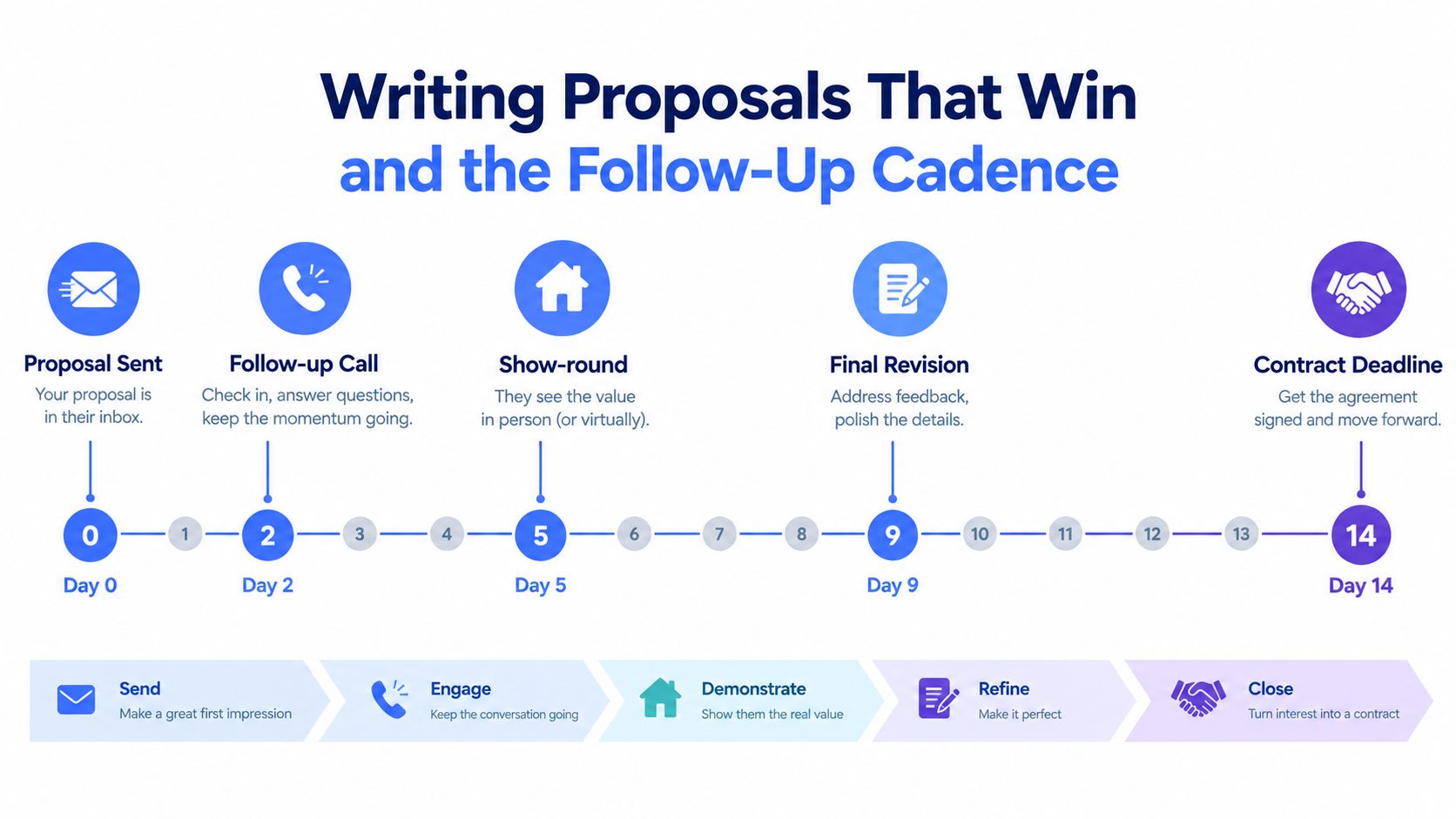
A follow-up sequence the team can use
- Within 24 hours: “Thank you for speaking with us. I've attached your proposal for [event]. The [option] seems the closest fit because [reason]. Could we arrange a short call to answer questions?”
- Day 3: “I wanted to check that the proposal reached you. Which option feels closest, and is there anything you'd like us to adjust?”
- Day 7: “We've reviewed your requirements and can also offer [relevant value]. Would that help you decide between the options?”
- Day 14: “Your provisional hold currently expires on [date]. Please let me know if you'd like to proceed, discuss an amendment, or release the date.”
- Day 21: “I'm closing the current follow-up on this enquiry, but I'd be pleased to revisit it if your date or plans change. Is the event still active?”
Use the event proposal and quote software for venues to standardise the content, but keep the judgement human. Automation should protect consistency, not replace relevance.
Show-Rounds, Online Acceptance and Deposit Flows
A show-round is a sales appointment, not a tour of empty rooms. The couple should leave knowing how their guests will move through the venue, what the service will feel like, and what decision they can make next.
A practical 45-minute agenda works well:
- Welcome: Confirm the couple's priorities and restate the event requirements.
- Story: Explain what the venue does especially well for this type of celebration.
- Walk-through: Follow the guest journey from arrival to departure, not just the floor plan.
- Taste or service detail: If a tasting is booked, connect each choice to the proposed package.
- Objection handling: Ask what still feels uncertain. Deal with price, layout, timing, access, or suppliers directly.
- Soft close: Agree the next action, whether that is a revised proposal, a date hold, or contract issue.
The coordinator should ask questions throughout. “How would you like guests to feel when they arrive?” produces better information than a sequence of room descriptions. Use the answers in the revised proposal so the client can see that the venue listened.
Remove acceptance friction
Once the client has decided, the path should be obvious. An online acceptance flow can let them review the proposal, accept the selected option, sign the contract, pay the deposit, and trigger the next communication without requiring several separate emails.
Before issuing the contract, confirm:
- Terms and conditions are available and understandable.
- Cancellation and amendment rules are clear.
- Minimum numbers and payment dates are recorded.
- Capacity and room layout are suitable.
- Supplier insurance requirements are stated where relevant.
- Dietary and allergen declarations have a defined collection point.
- The client understands what makes the booking confirmed.
UK food-business guidance says managers, kitchen staff, and front-of-house teams must provide allergen information and avoid cross-contamination, as set out in the GOV.UK allergen checklist for food businesses. Capture dietary and allergen details early, but don't treat an unchecked declaration as operational sign-off. The kitchen and service teams still need the correct controls.
Show-round day checklist
Before arrival, check the room, lighting, toilets, access route, sample menus, availability, and the client's record. During the appointment, ask about the decision process, show the guest journey, and agree a next date. After departure, send the promised material promptly and update the stage before the next enquiry arrives.
Before signature, have one person verify the date, spaces, numbers, menu basis, payment schedule, special requirements, and contract status. A fast deposit link is useful only when the underlying offer is accurate.
Measuring What Matters Across the Funnel
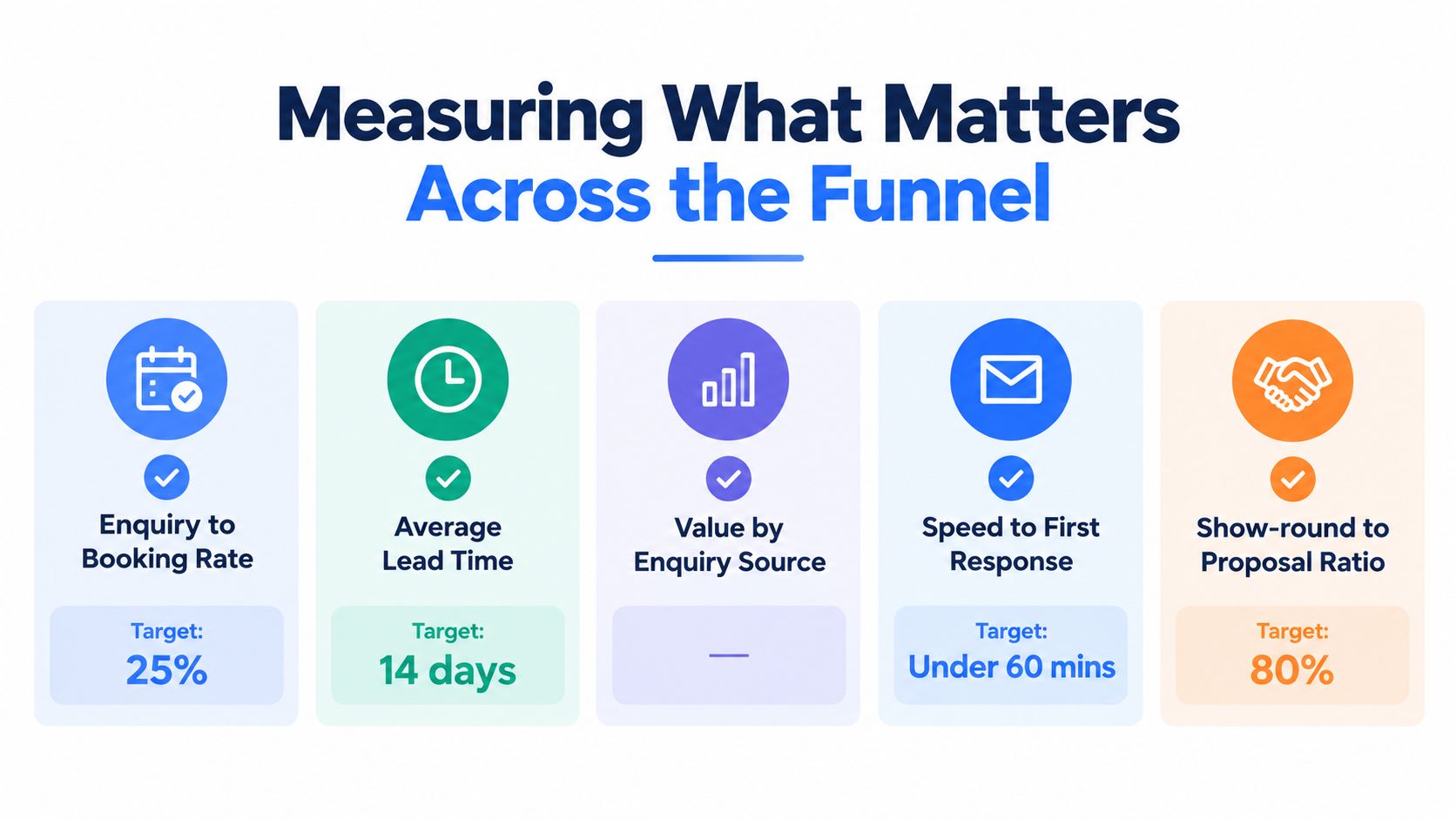
A useful dashboard shows where a booking stalls and who can change the outcome. Start with enquiry-to-booking rate, then split it by source, event type, date pattern, owner, and value band. An acceptable overall rate can hide lost fixed-date weddings caused by slow responses, or a diary filled with low-value events that demand heavy planning.
Track average lead time, enquiry value by source, speed to first response, show-round-to-proposal ratio, proposal-to-deposit conversion, and average revenue per confirmed event. The separate 2026 UK event-planning index reported a median enquiry for 40 guests, a median lead time of 53 days, and a median estimated budget of £875. The MIA benchmark report recorded an average enquiry lead time of 15.2 weeks and average enquiry value of £30,927. The different profiles make one blended conversion figure unsafe for decision-making.
The weekly review
Review the pipeline at the same time each week:
- Volume: How many new enquiries arrived?
- Speed: How quickly did the team acknowledge and personally respond?
- Movement: How many records reached a show-round, proposal, contract, or confirmation?
- Value: Which sources and event types produced the strongest commercial opportunities?
- Ageing: Which records have no next action or have stayed too long at their current stage?
Keep the review practical. Ask, Where is the largest avoidable drop-off? Then ask whether the cause is demand, sales behaviour, offer quality, or operational capacity. Choose one owner and one action, such as routing new enquiries to a duty owner, rewriting the first-response template, or coaching proposal calls.
Use a spreadsheet first if that is what the venue has. Give every record a stage, value, owner, last-contact date, and next action. CreventaFlow and Creventa can scale that same discipline later, provided the team measures the workflow before automating it.
Do not celebrate average order value while peak-date enquiries wait untouched. The useful decision connects a metric to an accountable change.
Scaling the Playbook With CreventaFlow and Creventa
CreventaFlow, Creventa's AI-first enquiry and event sales product, maps directly onto the workflow described above. Enquiries from the venue's channels can enter a tracked pipeline, receive an acknowledgement, move through defined stages, and carry follow-up tasks rather than living in disconnected inboxes.
The system supports branded proposals and quotes, payment schedules, forecasting, and pace reporting, allowing managers to see how the season is developing rather than relying on a static diary. Once the booking is confirmed, Creventa takes over the guest layer with venue-branded, white-label emails for RSVPs, food choices, allergies and dietaries, drinks pre-orders, and seating. Its wider workflow includes pre-orders, seating, place cards, reports, post-event feedback, and guest insights.
Creventa integrates with Delphi, Opera Cloud, SevenRooms, OpenTable, Guestline/RezLynx, Stripe, Adyen, and PlanetPay. It can also sit alongside spreadsheets while the team establishes consistent qualification, ownership, proposal, and payment habits. Implementation typically takes a couple of days rather than a long IT project, and Creventa pricing is public and transparent.
The product has been used by organisations including Malmaison and Hotel du Vin, Wolseley Hospitality Group, and Tottington Manor. Those names demonstrate the range of hospitality settings, but the operating principle remains the same for a small venue: capture the enquiry, make the next step clear, and keep the guest information connected to the confirmed booking.
Start in week one with five actions:
- Switch on enquiry auto-acknowledgement.
- Set qualification scoring rules.
- Load the three-option proposal template.
- Connect the deposit acceptance route.
- Book a weekly KPI review with named owners.
For background on enquiry workflow design, you can also review the Creventa partner information, while keeping the focus on your own process rather than on software comparisons.
Creventa brings enquiry management, branded proposals, deposits, guest pre-orders, allergen and dietary capture, seating, communications, and reporting into a connected hospitality workflow. Visit Creventa to see how your team can turn the process in this guide into a repeatable route from first enquiry to confirmed booking and well-prepared event.
Andrew Norton, Founder, Creventa. Andrew founded Creventa after years working with hospitality venues on the admin gap between a confirmed booking and event day.