You've probably got dates in the diary, enquiry volume looks healthy, and the sales report says events are doing well. Then the month closes and the profit isn't there. That's the banquet trap. Revenue looks strong on paper, but over-catering, loose package design, unpriced late changes, weak wet spend, and sloppy cover counts eat the margin before the first plate leaves the pass.
If you want to know how to improve profit margins on banquets and group bookings, stop obsessing over revenue per head. Focus on gross profit per head and the handful of controllable levers that move it. That means tighter menus, firmer commercial terms, cleaner pre-orders, stronger drinks pre-commitment, and post-event reporting that tells you what made money and what didn't.
Table of Contents
- Why Banquet Profit Is About Gross Profit Per Head Not Revenue
- Menu Engineering and Pricing That Protects Margin
- Deposits Minimum Spends and Prepayment Controls
- Cut Waste and Kitchen Load With Accurate Pre Orders
- Lift Wet Spend With Structured Drinks Pre Orders and Upsells
- Measure Learn and Repeat With KPIs and a Quick Implementation Checklist
Why Banquet Profit Is About Gross Profit Per Head Not Revenue
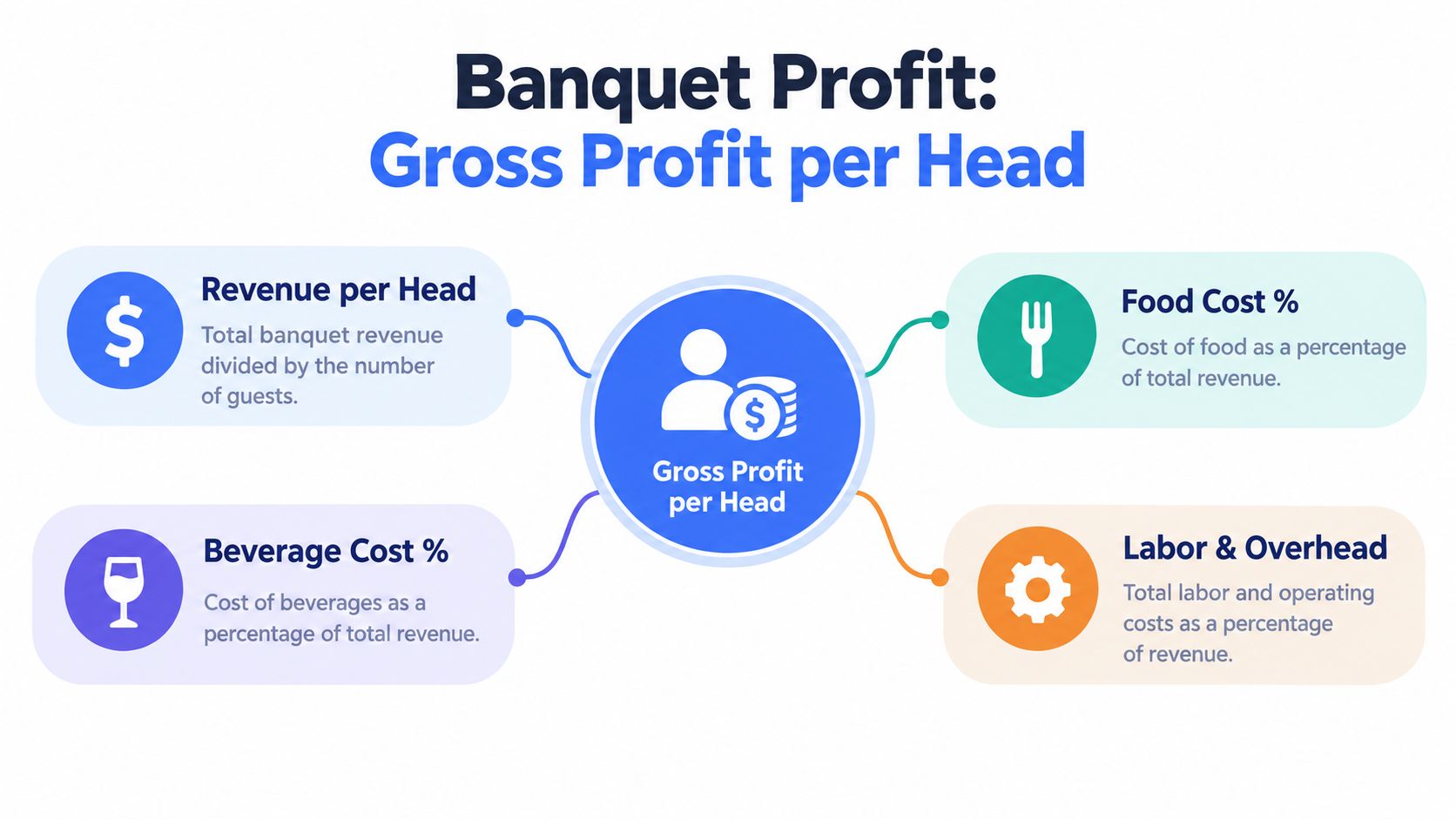
A busy diary doesn't guarantee a profitable function sheet. Two events can both sell at the same headline rate and deliver completely different outcomes once you account for food cost, beverage mix, labour, waste, and last-minute complexity.
That's why I'd rather look at gross profit per head than revenue per head. Revenue flatters. GP per head tells the truth.
Watch the margin, not the vanity number
UK hospitality margins are tight. Gross margins in UK hospitality are often cited around 20 to 30%, while UK banqueting businesses are commonly reported at 7 to 20% net margin depending on operational efficiency, as discussed in this UK margin analysis. That leaves very little room for generous buffers, casual discounting, or “we'll sort it on the day” event planning.
A lot of teams still quote and review events using only sales per head. That's incomplete. If one group books a neat set menu, prep-light drinks package, and accurate final numbers, it can outperform a higher-spending group that demands multiple menu swaps, late dietary changes, and unpredictable bar consumption.
If you want a quick refresher on the distinction between gross margin and net margin in practical commercial terms, using profit margin in business is a useful read.
The numbers that matter before you change anything
Track these before you rewrite menus or chase more volume:
- GP per head: Your real event output, not just top-line sales.
- Food cost per confirmed guest: Based on what people chose, not what you guessed they might choose.
- Wet spend per head: Usually your cleanest margin line if you structure it properly.
- Labour per cover: Built from realistic service needs, not worst-case panic rostering.
- Late-drop exposure: The value you lose when covers vanish after ordering windows close.
Practical rule: If your team can't state expected GP per head before the event and actual GP per head after it, you're pricing blind.
Small cost control beats volume chasing
WRAP says UK hospitality and food service businesses throw away 1.1 million tonnes of food each year, and 75% of that food could have been eaten, with a cost to the sector of about £3.2 billion annually. WRAP also reports that food waste equals 18% of food purchased in the sector, meaning nearly one in five pounds spent on food never reaches a guest's plate, according to the UK Parliament briefing on food waste.
That's why margin improvement on banquets rarely starts with selling more covers. It starts with stopping avoidable leakage on covers you already have.
For operators tightening their costing discipline, a practical next step is building event menus from actual plate cost rather than instinct. This food cost calculation guide is a useful starting point for reviewing where banquet pricing stops protecting margin.
Menu Engineering and Pricing That Protects Margin
Most banquet menus are too generous, too long, or too vague. That usually comes from a sales instinct. Give people lots of choice, keep the package flexible, and close the booking. Operationally, it's expensive. Commercially, it's lazy.
A profitable banquet menu does three things. It controls production, protects spend per head, and nudges guests into higher-margin choices without making them work through an endless list.
Build packages, don't build chaos
Start with three tiers. Good, better, best. That structure works because people compare within the frame you set instead of negotiating from scratch.
Use it across:
- Set menus: Keep each tier deliberately engineered, not just cosmetically different.
- Canapés and bowl food: Sell fixed bundles with clear counts and service windows.
- Drinks inclusions: Attach upgrades to the package, not as a long afterthought list.
- Minimum spend logic: Every seat should carry protected value.
Long à la carte style banquet menus create admin, indecision, and uneven production. Tight packages create cleaner prep and better forecasting.
If your team needs a commercial sense-check on setting profitable menu prices, that guide is worth reading alongside your own dish cost sheets.
Cost dishes for contribution, not just popularity
Some dishes sell well and still drag the event down. Banquet menu engineering is about contribution per cover, not just what sounds attractive on a proposal.
Here's the simple rule. Every main course option should be assessed against:
- Ingredient cost
- Prep and finishing time
- Waste risk
- Plating speed
- Substitution risk
- Guest appeal
That's why vegetarian alternatives matter more than many teams realise. In set-menu banqueting, a vegetarian option often takes up around 20 percent of selections. If you cost it properly, that mix shift can lift the event margin without raising the headline selling price.
A smart vegetarian alternative isn't a dietary concession. It's a menu engineering tool.
Worked example for vegetarian option GP
Say you're selling a three-course set menu at £45 per head.
If every guest takes a meat main costing £12, your GP on that main line is lower than it needs to be. Now replace one in five meat mains with a vegetarian main costing £8 while keeping the selling price fixed. Across the event, that change reduces blended food cost enough to lift event GP by roughly 3.5 to 4 percent.
| Menu Structure | Cost Per Head | Sell Price | GP Per Head |
|---|---|---|---|
| All guests on meat main | £12 main cost basis | £45 | £33 before other menu costs |
| 80% meat and 20% vegetarian | £11.20 blended main cost basis | £45 | £33.80 before other menu costs |
The exact outcome depends on your starter, dessert, and full menu build, but the principle is solid. A well-designed vegetarian option can increase margin without making the guest feel they've been steered into a cheaper dish.
Protect every seat
Don't let chairs go undervalued.
Use these rules:
- Set a floor: Every package needs a minimum per-head value.
- Price canapés properly: Don't throw them in because the organiser asks nicely.
- Bundle bowl food intelligently: It's often operationally cleaner and commercially stronger than overcomplicated plated choice menus.
- Keep add-ons finite: Too many choices reduce uptake and increase admin.
For joiner events and shared parties, package structure matters even more because one underpriced booking can dilute the economics of the whole room. This event ticketing strategy guide is useful if you're reviewing how package design and ticket structure work together.
Deposits Minimum Spends and Prepayment Controls
Most margin gets lost before the event starts. It disappears in soft terms, weak deposits, low-friction cancellations, and the habit of releasing operational detail before the money is secured.
If your commercial controls are vague, the event team ends up subsidising indecision.
Minimum spend is not optional
Group-booking discounting is where weak operators bleed. Fixed labour, setup, linen, glassware, and room-turn costs don't disappear because the organiser wants a deal.
The safer approach is simple:
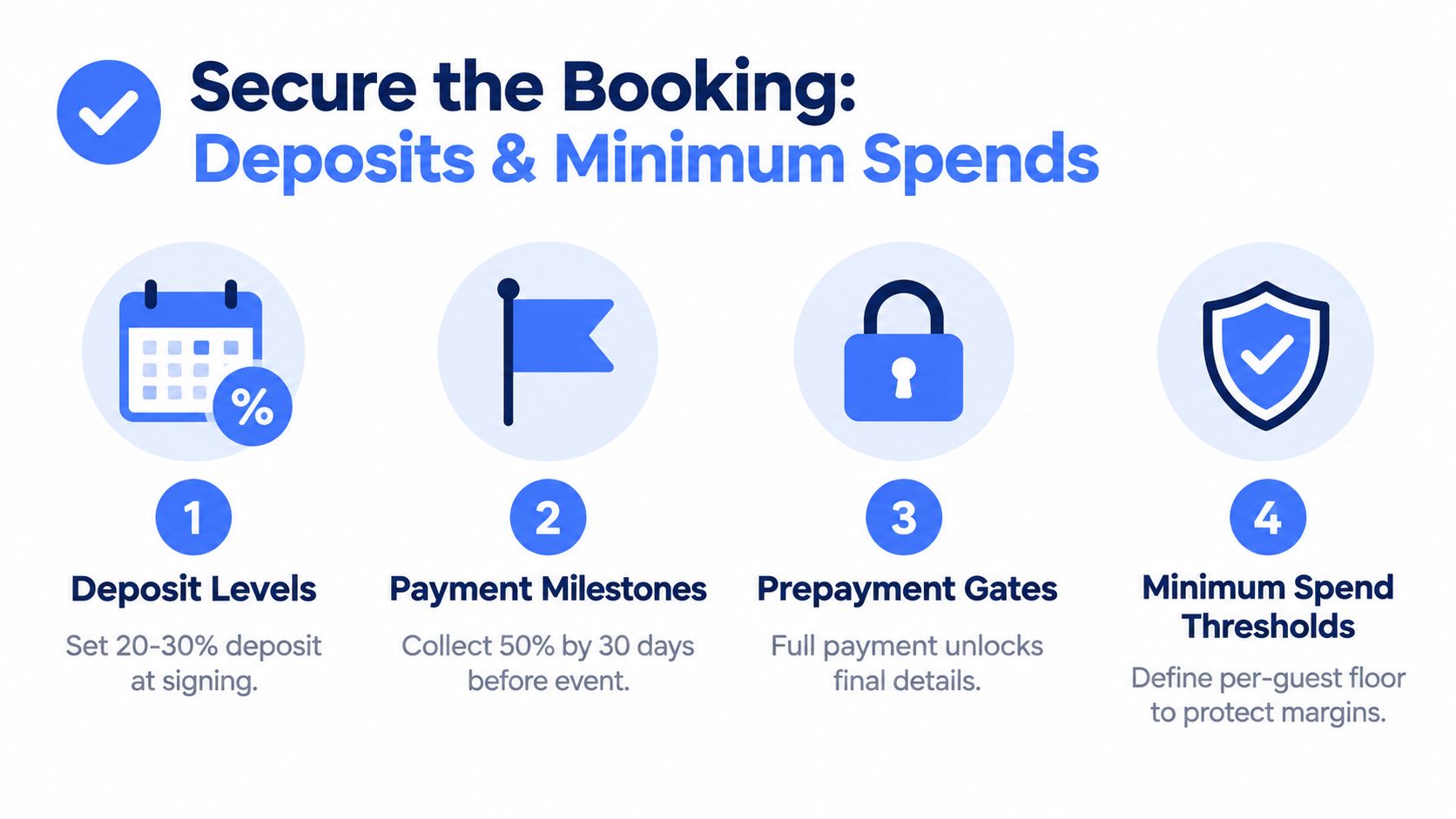
- Set a per-guest floor: Quote from the minimum viable spend, not the organiser's hopeful budget.
- Require deposits early: A signed contract without money attached is not a secure booking.
- Use payment milestones: Don't leave the full balance to the final week.
- Charge for late reductions: If covers drop after food and labour are committed, protect the venue.
Food-led group occasions can boost demand while profits still get squeezed. Early 2026 UK reporting noted stronger festive trading from group bookings and set menus, yet UK hotel GOP margins still fell, including a national February drop from 23.4% to 22.3% and London falling from 26.3% to 24.2%, as reported in this UK hospitality coverage.
Make payment unlock process part of the operation
Don't treat finance and event planning as separate lanes. Tie them together.
A clean operating rule looks like this:
- Deposit received. Date held.
- Next payment received. Menu portal or event detail form released.
- Final balance received. Final guest changes accepted.
- Payment overdue. Access to detail submission paused.
That sounds firm because it is. It also saves hours of chasing and stops the event team from planning around bookings that aren't commercially secure.
If a Party Lead hasn't paid, they haven't earned flexibility.
Wording matters with organisers
Be direct. Don't bury the important bits in legal language nobody reads.
Tell organisers:
- Your final numbers date
- What happens after that date
- What's included and what's extra
- Which items are prepaid
- Which changes trigger additional charges
For joiner and shared party formats, ticketed structures usually outperform loose RSVP models because commitment is clearer and no-show risk is lower. If you're tightening terms, this guide to deposit and payment schedules for event bookings is a practical reference point.
Cut Waste and Kitchen Load With Accurate Pre Orders
Banquet profitability improves fastest when the kitchen stops cooking for uncertainty. Broad production buffers feel safe, but they destroy margin.
WRAP's long-running UK work found hospitality and food service waste is equivalent to about 1.3 billion meals a year, or roughly one in six of the 8 billion meals served annually, according to this WRAP summary cited by the Craft Guild of Chefs. For banquets, that's not an abstract sustainability point. It's a direct production discipline issue.
Pre-ordering is a margin tool, not an admin chore
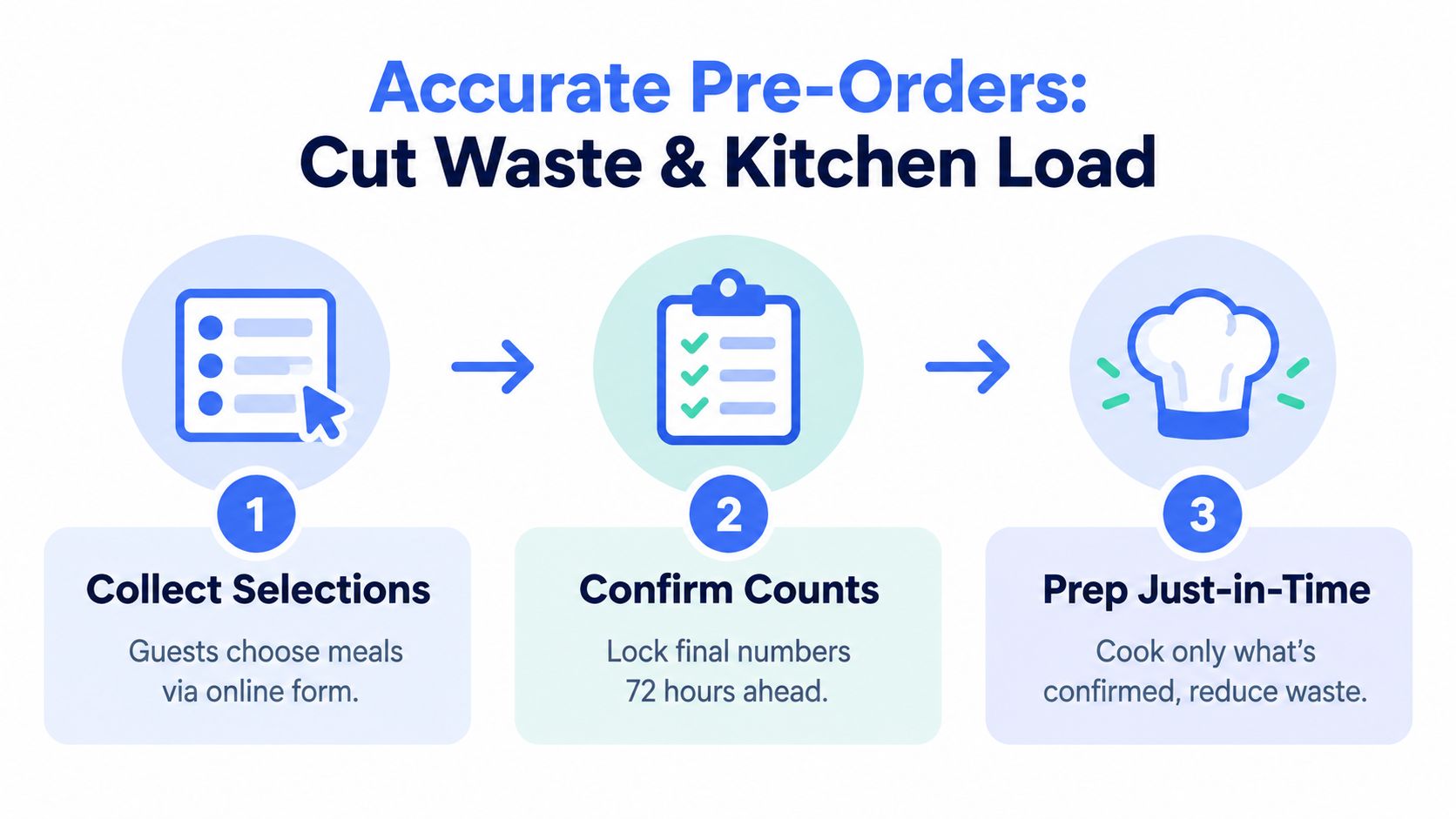
WRAP says hospitality venues should pre-select or pre-order menu options as far forward as possible when the customer base is relatively predictable, specifically to move towards cook-to-order production and reduce overproduction risk, as set out in the WRAP hospitality waste report.
That's exactly what banquet teams should be doing.
The workflow is straightforward:
- Collect confirmed guest choices in advance.
- Capture allergens and dietary needs per person.
- Lock final counts by a clear deadline.
- Issue chef, food pass, and front-of-house reports from one data set.
- Prep to the confirmed mix, not the theoretical maximum.
Track waste by event type
Not every event behaves the same. Weddings, festive joiners, corporate dinners, awards nights, and conference dinners produce different waste patterns.
Watch for these failure points:
- Late headcount movement: Usually causes overproduction if the kitchen has already committed.
- Multiple fallback meals: “Just in case” vegans, gluten free plates, and extra mains often stack up untouched.
- Uncontrolled bread and sides: Cheap to add, expensive at scale when routinely overproduced.
- Plate waste: Service style and portioning matter as much as prep accuracy.
The UK Parliament's report on food waste in England states that roughly 30% of hospitality waste comes from customers' plates, and around 1 in 6 meals served in the UK is wasted, which is why portion control and service design matter alongside forecasting in banqueting, as noted in the Parliamentary committee report.
Tight pre-orders fix one half of the problem. Portion discipline fixes the other half.
Staff to real covers, not fear
Labour disappears quickly on banquets because managers roster for what might happen rather than what has sold. If your pre-orders are clean and your counts are locked, staffing can follow the event properly.
Independent UK hospitality analysis notes gross margins are often only 20 to 30%, and UK hotel F&B margins were reported at 25.8% in regional hotels in Q2 2026, showing how quickly event profit disappears once staffing and departmental costs are counted, according to the Knight Frank UK hotel dashboard.
One practical way to make this easier is using a single workflow that collects guest choices, dietary details, and payments, then turns them into service-ready reports. Creventa, founded in June 2020 by Luke Ireland and Andrew Norton, does that through a core platform covering pre-orders, allergens, seating, place cards, and reports, alongside CreventaFlow for enquiries and quotes, Prinq for pre-event ordering and payment, and post-event feedback and guest insights. It also lets Party Leads or guests submit selections through white-label venue-branded emails, and setup typically takes a couple of days.
If you're reviewing process changes around event ordering, this guide on event pre-ordering, wet spend and food waste is directly relevant.
Lift Wet Spend With Structured Drinks Pre Orders and Upsells
Food gets most of the attention. Drinks usually carry the easier margin.
That's why wet spend deserves a proper sales structure instead of a passive line at the bottom of the function sheet. If you leave it to ad hoc ordering on the night, you'll get patchy uptake, slower service, messy stock planning, and guests defaulting to the cheapest obvious option.

Sell choices in tiers, not lists
A long drinks list is not a strategy. It's avoidance.
Give the organiser and guests a small number of clear paths:
- Good: House wine and arrival fizz
- Better: Named upgrade wines plus table package
- Best: Premium wine, reception package, and after-dinner add-on
That model works because it reduces friction. People don't need to become buyers of dozens of SKUs. They just need to choose a level.
It also opens the door to simple educational prompts. If you're offering wine upgrades, a short note explaining style differences helps guests choose with confidence. Something as straightforward as this comparison of Australian vs Californian chardonnay shows the kind of plain-language cue that can support better premium selections.
Prepaid drinks beat hopeful bar spend
The strongest wet-spend events are usually the ones where drinks are committed in advance. Shared drinks menus, sectioned logically and locked once ordered, reduce indecision and protect stock planning. Party Leads ordering and paying for the whole group usually perform better than loose “people can get what they want on the night” setups.
That matters because this line often carries the cleanest incremental profit in the room.
Creventa reports around 23 percent higher wet spend and roughly 20 percent less food waste, and one Holiday Inn hotel reported a much larger wet spend uplift. Creventa also reports a 251% wet spend uplift from drink pre-orders at a Holiday Inn hotel, around 20% less food waste reported by a global hotel chain, over 2 million festive dishes ordered through Creventa at Christmas 2025, support for events from 4 to 2,500+ guests, and a 99.2% guest response rate to pre-order invitations. Those are platform-reported outcomes, not universal guarantees, but they point in the right direction operationally.
A short product walk-through helps show how structured pre-ordering works in practice:
Upsell without being pushy
The best banquet upselling doesn't feel like upselling.
Use:
- Arrival drink options
- Half-bottle and table package bundles
- Canapés plus fizz pairings
- Late-night add-ons
- After-dinner drinks selections
White-label venue-branded emails and reminders help because they make ordering feel like part of the event experience rather than a sales chase. Party Leads can sort the whole group, and guests can still add their own choices where the format allows.
For teams building this into their process, this guide on taking drink pre-orders for events is a practical reference.
Measure Learn and Repeat With KPIs and a Quick Implementation Checklist
Most venues don't have a pricing problem. They have a feedback problem. They run the event, bank the revenue, clear the room, and move on without properly reviewing where the GP came from or where it leaked away.
That guarantees repeated mistakes.
The KPIs worth tracking after every event
You don't need a huge dashboard. You need a short list reviewed consistently.
Track:
- GP per head
- Food cost percentage
- Wet spend per head
- Waste by event type
- Labour per cover
- Deposit collection status
- Late-drop and no-show pattern
WRAP estimates food waste in UK hospitality and food service costs about £2.5 billion per year, reinforcing that forecasting, portion control, and pre-order capture are financially material rather than minor housekeeping, as outlined in WRAP's true cost of waste report.
A simple event review sheet will tell you more than broad monthly averages. You want to know which menu sold well but underperformed, which organiser type bought strong drinks packages, which events generated plate waste, and which sales managers kept discounting chairs below viable spend.
Review the event while the details are still fresh. A margin lesson found six weeks later is usually useless.
A quick implementation checklist
If you want this fixed without turning the operation upside down, do it in this order:
- First, reprice around GP per head: Stop quoting from headline revenue targets alone.
- Then tighten the menu: Reduce unnecessary choice and build clearer package tiers.
- After that, harden terms: Deposits, payment milestones, late-drop rules, and minimum spends.
- Next, clean up pre-orders: Confirm guest choices, allergens, and final counts earlier.
- Then restructure wet spend: Offer good, better, best drinks paths and prepayment options.
- Finally, review every event: Feed results back into next month's pricing and staffing decisions.
Make the process stick
The operational challenge isn't knowing what to do. It's getting sales, events, kitchen, and front of house to work from the same information.
That's where practical systems earn their keep. Guests ordering through venue-branded emails, Party Leads paying for the whole group, deposits gating access to final event details, and instant chef, food pass, and front-of-house reports all reduce friction between commercial intent and operational delivery.
Real operators already working this way include Wolseley Hospitality Group, Malmaison and Hotel du Vin, and Derbyshire County Cricket Club. The point isn't the brand name. It's the model. Clean data in, cleaner margin out.
If you build that discipline, banquet profit stops being unpredictable. It becomes manageable.
Creventa gives venues one place to run the margin levers that matter on banquets and group bookings: pre-orders, allergens, seating, deposits, prepayments, drinks ordering, reporting, and post-event feedback. If you want tighter cover accuracy, stronger wet spend, and less admin between sales and service, visit Creventa.
Jake Crimmin, Hospitality Events Specialist, Creventa. Jake works with hotels and venues on event operations, focusing on how pre-orders and allergen data flow from the guest through to the kitchen.