The morning after a booking is confirmed, the sales win quickly becomes an operational test. A coordinator may have the contract filed, but dietary forms are arriving by email, the seating plan is changing, the kitchen needs reliable guest-level information, and the bar manager needs pre-order totals before stock is ordered. The right platform must handle that handover without forcing the team back into spreadsheets.
That's the buying question behind Event Temple alternatives for UK venues. A hotel sales CRM can be strong at pipeline management, proposals, contracts, BEOs and reporting, yet still leave the most detailed work to separate forms, inboxes and manual documents. This guide focuses on the gap between booking confirmed and guests seated, then maps the alternative categories and tools by where they help.
Table of Contents
- The UK Venue Reality Behind the Search
- What Post-Booking Guest Management Actually Covers
- The Categories of Alternative Worth Considering
- Feature Parity Across Pre-Orders, Seating, Allergens and Payments
- UK Compliance, Integrations and Pricing Transparency
- Why a Guest-First Platform Wins After the Booking
- Best-Fit Recommendations and Buyer Checklist
The UK Venue Reality Behind the Search
At a UK venue, the booking confirmation is often treated as the finish line for sales. Operations knows it's the starting gun.
Take a 180-guest wedding. The CRM has recorded the client, accepted the proposal and stored the event details. By the next morning, the coordinator is reconciling a spreadsheet of guest names, chasing missing menu choices, checking whether a reported intolerance is an allergy, and copying table requests into a seating chart. The chef wants an accurate allergen report. The front-of-house supervisor wants place cards. The bar manager wants to know how many guests have ordered arrival drinks.
The problem isn't that the booking system failed. Event Temple is capable at the enquiry-to-contract stage, particularly for hotel sales teams managing pipeline, proposals, BEOs and reporting. The gap appears after the commercial work is complete, when the venue needs to manage each guest, dish, table, payment and operational document.
UK market scale makes that handover commercially important. The sector recorded an estimated 1.08 million conferences and meetings at UK venues in 2024, involving 95.4 million delegates, around 144.8 million delegate days and £19.3 billion in direct expenditure across venues and destinations, according to the UK conference and meetings market report. The same report says 67% of delegates were non-staying business, a useful reminder that much venue activity involves frequent, short-stay functions rather than one-off hotel residents.
Operational rule: Choose technology for the work your team repeats after the client says yes, not only for the work that wins the booking.
A venue's bottleneck might be enquiry response, but it might also be the final menu chase, an unverified dietary note or a drinks order that never reaches purchasing. The UK competitive socialising market guide is a useful example of how varied modern venue activity has become. The more formats a venue runs, the more damaging fragmented guest data becomes.
The rest of this guide looks at the workflow itself, the main alternative categories, feature gaps, UK compliance, and the venue profiles that should consider each approach.
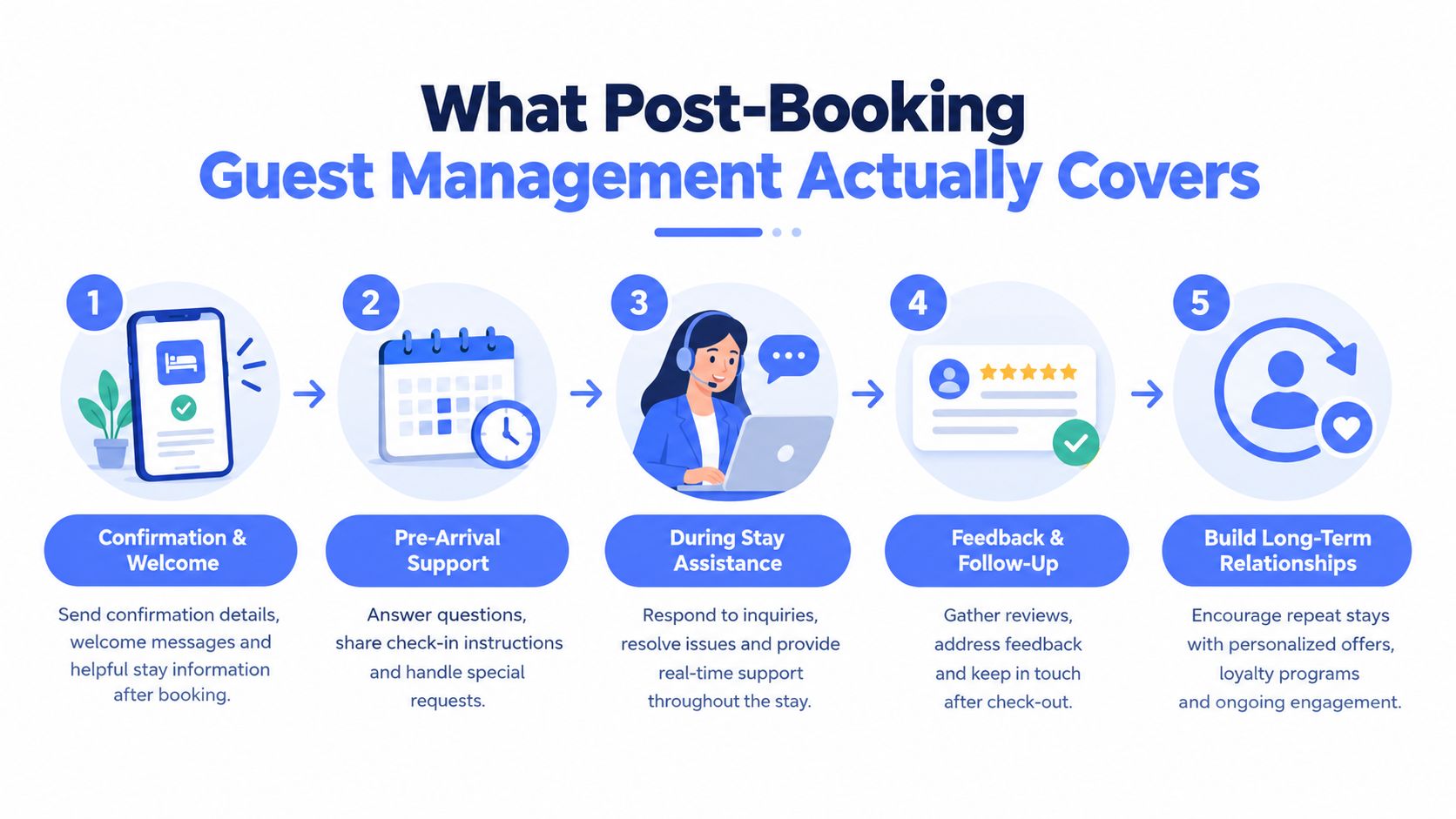
What Post-Booking Guest Management Actually Covers
Post-booking guest management is the operational layer that begins once the event has been accepted. It should create one dependable record for every guest and make changes visible to every department that relies on them.
The workflow usually includes:
- Guest capture: Record names, contact details, plus-ones, accessibility needs, table requests and host relationships.
- Menu and drinks collection: Send branded invitations so guests can select dishes and pre-order drinks without the coordinator copying responses manually.
- Allergen and dietary recording: Store requirements against each person, distinguish allergies from preferences where the workflow allows, and preserve a usable audit trail.
- Seating management: Build, edit and publish table plans while keeping guest information connected to the correct table and place.
- Operational reporting: Produce kitchen sheets, allergen matrices, cover counts, food-pass information, front-of-house reports and place cards.
- Supplier coordination: Share the right information with florists, AV teams, entertainers and other suppliers without exposing unrelated guest data.
- Arrival and event control: Support ticketing, check-in, table identification and last-minute updates on the day.
- Post-event continuity: Feed guest preferences, attendance, spend and feedback back into the venue's CRM or PMS.
These stages are interdependent. A seating change can affect table reports and place cards. A late menu selection can alter kitchen preparation and stock requirements. A newly declared allergy must reach the right operational people without relying on someone remembering to forward an email.
The minimum viable operational record
A useful guest record answers practical questions quickly:
- Who is attending?
- What are they eating and drinking?
- What must the kitchen know?
- Where are they sitting?
- Has the guest paid, checked in or responded?
- Which document needs updating after a change?
A generic event tool may collect names and registrations, but that doesn't mean it can create a kitchen-ready allergen report. A CRM may store a dietary note, but that doesn't mean the note is linked to the guest's seat, course and place card.
The full event journey overview provides a useful way to think about the process as one connected chain rather than a series of departmental handovers. For UK venues, that continuity matters because food service, payments and guest communications all depend on accurate data at the same time.
The Categories of Alternative Worth Considering
The right alternative depends on where work slows after a booking is confirmed. A venue with weak enquiry follow-up needs a different fix from one losing menu choices, allergen details or seating updates between confirmation and service. Use these enquiry management software alternatives to assess the sales side, then judge each category by its ability to support guest-level execution.
| Alternative Categories at a Glance | Capability Depth | UK Integrations | Compliance Coverage | Pricing Transparency |
|---|---|---|---|---|
| Dedicated guest-management platforms | Deep on pre-orders, seating, allergens, reports and guest communications | Often connects to PMS, payment gateways and venue systems | Strong when allergen data is held per guest and per dish | Frequently clearer, though check implementation and transaction fees |
| Broader hospitality event suites | Strong across enquiries, proposals, contracts and event operations | Usually suitable for hotel and multi-site environments | Varies by depth of guest and menu records | Often bespoke and quote-led |
| PMS add-ons | Useful for hotels wanting event data close to rooms and guest accounts | Strongest inside the existing property ecosystem | Often depends on additional event modules | Usually bundled or individually quoted |
| DIY and template-based stacks | Flexible for simple events and small teams | Relies on exports, connectors and manual reconciliation | Weak unless the team designs and maintains controls | Appears inexpensive, but labour and error costs are harder to see |
A dedicated guest-management platform fits venues that have solved pipeline management but still manage menu choices, allergies, seating and paperwork through disconnected processes. It can sit alongside an existing CRM, preserving the confirmed booking record while giving operations a clearer guest-level workflow. Check that changes flow into usable reports, not just individual records.
A broader hospitality suite suits a hotel group seeking one commercial and operational environment. It can reduce duplicated data, yet buyers must test the detail behind the interface. Guest-level execution is only useful when the system connects each person to their choices, requirements, seat and service documents, rather than storing information as notes or attachments.
A PMS add-on works for properties that need rooms, folios and event activity together. Its limitation is operational fit. Banqueting teams may have to adapt detailed event processes to property-management logic, especially when several guests share a booking or when seating and meal data change late.
The final category is the familiar combination of spreadsheets, email, online forms and shared documents. It can support low-volume events with clear ownership, but every handover needs checking. Labour appears in version control, import corrections, follow-up emails and the manual reconciliation of payments or guest responses.
For unusual formats, including celebrations at hen party houses UK, simplicity and guest communication may matter more than hotel-system depth. Choose by the constraint visible after confirmation. Kitchen errors call for stronger guest and menu controls, while weak lead follow-up calls for better enquiry management. A long feature list does not resolve either problem by itself.
Feature Parity Across Pre-Orders, Seating, Allergens and Payments
Feature parity looks different depending on where a platform begins. A CRM-led suite may be excellent at proposals and contracts but only partial on guest-level meal management. A guest-experience specialist may be stronger after confirmation while relying on another system for the original opportunity record.
| Capability | Event Temple | CRM-led suites | All-in-one hospitality suites | Guest-experience specialists | Generic event tools |
|---|---|---|---|---|---|
| Enquiry and pipeline | Strong | Strong | Strong | Partial to strong | Partial |
| Pre-order collection | Usually requires workflow configuration or an additional process | Partial | Variable | Strong | Partial |
| Editable seating plans | May support event planning, but test guest-level operational depth | Variable | Variable to strong | Strong | Often basic |
| Guest-level allergen tracking | Confirm depth before purchase | Often note-based | Variable | Strong when designed for hospitality | Usually form-based |
| Ticketing and check-in | May be available through event features or integrations | Variable | Variable | Often strong | Commonly available |
| Card payments and deposits | Available, but test payment schedules and reconciliation | Usually available | Usually available | Often central to the workflow | Frequently depends on third parties |
| PMS integrations | Stronger in hotel-focused deployments | Variable | Usually broad | Integration-led | Often export-based |
| Event reporting | Strong on commercial reporting | Strong on sales reporting | Broad, depending on configuration | Strong on operational reporting | Basic to moderate |
The important distinction is data structure. A form can ask whether a guest has an allergy. That's not the same as storing the answer against the right guest, menu choice, table and operational report.
Pre-orders should follow the same principle. The guest should receive a venue-branded invitation, make a selection, receive reminders where needed, and have the result available to the kitchen and purchasing team. If the coordinator still downloads a spreadsheet, checks duplicates and rekeys totals, the platform hasn't removed the core work.
Seating is another common trap. A static floor plan may look useful in a sales demonstration, but operations needs drag-and-drop editing, table-level views and output that stays current when the host moves a guest.
The event allergen tracking workflow is the standard to test. Ask the supplier to demonstrate a late dietary change, a table move and a revised kitchen report in one live scenario. If the answer involves exporting, editing and re-uploading, the system is only partially covering the post-booking process.
UK Compliance, Integrations and Pricing Transparency
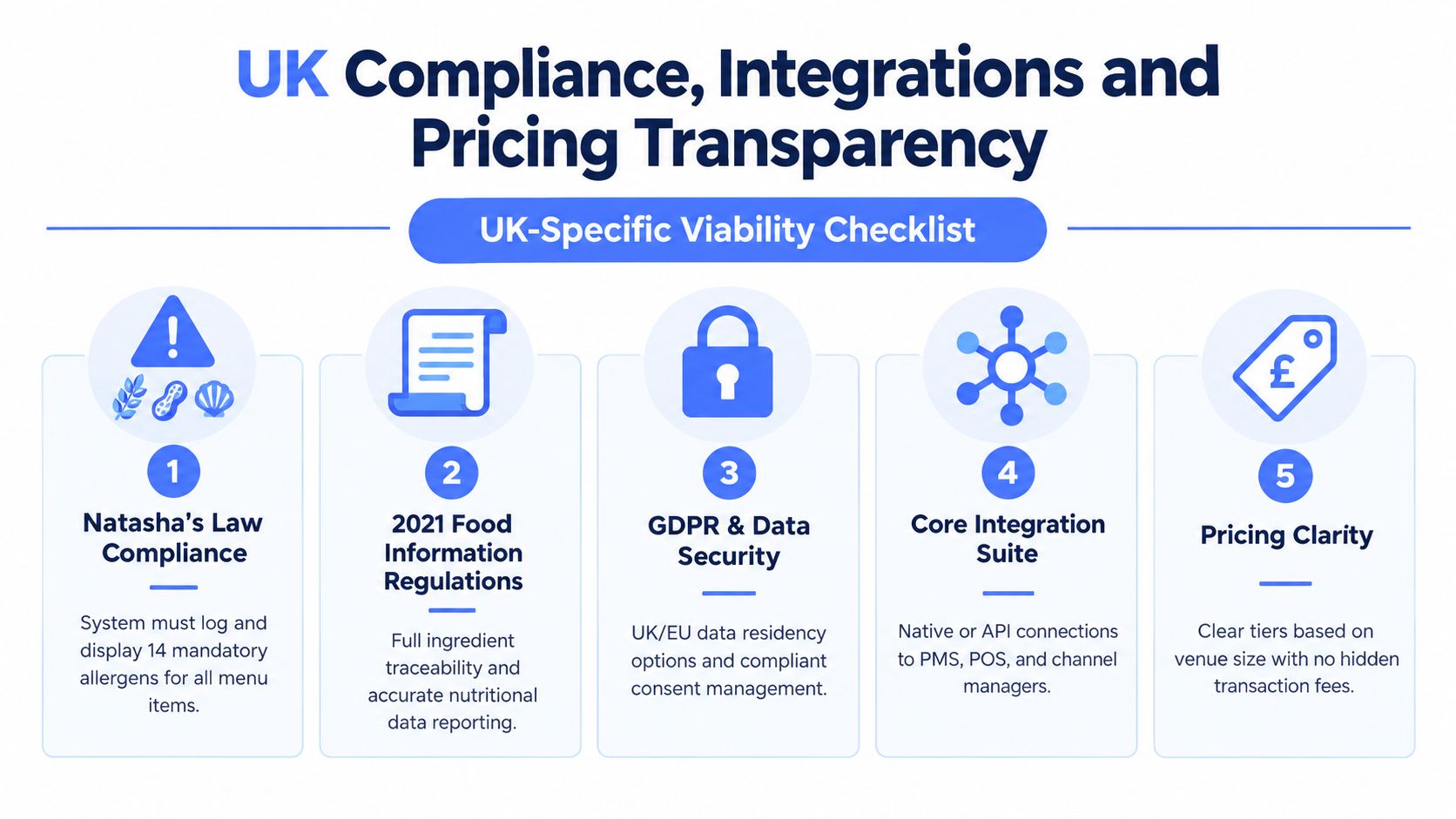
UK compliance is not a checkbox that can be delegated to a generic notes field. The Food Information Amendment known as Natasha's Law was passed in September 2019 and came into force on 1 October 2021. It requires full ingredients labelling that highlights allergens for food sold pre-packed for direct sale, including items such as sandwiches, salads and cakes, as explained in this Natasha's Law guidance for hospitality businesses.
UK food businesses must provide information for the 14 regulated allergens. Government guidance also says that buffet items need allergen information separately for each item, rather than one general statement covering the whole buffet, as set out in the UK allergen guidance for food businesses.
That requirement changes the software test. The venue needs item-level menu data, guest-level requirements and reports that kitchen and front-of-house staff can use. UKHospitality's allergen questions and answers also explains that information for non-prepacked food must be collated on-site and available for discussion with customers.
Integration and payment questions
Test integrations with the systems your team uses, not only those shown in a brochure. A hotel may need PMS connectivity, while a restaurant or independent venue may care more about payment gateways, POS handover and finance exports. Ask whether the integration is native, API-based, one-way or two-way, and what happens when a booking changes.
Payment design matters too. Check deposits, staged schedules, refunds, reconciliation and PCI responsibilities. A useful event registration form guide with payment illustrates why registration and payment should be considered together rather than treated as separate administrative tasks.
Pricing needs the same scrutiny. Compare monthly subscriptions, per-event charges, per-guest fees, setup work, support, payment processing and additional users. Public pricing is easier to assess, but a low subscription can still become expensive if every event, guest or transaction attracts a separate charge.
The hospitality integrations overview is a useful reference point for the questions to ask. Also check GDPR and PECR controls, consent records, retention rules, role permissions and data residency. A venue should know who can export guest data, where it is stored and how access is removed when staff leave.
Why a Guest-First Platform Wins After the Booking
The strongest argument for a guest-first platform is operational continuity. The guest's menu choice, allergy, table, payment and check-in status should not live in five disconnected places.
That approach is particularly relevant in the UK because allergen information has to be available and usable at service. Food Standards Agency guidance says that for pre-ordered restaurant food served to large groups, allergen information should still be discussed with individuals on the day before service, as explained in the guidance on allergen information for pre-ordering. Software cannot replace that conversation, but it can give staff a reliable record to work from.
A practical guest-first workflow sends white-label, venue-branded emails that let guests RSVP, choose food, declare allergies and dietaries, and pre-order drinks themselves. It then turns those responses into kitchen reports, food-pass information, front-of-house reports and printable place cards. The coordinator supervises exceptions instead of manually transcribing every response.
One UK platform in this category is Creventa, which covers pre-orders, allergens, seating, place cards, reports, enquiries, proposals, quotes, payments, ticketing and post-event feedback. It can run alongside an existing CRM rather than replacing it, and its stated operating range is from 10 to 1,100+ guests. Its workflow includes tracking the 14 mandatory allergens plus custom allergies, automatic chef and front-of-house reports, drag-and-drop seating plans, delegated hosts, deposits and payment schedules.
Named users include Malmaison and Hotel du Vin, Wolseley Hospitality Group, Derbyshire County Cricket Club, Parmar Collection, Tottington Manor and Mercure Tunbridge Wells. Creventa also states that setup can take a couple of days and may be completed in hours, rather than requiring the multi-week rollout often associated with heavyweight platforms.
Its integrations include Delphi, Opera, Adyen, Stripe and iVvy. Reported outcomes should be treated as vendor-reported, not universal benchmarks. Creventa reports around 23% higher wet spend and roughly 20% less food waste, while another published proof point records a 251% wet spend uplift from drink pre-orders at a Holiday Inn hotel using Creventa. It also reports a 99.2% guest response rate to pre-order invitations and more than 2 million festive dishes ordered through the platform at Christmas 2025.
The recommendation is simple. If your venue already has a workable sales pipeline and the pain starts after confirmation, test a guest-first platform before replacing the entire commercial stack.
Best-Fit Recommendations and Buyer Checklist
The right choice depends on the venue's event pattern, not its brand profile. A boutique hotel hosting regular private dinners needs reliable guest-level menu and allergen capture. A multi-property hotel group may prioritise PMS reporting and central governance. An independent restaurant running tastings needs ticketing, payment and yield visibility. A stately venue needs seating, run sheets and controlled communication for complex weddings.
| Best-Fit Recommendations by UK Venue Type | Recommended Category | Pilot Focus | Switching Effort |
|---|---|---|---|
| Boutique hotels with recurring private dinners | Dedicated guest-management platform | Pre-orders, allergens, drinks and kitchen reports | Low to moderate if retained alongside the CRM |
| Large hotel groups | Broader hospitality suite or integrated guest platform | PMS connectivity, permissions and multi-property reporting | Moderate to high, depending on data migration |
| Independent restaurants and event spaces | Guest-experience specialist | Ticketing, payments, menus and check-in | Low to moderate |
| Heritage and stately venues | Dedicated guest-management platform | Seating plans, place cards, dietary controls and run sheets | Moderate, with careful event-template setup |
For boutique hotels, pilot one full dinner cycle from invitation through post-event feedback. For larger groups, test one property and one live PMS integration before attempting a central rollout. Restaurants should test a ticketed event with refunds, late responses and door check-in. Heritage venues should test a wedding with multiple tables, delegated hosts and last-minute seating changes.
Use this buyer checklist before signing:
- Post-booking coverage: Confirm the platform handles guest data, menus, seating, documents and follow-up.
- Allergen depth: Test the 14 regulated allergens, custom allergies, buffet items and guest-level reporting.
- Live integration: Run a real event through the PMS and finance workflow.
- Payment choice: Review deposits, schedules and gateway support, including Stripe and Worldpay.
- Seating and ticketing: Test table changes, check-in, place cards and capacity controls.
- Transparent pricing: Identify subscriptions, per-event fees, per-guest charges and payment mark-ups.
- Data governance: Verify residency, permissions, retention and export controls.
- UK references: Ask for references from venues with comparable service complexity.
- Onboarding support: Confirm who builds templates, trains staff and handles launch issues.
- Reporting granularity: Check that operations and finance can access the detail they each need.
For most UK venues, the best Event Temple alternatives aren't the ones with the longest sales feature list. They're the ones that remove the manual work between a signed booking and a well-run service.
Creventa gives UK hospitality venues a guest-level workflow for pre-orders, allergens, seating, payments, ticketing and operational reports, while allowing the existing CRM to remain in place. Visit Creventa to see how it can support the post-booking work your team is currently managing through spreadsheets and email.
Jake Crimmin, Hospitality Events Specialist, Creventa. Jake works with hotels and venues on event operations, focusing on how pre-orders and allergen data flow from the guest through to the kitchen.