The contract is signed, the deposit is paid, and the sales team has marked the event as won. Then the operational work begins. Guests need to choose meals, drinks, and dietary options. The chef needs a reliable brief, the organiser needs a branded guest experience, and the events team needs seating plans, place cards, payment records, and clear updates. Too often, those details sit across email threads, spreadsheets, PDFs, and disconnected booking tools.
That's why the right question for UK hotels and venues isn't only which platform can attract registrations or manage a conference website. It's which system can carry the guest journey from confirmed booking to a well-executed event. The strongest Cvent alternatives for UK hotels and venues depend on whether your priority is enterprise event marketing or hospitality operations, particularly food and beverage execution.
Table of Contents
- The Post-Booking Gap in Event Software
- Why UK Venues Need Hospitality-Specific Tools
- Comparing Enterprise Platforms and Venue Software
- Mastering the Guest Journey and Allergen Compliance
- Real-World Outcomes for UK Hotel Groups
- Evaluating Pricing Transparency and Implementation Speed
- Your Venue Software Buying Checklist
The Post-Booking Gap in Event Software
A hotel can win an enquiry efficiently and still lose hours after confirmation. The organiser accepts the proposal, but menu choices arrive by email. One guest adds an allergy in a spreadsheet, another changes their selection by telephone, and a third appears on the seating plan without a recorded meal. On the event day, the kitchen works from one document while front of house works from another.
That isn't a registration problem. It's a post-booking control problem.
Broad enterprise event platforms are built for large conferences, complex attendee journeys, event marketing, registration, badge printing, sponsorship, and reporting. They're often the right category for global programmes with multiple tracks, marketing campaigns, exhibitors, and advanced registration logic. A venue team whose main challenge is executing a banquet, awards dinner, Christmas party, or recurring conference meal may need a different centre of gravity.
Hospitality-specific venue software starts later in the journey. It focuses on the information teams need once a booking is confirmed:
- Guest choices: Food, drinks, tickets, deposits, and payment status.
- Operational detail: Seating, place cards, table layouts, and function documents.
- Kitchen communication: Clear, current reports that translate guest data into production decisions.
- Guest contact: Venue-branded invitations, reminders, confirmations, and updates.
- Compliance: Structured recording of dietary requirements and allergens.
A practical explanation of the workflow appears in this guide to collecting food and drink pre-orders for events. The important distinction is that pre-orders aren't merely a convenience for guests. They're an operational input that affects purchasing, preparation, staffing, service, and waste.
Practical rule: Evaluate software against the work your team does after the booking is won, not only the features used to secure it.
The categories aren't mutually exclusive. A global hotel group may need enterprise marketing and registration for major conferences, while its properties still need a hospitality layer for menus, seating, allergens, and kitchen-ready outputs. Smaller and mid-sized venues may find that a focused system removes more daily friction than a broad platform they'll only use partially.
Why UK Venues Need Hospitality-Specific Tools
UK hotels and venues operate in a dense, recurring events market. The 2018 UK Conference and Meetings Survey estimated 1.48 million conferences and meetings, with 95.3 million delegates and around 152.8 million delegate days. The average venue hosted 428 conferences and meetings per year, while 58% of events took place in hotels and hotels represented 52% of venues. These figures are documented in the UK Conference and Meetings Survey report.
That scale changes the procurement calculation. If teams repeat the same manual work across hundreds of events, small improvements in enquiry handoff, menu collection, seating amendments, payment chasing, and document production can compound across a property portfolio. The software doesn't need to transform one spectacular event to justify itself. It needs to make recurring operational work more reliable.
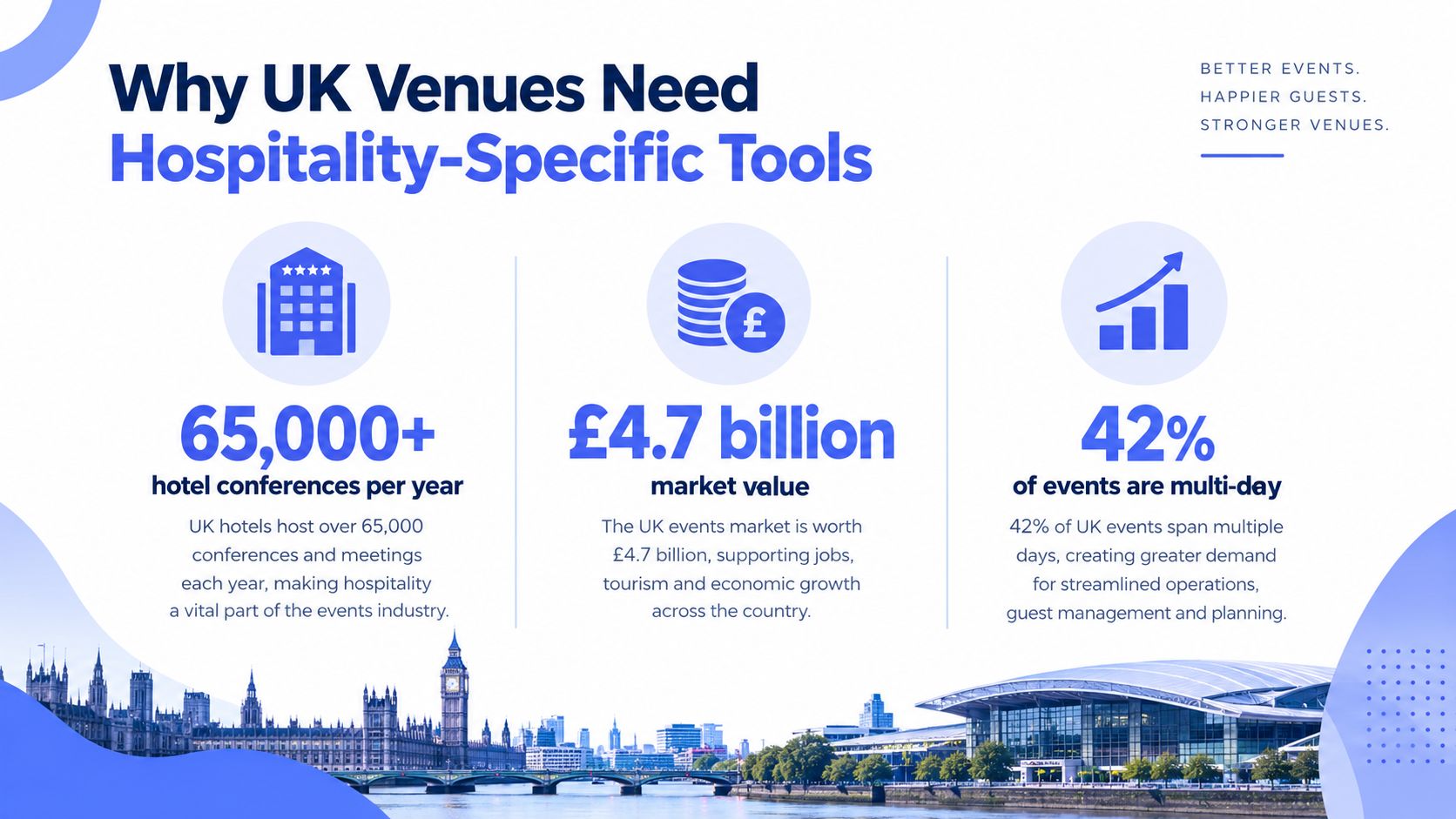
The latest rebound reinforces that need. The 2024 UK Events Report estimated 1.08 million conferences and meetings, roughly 95.4 million delegates, 144.8 million delegate days, and £19.3 billion of direct expenditure in venues and the wider destination. It estimated about 3,500 UK venues and an average of 312 conferences and meetings per venue. The report described this as the highest level since 2020, while event volume remained at 77% of 2019's level, leaving room for continued recovery and digitisation. Those figures come from the 2024 UK Events Report update.
The operating model matters
Hotels aren't just selling attendance. They're selling bedrooms, meeting space, food, drink, service, and an experience delivered by multiple departments. A system that stops at registration can leave the catering manager, chef, and front-of-house team dependent on manual reconciliation.
That's why content teams researching venue technology should look beyond generic event feature lists and browse corporate event blogs for practical hospitality context. The relevant buying question is whether the platform reflects how a venue works.
For a deeper look at the category, see this overview of event management software for hotels. The best fit will depend on your booking volume, event mix, existing property systems, and the complexity of your food and beverage operation.
Comparing Enterprise Platforms and Venue Software
Cvent fits the heavyweight enterprise platform category. It's strong when an organisation needs large-scale conference registration, complex event marketing, broad attendee management, and structured reporting across major programmes. That breadth can be valuable, but it can also introduce a longer implementation path and more administration than a venue needs for routine post-booking execution.
Hospitality venue software takes a narrower, deeper approach. It prioritises the details that affect service delivery, including meal choices, allergy records, table plans, payments, and documents for the kitchen and front of house. Neither category is automatically superior. The correct choice follows the operational bottleneck.
| Feature category | Enterprise event platforms | Hospitality venue software |
|---|---|---|
| Primary strength | Large conferences, registration, event marketing, complex attendee programmes | Post-booking execution, catering, seating, payments, and venue administration |
| Guest communications | Often broad, campaign-led, and event-wide | Venue-branded, white-label communications tied to the confirmed booking |
| Food and drink pre-orders | May require configuration or additional workflow design | Core workflow for collecting guest choices and changes |
| Allergen tracking | Can be captured as registration data | Structured tracking for the 14 legally declared allergens, plus custom allergens |
| Seating | Suitable for selected event formats, depending on configuration | Drag-and-drop seating plans designed around tables and hospitality layouts |
| Kitchen outputs | General reports and exports | Automatic chef reports, food pass sheets, front-of-house reports, and place cards |
| Payments | Registration and ticketing payments at enterprise scale | Deposits, pre-payments, event orders, and payment collection connected to venue workflows |
| PMS synchronisation | Often dependent on integrations and implementation scope | Designed to connect venue activity with relevant property and booking systems |
| Implementation | More extensive configuration, governance, and training may be required | Typically faster to deploy for focused venue workflows |
| Best for | Global conferences, complex marketing programmes, and large attendee ecosystems | Hotels, restaurants, stadiums, clubs, and venues where service execution is the priority |
A venue shouldn't buy enterprise breadth just because the feature list is longer. If the team spends its day resolving menu amendments, chasing deposits, moving guests between tables, and recreating function sheets, those are the capabilities to test first.
Creventa is one example of the hospitality-specific category. Its core platform covers pre-orders, allergens, seating, place cards, and reports, while CreventaFlow handles enquiries, proposals, and quotes. Prinq allows guests to order and pay before events, with post-event feedback and guest insights completing the journey. It integrates with Delphi, Opera Cloud, SevenRooms, OpenTable, Guestline/RezLynx, Stripe, Adyen, and PlanetPay. For venue teams assessing all-in-one event management software for venues, the relevant test is whether those workflows reduce handoffs rather than whether the platform contains every enterprise module.
Mastering the Guest Journey and Allergen Compliance
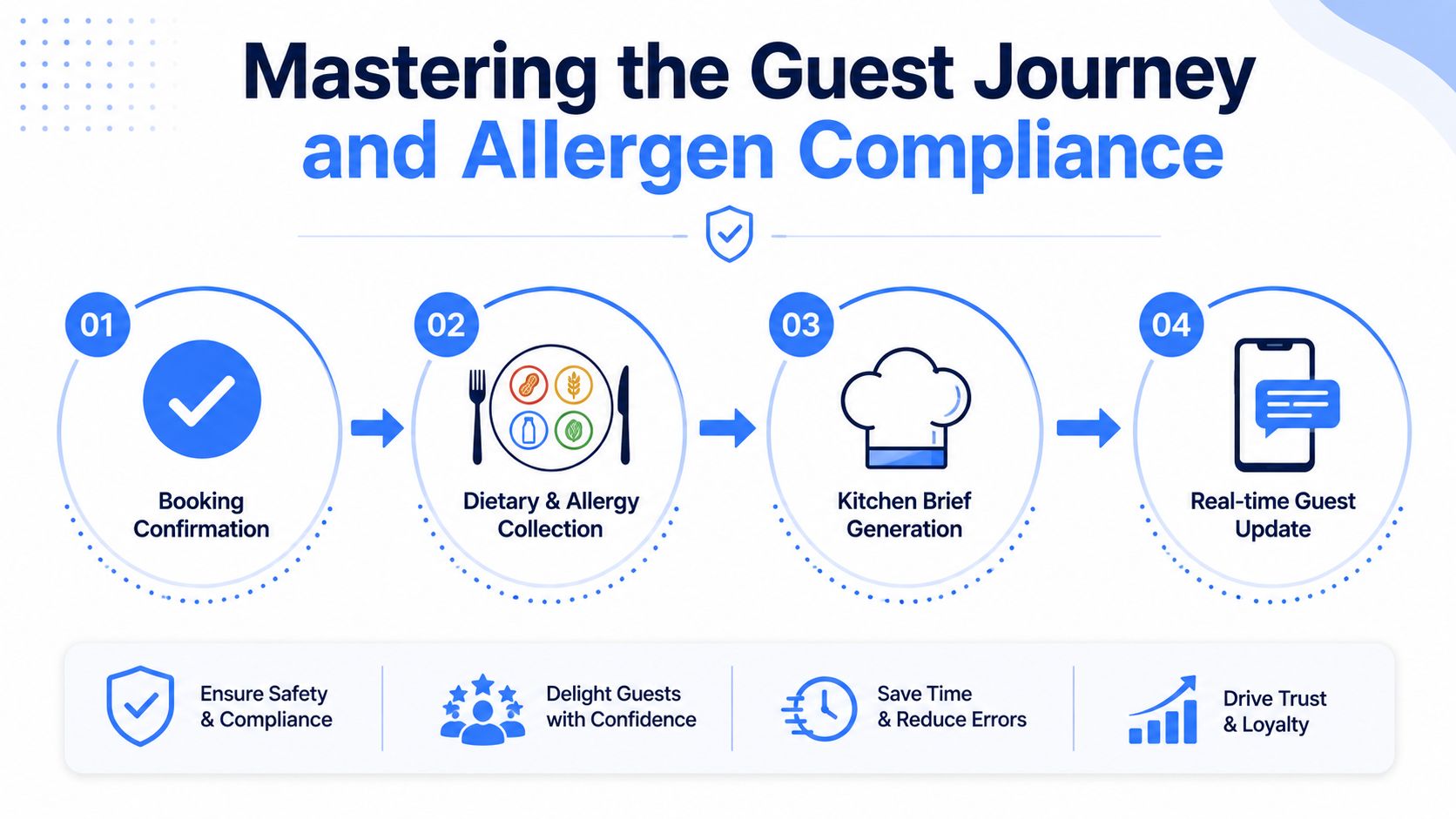
The post-booking workflow should have a clear owner, a controlled source of truth, and an output for each operating team. A practical sequence looks like this:
- Confirm the booking. Send a venue-branded, white-label communication that explains what guests need to provide and when.
- Collect choices centrally. Gather menu selections, drink pre-orders, dietary requirements, seating information, and payment details through a structured form rather than scattered replies.
- Validate the records. Review incomplete responses, duplicate guests, changed choices, and unallocated requirements before the event brief is finalised.
- Publish operational outputs. Generate chef reports, food pass sheets, front-of-house reports, place cards, and table plans from the same live data.
Treat allergens as operational data
UK food businesses must tell consumers whether food contains any of the 14 legally declared allergens, and the requirement applies to both prepacked and non-prepacked food and drink. The detail differs according to whether food is prepacked, prepacked for direct sale, or loose, as explained in Food Standards Scotland's allergen guidance.
For prepacked food, the packaging must carry an ingredients list, with allergenic ingredients emphasised each time they appear. PPDS food requires a full ingredients list with allergens highlighted, according to UK government allergen guidance for food businesses. Natasha's Law came into force across the UK in October 2021, making this particularly relevant to individually wrapped items and event food prepared on site, as outlined by Allergy UK's food business guidance.
A reliable system should record the legally declared allergens and allow venues to add custom allergen or dietary fields that reflect their menus and service model. It should also show the information in a format the kitchen can use, rather than leaving a manager to interpret free-text email responses during service preparation.
The same principle applies to advance-ordered event food. UK government guidance for community and charity events requires the name of the food and a full ingredients list with the mandated allergens emphasised for prepacked and PPDS food. Food operations should therefore treat compliance as part of the booking workflow, not as a last-minute check.
This video provides a visual introduction to the operational sequence:
A practical guide to preventing allergen mix-ups at large catering events is useful when testing whether a platform supports real service conditions. Look for version control, clear guest-level records, automatic reports, and a straightforward way to update information when a guest changes their mind.
Real-World Outcomes for UK Hotel Groups
Software only matters if it changes venue performance. The most useful evidence comes from operational outcomes tied to specific workflows, not broad claims about digital transformation.
A Holiday Inn hotel using Creventa reported a 251% uplift in wet spend from drink pre-orders. That result should be treated as a reported customer outcome, not a guaranteed return. The commercial lesson is clearer than the headline: when guests can select and pay for drinks before arrival, the venue creates a deliberate sales moment instead of relying entirely on service-time decisions.
Food waste shows a similar relationship between data quality and execution. A global hotel chain reported around 20% less food waste after using more accurate event pre-order information. Again, the outcome belongs to that customer's implementation and operating context. It doesn't mean every venue will achieve the same reduction, but it demonstrates why reliable guest choices can influence production planning.
Scale changes the value of consistency
Creventa has processed over 2 million festive dishes ordered at Christmas 2025, a canonical customer and platform proof point. Its workflows support events from 4 to 2,500+ guests, while the stated customer range includes operations from 10 to 1,100+ guests, reflecting different descriptions of the platform's event and customer scale.
Those ranges matter because the same problem appears at different sizes. A small private dinner may need a simple seating plan and dietary record. A large awards evening may need hundreds of meal selections, place cards, kitchen reports, payment records, and late amendments. The volume changes, but the need for a single dependable dataset doesn't.
Real customers include Malmaison and Hotel du Vin, Wolseley Hospitality Group, and Derbyshire County Cricket Club. Their inclusion demonstrates that the use case extends across hotel groups, hospitality portfolios, and sporting venues rather than belonging to one narrow property type.
Creventa also reports a 99.2% guest response rate to pre-order invitations. That figure is an attributed platform outcome, not a universal benchmark. The practical point is that guest communications need to be clear, venue-branded, mobile-friendly, and supported by reminders, otherwise the venue recreates the manual chasing it hoped to remove.
Evaluating Pricing Transparency and Implementation Speed
Pricing and implementation deserve the same scrutiny as functionality. A platform can have an impressive feature list and still deliver poor value if the venue needs a lengthy discovery process, extensive consultancy, specialist administrators, or paid modules before the team can execute a normal event.
For UK operators, public pricing creates a useful starting point. It lets finance, operations, and IT discuss the likely investment before a long sales process begins. It also makes it easier to compare the cost of software with the internal time currently spent reconciling spreadsheets, chasing choices, producing documents, and correcting service errors.
Creventa's pricing is public and transparent, published on its website. Its typical implementation timeline is also a differentiator: the platform generally goes live in days, and often within hours, for focused venue workflows. Enterprise platforms such as Cvent can take much longer to roll out because they may require wider configuration, governance, integrations, training, and ownership across departments.
That isn't a criticism of enterprise software. Complex programmes often need that structure. A global conference operation may welcome detailed configuration and formal implementation controls. A hotel that needs to standardise pre-orders and seating across properties may place more value on rapid adoption and immediate operational use.
Measure the real cost of delay
Ask what happens while the system is being implemented:
- Manual labour: Who continues to reconcile emails and spreadsheets?
- Service risk: Who owns dietary amendments that arrive after the function sheet is issued?
- Commercial leakage: Who follows up unpaid deposits or missed drink opportunities?
- Roll-out friction: Can another property adopt the workflow without rebuilding it?
Use this event software switching checklist to document current processes before comparing proposals. The best procurement decision isn't always the platform with the broadest capability. It's the one that delivers the required workflow at a sensible implementation cost, with ownership that your team can sustain.
Your Venue Software Buying Checklist
Start with the event journey, not the software brochure. Map what happens from enquiry through proposal, confirmation, guest communication, pre-order collection, seating, kitchen preparation, service, payment reconciliation, and post-event feedback. Mark every point where staff copy information from one system to another.
Then involve the people who use the outputs. A sales manager may prioritise enquiry tracking, while a chef needs accurate meal and allergen reports. Front of house needs an accessible seating plan and place cards, finance needs payment visibility, and senior operators need cross-venue reporting.
Test the operational essentials
Use a live event scenario during demonstrations. Ask the supplier to show what happens when a guest changes a meal, adds an allergen, moves tables, pays a deposit, or fails to respond to an invitation.
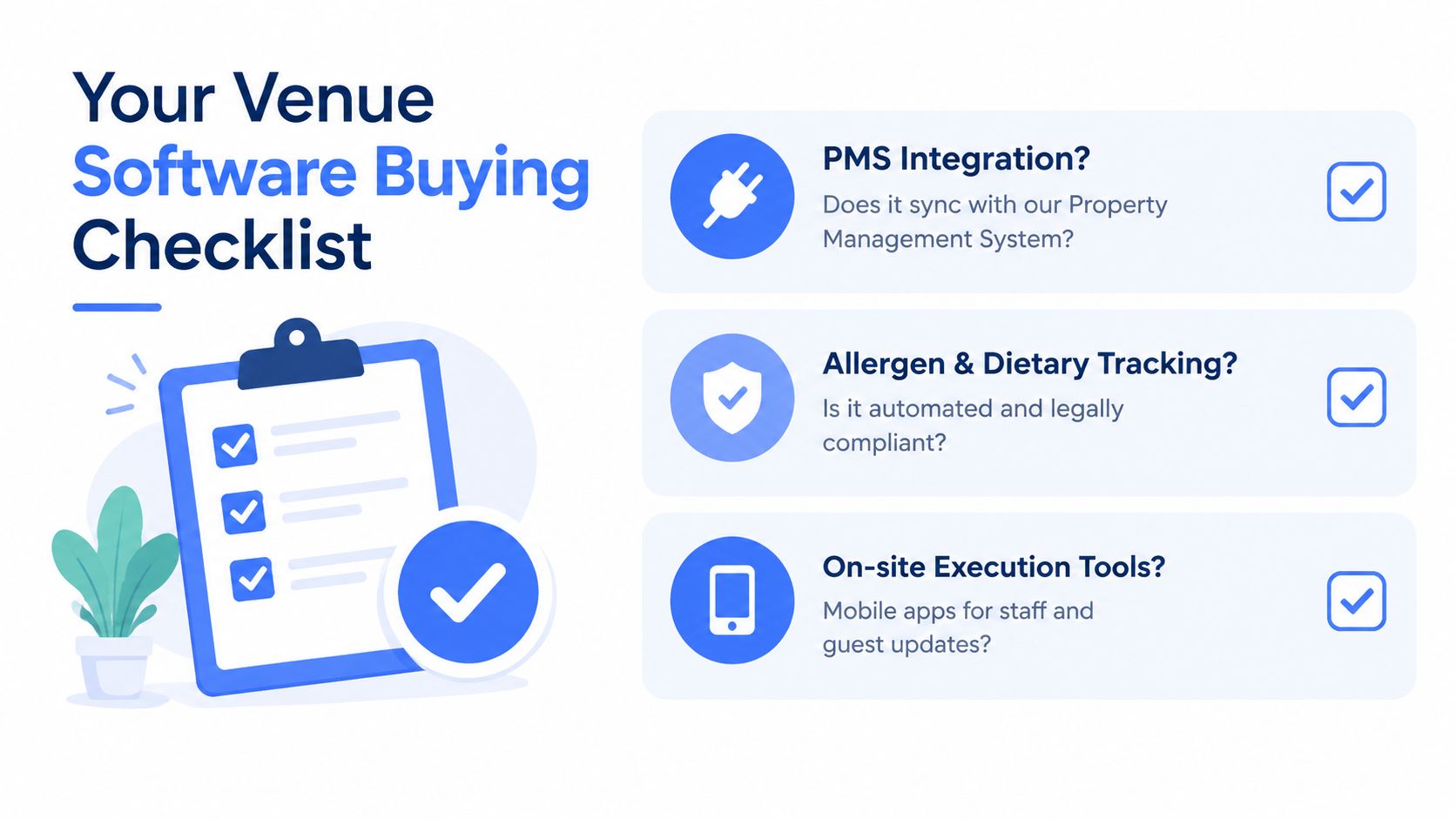
Your checklist should include:
- PMS integration: Does the system connect with your property and booking environment, including relevant PMS or event systems?
- Allergen controls: Can it track the 14 legally declared allergens, plus custom requirements, and produce usable compliance reports?
- Guest communications: Are emails and forms white-label and venue-branded, with reminders and clear response tracking?
- Seating: Can staff use drag-and-drop layouts, record guest relationships, and manage a delegated host system?
- Kitchen outputs: Does the platform automatically produce chef reports, food pass sheets, front-of-house reports, place cards, and function documents?
- Payments: Can guests pay deposits or pre-orders through PCI-compliant gateways, with clear reconciliation?
- Reporting: Can managers see performance across properties without asking each venue to build a separate spreadsheet?
- Feedback: Does the system capture post-event feedback and guest insights that sales teams can use later?
Give each stakeholder a pass or fail
Don't accept a successful sales demonstration as proof of operational fit. Give the chef, events manager, finance lead, and front-of-house supervisor a short test script and ask each person to score the workflow independently.
A useful decision record includes:
- The current failure: Identify the manual handoff or recurring error you need to remove.
- The required output: Name the document, report, payment record, or guest communication the team needs.
- The owner: Confirm who will administer the workflow after launch.
- The integration: Verify which existing systems must exchange booking or guest information.
- The adoption test: Ask whether a new property or team member could use the workflow without extensive specialist training.
- The commercial measure: Choose a practical indicator, such as response completion, payment collection, planning time, food waste, or pre-order value.
For hotels and venues, Creventa brings together enquiries, guest pre-orders, allergen and dietary tracking, seating, payments, communications, reporting, and post-event feedback in one hospitality-focused system. Visit Creventa to review its public pricing, integrations, and implementation approach, then test the platform against a real upcoming event before committing.
Jake Crimmin, Hospitality Events Specialist, Creventa. Jake works with hotels and venues on event operations, focusing on how pre-orders and allergen data flow from the guest through to the kitchen.