A Saturday in December can look healthy on the booking screen and still be close to breaking point. One party has 48 guests but no pre-orders, two allergen alerts appear on the pass during service, and the duty manager is reconciling deposits on a tablet while trying to release the next table. The room is busy, but the team is working from different versions of the truth.
That's the central planning problem. A venue Christmas season isn't a collection of bookings. It's one connected commercial and operational system, linking packages, guest choices, deposits, allergens, seating, staffing, supplier orders and reporting. UK demand is concentrated enough to make average-month forecasting unreliable. The week commencing 8 December accounted for 34% of festive bookings in one UK bookings dataset, while Christmas Day bookings rose 4% year on year. The Morning Advertiser's festive trading report also recorded sharply different city patterns, with Christmas Day reservation growth in Manchester, Glasgow, Bolton and Worcester, while London declined.
A practical answer to how to plan a venue Christmas season is to make every decision traceable from the first enquiry to the final reconciliation. The playbook below is designed for hotel meetings and events teams, restaurants, pubs, clubs, stadium hospitality managers and multi-site operators who need a plan that can be handed over without guesswork.
Table of Contents
- Set the Christmas Season Operating Plan
- Build the Planning Timeline and Milestones
- Design Profitable Packages and Deposits
- Control Menus, Pre-Orders and Allergens
- Plan Seating, Capacity and Ticketing
- Coordinate Staff, Suppliers and Communications
- Run Service, Close Out and Improve
Set the Christmas Season Operating Plan
The Saturday service above should never be the first time the kitchen discovers that a large party has different menu choices, or the first time finance finds that a deposit is missing. Before you design a menu, write the operating plan that defines what the venue is trying to sell, what it can safely deliver and who owns each decision.
Start with the commercial target. Set the expected revenue per cover, event count and ancillary spend, then separate those targets by service type. A lunch package with a short drinks offer behaves differently from a private evening party with entertainment, minimum spend and extended dwell time. UK Christmas activity is substantial enough to influence annual venue strategy. A 2025 projection put festive hospitality spend at £12.6bn, with 39.57 million people expected to visit UK hospitality venues, although the projected visitor count was lower than the previous year. The published UK Christmas hospitality report also recorded average spend per head of £26.53 in one December trading update.
Set boundaries before selling
Commercial ambition must sit inside operational guardrails. Record the maximum covers per hour, realistic dwell time, service style, kitchen production limit, bar throughput, arrival pattern and compliance restrictions. A room may physically fit more guests than the team can serve with the promised timing and standard.
Name one accountable owner for each operating area:
- Kitchen owner: controls menu feasibility, production quantities, substitutions, allergen procedures and supplier specifications.
- Floor owner: owns seating, table holds, service sequence, place cards and table changes.
- Marketing owner: manages package messaging, audience segments, booking cadence and reminder communications.
- Finance owner: controls deposits, balances, refunds, complimentary spend and reconciliation.
Each owner must keep the same live event record current. That record should contain guest profiles, deposits, pre-orders, allergens, table holds and supplier orders, with a clear timestamp and owner for material changes.
Practical rule: If a decision exists only in someone's inbox, notebook or personal spreadsheet, it hasn't been operationally agreed.
The written plan should also define escalation. Who can approve a late dietary change? Who can release a held table? Who can authorise a refund or complimentary item? The hand-over rule is simple: every decision lands in one shared plan before it becomes a booking. That prevents the sales promise, kitchen preparation and service execution from drifting apart.
Build the Planning Timeline and Milestones
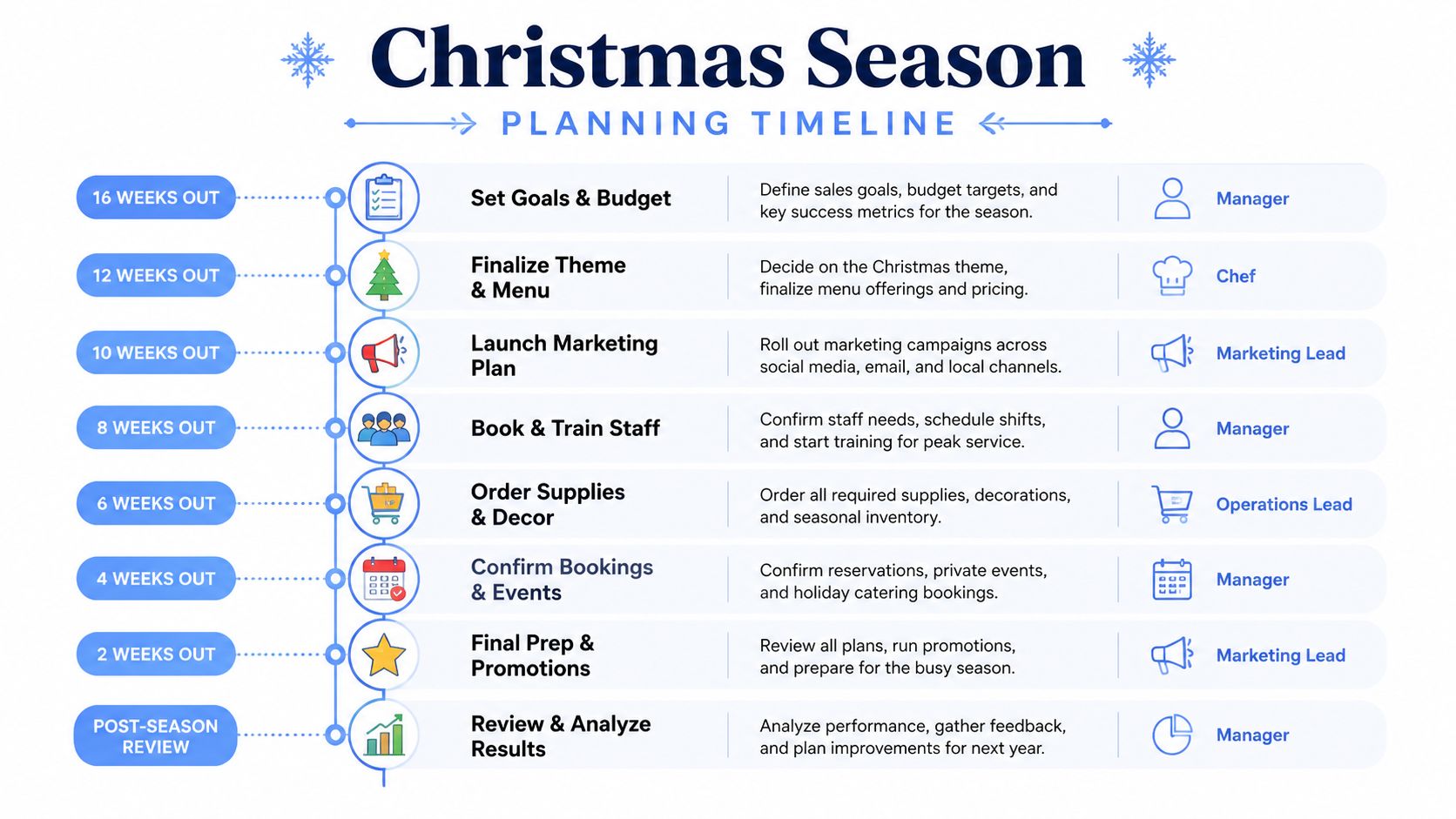
Work backwards from each service date, then place the whole season on one dated timeline. A useful structure begins roughly 16 weeks out and ends with the post-season review. The exact calendar can move, but the ownership and exit criteria must remain visible.
Assign decisions, not activities
At each milestone, record four things: the decision, the owner, the approval required and the evidence that proves completion.
At roughly 16 weeks out, the venue manager should approve the trading shape, target dates, service windows and capacity assumptions. The exit criterion is a signed operating brief that marketing and sales can use without adding unapproved promises.
The commercial lock follows. The events or commercial lead finalises the package grid, pricing, inclusions, deposit rules and cancellation terms. Finance approves the payment logic, while the manager confirms that the offer fits the room and service model. It isn't complete until the same package names and prices appear in the booking record, guest communications and internal function documents.
Protect the expensive deadlines
Marketing launches after the commercial lock, with separate messages for corporate groups, private parties, repeat guests and late demand. The booking team owns response tracking and the manager approves any exception to capacity or terms.
At approximately six weeks out, lock the menus, dish descriptions, allergen information and dietary alternatives. This deadline is expensive to miss because a late menu change affects guest communications, supplier quantities, kitchen prep and compliance checks at once. UK hospitality guidance recommends written allergen information alongside direct dialogue between staff and customers, particularly where group pre-orders and seasonal menu changes increase risk. UKHospitality's allergen guidance provides the relevant operational context.
Seven days before service, lock final numbers, pre-orders, allergens, seating, supplier quantities and staffing. That's the point at which the booking record becomes the production brief. Any later change follows the documented exception route rather than altering a spreadsheet.
The supplier lock should include delivery slots, last-order dates, backup contacts and escalation instructions. The service lock should include briefings, run sheets, contingency plans and manager cover. After the final event, the owner of the review records revenue, variance, feedback, staffing observations and supplier performance. The timeline remains the single source of truth, not a decorative project plan.
Design Profitable Packages and Deposits
Christmas buyers usually choose between a small number of recognisable offer shapes. The right choice depends less on how attractive the menu looks and more on whether the package protects margin while giving the operation information early enough to act.
| Package Type | Guest Value Perception | Margin Protection | Operational Complexity | Recommended Deposit Terms |
|---|---|---|---|---|
| Set menu only | Clear and easy to understand | Strong control over ingredients and portions | Low to moderate | Fixed per-head deposit, with the balance tied to confirmed numbers |
| Set menu with drinks package | Feels generous and simplifies decisions | Protects spend when drinks are designed around controlled products | Moderate, with bar-prep requirements | Per-head deposit, followed by an advance balance deadline |
| Shared-party package | Creates a social, abundant experience | Can protect margin through planned sharing portions | Moderate to high, especially for dietary variation | Staged deposits for larger parties, with final payment before service |
| A la carte with minimum spend | Offers flexibility and personal choice | Minimum spend creates a revenue floor | High, with less predictable production | Deposit linked to the area or booking, with a sliding cancellation scale |
Cost pressure makes package design more important than blanket discounting. UK Christmas party research found a gap between planned and actual spend, with London averages of £132 budget versus £115.38 spend, and the rest of the UK averaging £95.44 budget versus £82.46 spend. The UK Christmas party market report indicates that buyers may trim inclusions or downgrade rather than cancel, so value cues matter.
Use deposits to create certainty
For a fixed set menu, a per-head deposit is straightforward because the venue knows what it's preparing. For larger parties, stage payments around booking confirmation, pre-order completion and the final balance. Closer to service, a balance that can't be recovered should be collected before the kitchen commits stock and labour.
Cancellation terms must be proportionate. UK Government guidance says deposits should be only a small percentage of the total price, advance payments should reflect the venue's actual expenses, customers shouldn't lose large advance payments in every circumstance, and sliding scales should match likely losses. The Government's guidance on fair deposits and cancellation terms is written for wedding venues, but its principles are useful for Christmas bookings.
Consider a value-led drinks package rather than a small food discount. A controlled welcome drink, selected table wine or defined beer and soft-drink allocation gives the guest a visible benefit while letting the bar forecast products and service timing. A food discount reduces revenue without necessarily reducing kitchen complexity. The package should be tested against five questions:
- Cover count: Does the offer work for small tables, large groups and joiner parties?
- Service style: Can the team deliver it without creating an arrival or bar queue?
- Pre-order compliance: What information must be received before stock is committed?
- Payment timing: When does the venue have enough cash certainty to order?
- Final-week fallback: What happens if numbers fall, rise or split across package tiers?
Control Menus, Pre-Orders and Allergens
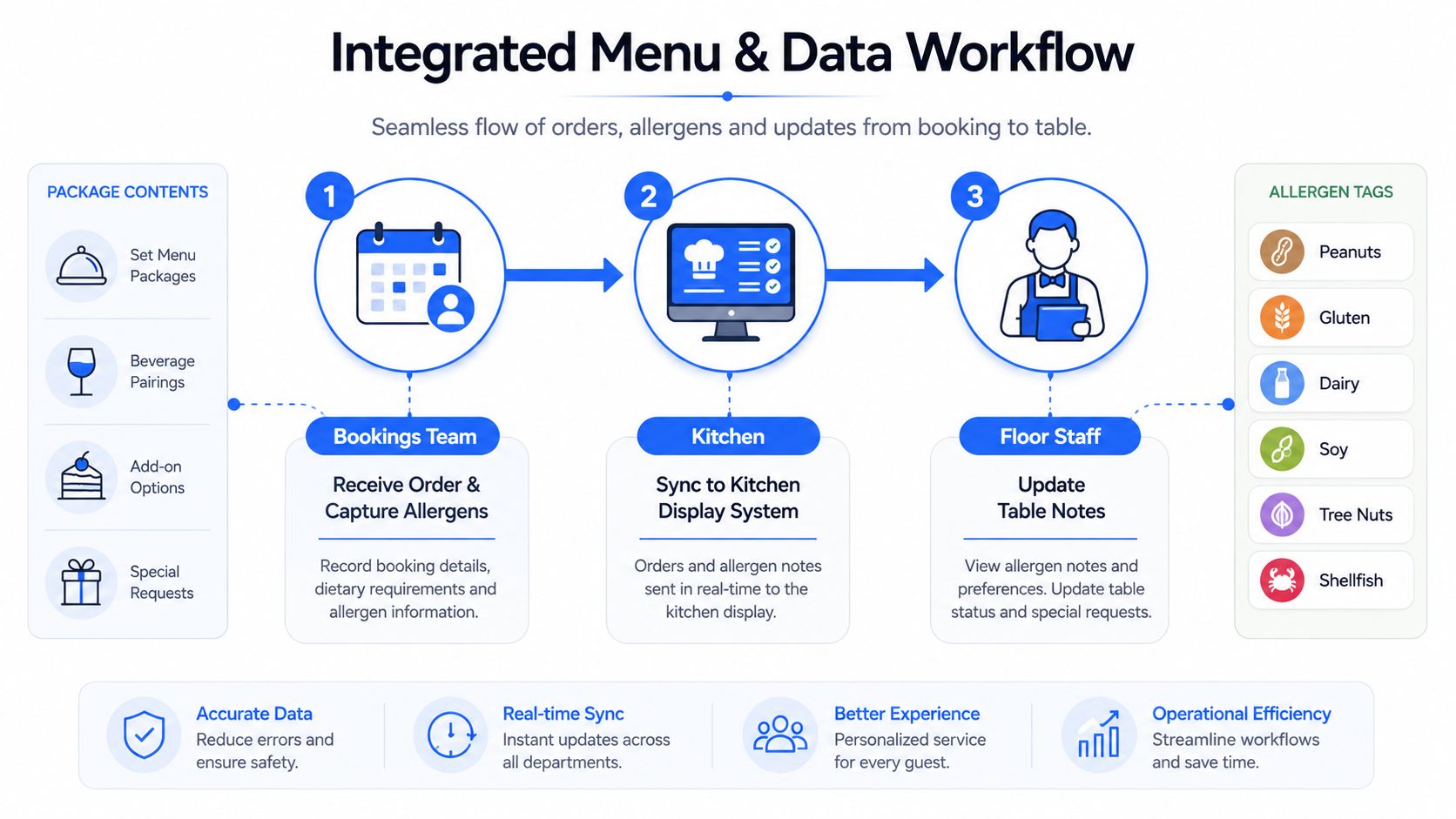
The kitchen shouldn't receive one menu attachment, the floor another and the booking team a third version in an email thread. Build one master menu record containing package contents, dish descriptions, allergen tags, dietary alternatives, portion assumptions and service dates. Version it whenever a dish changes, then make the active version visible to every team using it.
UK food businesses must identify and communicate the presence of 14 major allergens. Prepacked food sold directly to consumers must carry full ingredient labelling, with allergens emphasised under Natasha's Law. This UK allergen management guidance sets out the relevant requirements.
Capture information per diner
Send each organiser a structured pre-order form rather than asking for a reply-all email. Capture the package choice, course selection, allergen, dietary requirement, intolerance severity and notes for each diner. A group organiser may know that someone is vegetarian but not understand whether cross-contact creates a serious risk, so the form must prompt for clarification and the team must follow up directly where the answer is unclear.
Set a hard cut-off of 7 to 10 days before the event for party pre-orders. Allow adjustments 24 to 48 hours before service only through an approved process. The booking owner should confirm the change in writing, the kitchen owner should accept or reject the operational impact, and the floor owner should update the table record and place-card information.
Late changes need an exception path. It should cover:
- Late dietary disclosure: Manager confirms whether a safe alternative is available, then records the decision for the kitchen and floor.
- Child or menu swap: Booking owner checks price and production impact before updating the guest record.
- Split bill: Finance confirms the payment method and any service implications before the event.
- Surprise request at arrival: Floor staff escalate rather than promise an unverified dish.
Make the handoff audit-ready
Before service, produce a printed handoff sheet sorted by table and course. Cross-check it against final covers, the seating plan and the allergen summary. The pass needs to know what to plate, the floor needs to know what each guest ordered, and the manager needs to show how allergen information moved from guest disclosure to service instruction.
Creventa's core platform brings together pre-orders, allergens, seating, place cards and reports, while its guest ordering and payment product, Prinq, supports advance choices and payment capture. CreventaFlow handles enquiries, proposals and quotes, and the platform can generate kitchen-facing documents from the same guest and event data. Use that type of connected workflow, or reproduce its logic with another properly controlled system, but don't make email attachments the operating model.
Plan Seating, Capacity and Ticketing
Physical capacity is only the starting point. Usable capacity is the number of guests the kitchen, bar, floor and payment process can serve during the promised window without turning the experience into a queue.
Festive dwell time often rises because guests arrive early for drinks, wait for a whole group, order additional courses, listen to speeches and split cheques. Oxford Partnership data recorded average dwell time of 145 minutes, up 16% year on year, in one Christmas period, alongside average spend per customer of £26.37 and drink spend of £21.02. The Drinks Business festive trading update later recorded average dwell time of 150 minutes, occupancy of 63.9% and average spend per head of £26.53.
Back-calculate service windows
Measure dwell time by package, not just by venue average. A quick set menu may turn faster than a shared-party format with speeches and pre-ordered drinks. Include welcome service, seating, food pacing, dessert, coffee, payment and table reset in the calculation.
Then decide:
- Usable covers: Set a cover ceiling for each service window based on the complete service journey, not available chairs.
- Hold-back tables: Reserve a controlled number of tables for late release, operational recovery or high-value demand.
- Group cut-offs: Define the largest party size each service can absorb without disrupting other tables.
- Walk-ins: Decide whether walk-ins are accepted, restricted to a defined area or declined during peak windows.
- Waitlists: Record party size, preferred time, package suitability and contact priority so releases are fair and useful.
Independent UK seating calculations use a simple rule: tables needed equal guests minus top-table guests, divided by seats per table, then rounded up. Spare seats equal total seats minus total guests. This UK seating-plan calculator illustrates the mechanics, but a venue must still apply its own access, service and safety constraints.
| Service Window | Realistic Dwell | Usable Covers vs Seats | Deposit Rule | Release Window |
|---|---|---|---|---|
| Early lunch | Package-dependent, including arrival and reset | Set below physical capacity to protect turnover | Per-person deposit | Release unconfirmed holds after the agreed confirmation point |
| Peak lunch | Longer dwell where drinks and courses overlap | Cap at the kitchen and floor limit | Per-person deposit with clear balance date | Release late holds only after manager review |
| Early dinner | Allow for arrival clustering and pre-service drinks | Protect the first course window from overbooking | Deposit plus pre-order completion requirement | Release unconfirmed tables when final numbers are due |
| Peak dinner or private party | May require the longest dwell allowance | Use capacity caps and minimum spends for defined areas | Staged payments for larger groups | Release only under the service manager's approval |
Link deposits, pre-orders and table plans to the same live guest record. If a party cancels, the table should become available without manual copying. If a group adds a drinks package, the seating and payment view should show the commercial change immediately.
Coordinate Staff, Suppliers and Communications
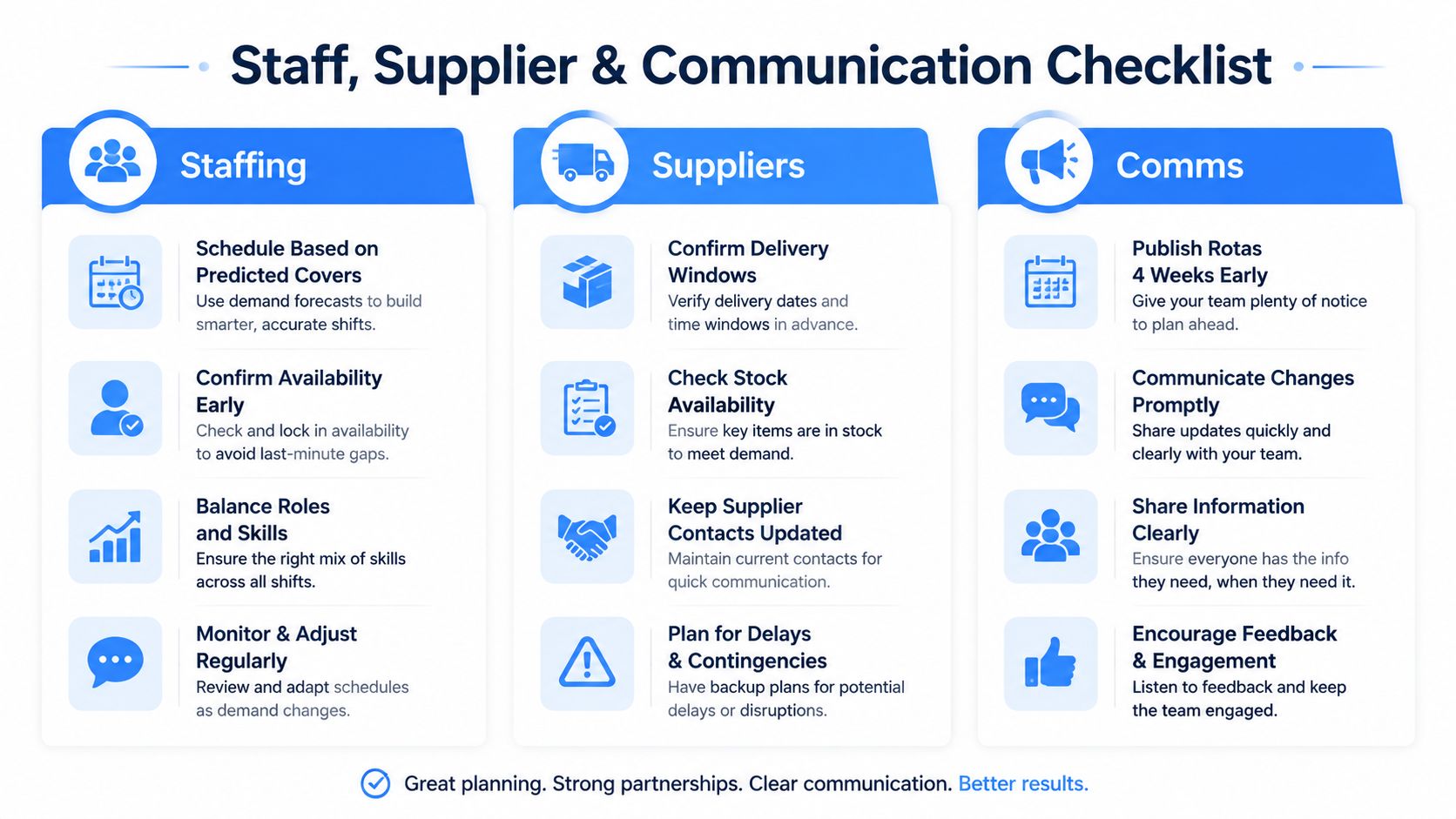
A Christmas rota built from last year's headcount is a weak forecast. Schedule against predicted covers, package mix, dwell time and service windows, then publish early enough for seasonal staff to commit. The staffing plan should show not only how many people are present, but who can cover each pressure point when the original plan changes.
Cross-train the team deliberately. Hosts should understand enough bar flow to support an arrival surge. Runners should know the pass sequence. Supervisors should be able to take control of either floor or service coordination. Every pre-service meeting should cover package inclusions, allergen escalation, payment scripts, table moves and the language staff should use when a guest requests something outside the agreed offer.
Tie suppliers to confirmed demand
Supplier orders should follow the same dates as pre-order cut-offs. Set standing orders for predictable proteins and produce, record delivery windows, confirm last-order dates and name a backup contact for critical items. If a delivery misses its slot, the escalation path should identify who can approve a substitute, who updates the menu record and who informs the floor.
Longer stays and higher-value festive occasions place pressure on food, drink, seating and service flow. The later festive trading update cited above reported average spend per head reaching £26.53, so the operation needs enough stock and labour to fulfil the offer without treating every possible upsell as an unplanned exception.
Give communications a job
Build the guest calendar around decisions:
- Save the date: Establish the offer, date and booking route.
- Deposit link: Confirm terms, inclusions and payment deadline.
- Pre-order prompt: Collect choices, allergens and dietary notes.
- Reminder sequence: Chase incomplete forms and unpaid balances.
- Arrival details: Send timings, access, dress guidance and transport information.
- Thank-you message: Invite feedback and capture future preferences.
Automate routine reminders, but personalise high-value or complex group communications. A run sheet and contacts sheet should sit with every event, showing final numbers, special requirements, manager on duty, supplier arrivals and escalation contacts. When the events coordinator hands over to the duty manager, the document should answer the operational questions without another meeting.
Run Service, Close Out and Improve
Many venues treat the end of service as the end of planning. That's where valuable evidence gets lost. A controlled Christmas operation closes each event financially, operationally and commercially before the team leaves, then converts the findings into changes for the next season.
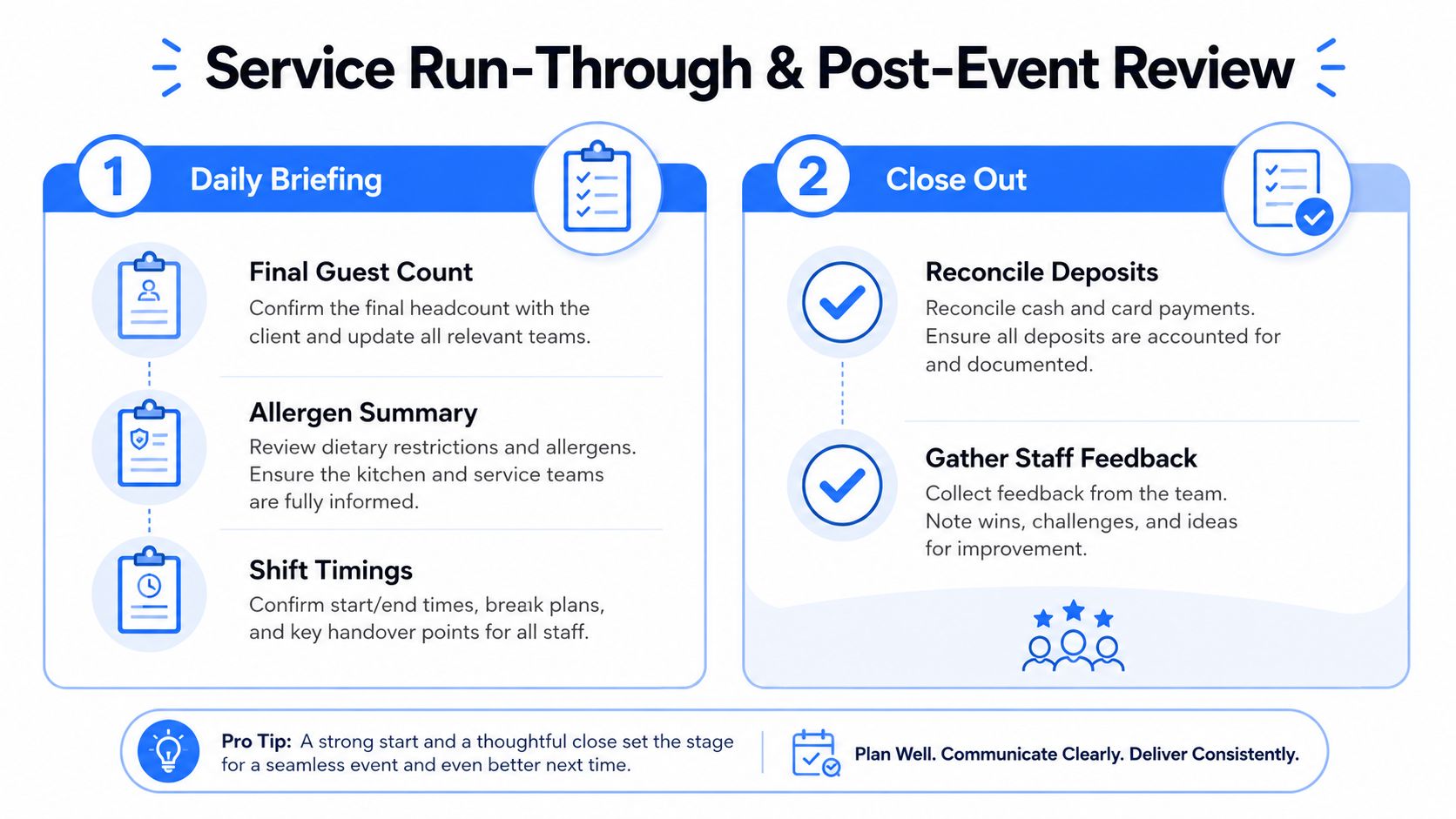
Issue a daily briefing sheet with final guest counts, table plans, allergen summary, role assignments and shift timings. The manager should confirm the active menu version, late exceptions, supplier arrivals and any tables held for release. This creates one reference point for the host, kitchen, floor supervisor and finance lead.
Close the numbers before closing the doors
After each event, reconcile deposits, card takings, gift vouchers and complimentary spend against the booking record and till reports. Set a variance threshold in advance. Any discrepancy above it needs an owner, a written explanation and a resolution date before the event is marked complete.
The same closeout should capture service evidence:
- Timing: Record arrival flow, first drinks, course pacing, dessert peak and table reset.
- Guest issues: Group complaints by menu, waiting, payment, seating or communication.
- Suppliers: Note delivery accuracy, substitutions, quality and response to escalation.
- People: Record staffing gaps, excessive pressure, breaks missed and useful cross-cover.
- Data quality: Check whether allergens, pre-orders, deposits and final numbers matched the live record.
A short post-event survey gives guests a route to comment while the experience is fresh. The manager debrief adds context that a survey can't provide, especially around kitchen bottlenecks, team welfare and decisions made under pressure.
Turn memory into an operating asset
Write the retrospective while the season is still recent. Rank each problem by impact, assign an owner, set a deadline and define the evidence that proves the fix is complete. A useful retrospective template includes:
- Issue: What happened, on which service and under which package?
- Impact: Did it affect revenue, safety, guest experience, labour or waste?
- Root cause: Which decision, handoff or control failed?
- Owner: Who can change the process?
- Deadline: When must the change be ready for the next season?
- Exit criterion: What record, test or briefing proves it works?
The same structure works for a supplier scorecard, variance report and end-of-season reconciliation. Don't rely on “we'll remember that next year”. Store the final package versions, guest-response patterns, seating constraints, payment exceptions and service notes in the venue's operating record.
Creventa was founded in June 2020 by Luke Ireland and Andrew Norton and provides a connected event workflow covering enquiry management, guest pre-orders, allergen and dietary tracking, seating layouts, payments, communications, post-event feedback and guest insights. Its public pricing is transparent, and it integrates with Delphi, Opera Cloud, SevenRooms, OpenTable, Guestline and RezLynx, Stripe, Adyen and PlanetPay where venues need booking, property, payment or guest-record connections.
If your Christmas planning still depends on separate spreadsheets for packages, pre-orders, allergens, seating and deposits, map the handoffs before your next peak service and identify where information gets copied or lost. Visit Creventa to see how one hospitality-focused workflow can connect guest data, operational documents, payments and post-event reporting from enquiry through closeout.
Claire Gaskell, Customer Success, Creventa. Claire helps venues onboard and get the most from Creventa, from menu setup and branded guest invitations to reporting on event day.