A banquet captain checks the organiser's spreadsheet. The chef checks a printed function sheet. A server checks handwritten place cards. The guest who mentioned a sesame allergy by reply email checks nothing, because they assume the venue has it covered. That's how an allergy gets missed at a large event. Not because nobody cared, but because the information broke somewhere between invitation, kitchen prep, seating and service.
Allergen safety at scale isn't a menu note. It's a chain of controls. You need guest-by-guest capture, separate allergy and preference records, kitchen verification before menus are locked, segregation in prep and plating, visible service flags, a protocol for late changes, and an auditable close-out after the event. If one link is weak, the whole event becomes dependent on memory and luck.
In the UK, food businesses must tell consumers if any of the 14 regulated allergens are present in non-prepacked food, and that applies to hotel banquets, conference buffets, canapés and pre-ordered event meals, not just retail food service, under UK allergen guidance for food businesses. Natasha's Law also changed expectations by pushing the industry toward clearer, more standardised allergen communication for food prepared on site and sold directly.
The practical lesson is simple. A declaration form helps, but it doesn't replace kitchen assessment. You still need a chef to decide whether a dish can be served safely, whether a substitute is safe, and whether cross-contact risks are controlled. If you're also reviewing venue hygiene risks more broadly, it can help to shop for allergy air purifiers alongside your food-safety planning.
The best practices for handling allergens at large hotel events start with operations, not software. Software helps later by removing transcription, chasing and document production once the process itself is sound.
Table of Contents
- 1. Separate allergen and dietary preference data collection at point of invitation
- 2. Kitchen-verified allergen matrices and recipe-level traceability
- 3. Kitchen segregation and cross-contamination control protocols
- 4. Pre-service kitchen and front-of-house briefings with allergen-specific run sheets
- 5. Visible allergen flagging on place cards, seating charts, and the kitchen pass
- 6. Protocol for late arrivals, seat swaps, and last-minute allergen updates
- 7. Automated allergen reporting and auditable records for compliance
- 8. Guest self-service allergen declaration with allergen-aware menu filtering
- 8-Point Allergen Management Comparison for Hotel Events
- Make the safe process the easy process
1. Separate allergen and dietary preference data collection at point of invitation
The first mistake is bundling everything into one box called “dietary requirements”. That field usually ends up holding vegan requests, dislikes, religious requirements, gluten avoidance, severe nut allergy and “no coriander please” in one untidy list. That's unworkable in a banqueting kitchen.
Allergies and preferences need separate workflows because they mean different things. One is a safety issue. The other is a service issue. Treating them as the same category leads staff to downgrade urgent information.
What to collect and how
Start with a simple gate question. Ask whether the guest has a food allergy that could make them ill. Then ask separately about dietary preference or lifestyle choice. For allergen capture, use the 14 regulated allergens as structured options and add free text for non-standard allergies, severity, and any extra context the kitchen needs.
The 14 regulated allergens are celery, cereals containing gluten, crustaceans, eggs, fish, lupin, milk, molluscs, mustard, peanuts, sesame, soya, sulphites and tree nuts. UK industry guidance commonly translates food allergy prevalence into around 2 million people living in the UK with food allergy, which is why this cannot be left to organiser memory or a final guest-count call with the client, according to UKHospitality allergen Q&A guidance.
Practical rule: organisers can coordinate, but guests should declare their own allergies wherever possible.
Guest-by-guest capture is safer than organiser-only collection because people describe their own risk more accurately. They'll often add detail an organiser won't know, such as whether the issue is mild intolerance, contact sensitivity, or a previous severe reaction.
What works in practice
A good invitation explains the difference in plain English. “Allergies are health risks. Preferences are choices.” That one line prevents a lot of muddled responses.
Useful habits at this stage include:
- Use separate fields: keep allergy declarations apart from vegetarian, vegan, halal, kosher or preference notes.
- Record timing: keep the date and time of each declaration for audit.
- Allow free text: guests often need to explain a non-standard trigger or severity.
- Push queries back to the guest: if the organiser answers on someone else's behalf, ask for direct confirmation.
If you want a clear example of the workflow, Creventa explains the handoff in its guide to preventing allergen mix-ups at large catering events.
2. Kitchen-verified allergen matrices and recipe-level traceability
A menu description isn't an allergen control document. “Chicken with spring greens” tells the guest almost nothing and tells the chef even less. The answer sits in the recipe, the garnish, the dressing, the stock, the seasoning and the supplier specification.
That's why large events need an event-specific allergen matrix, not a recycled restaurant matrix from six months ago. The matrix should map every dish against the regulated allergens and any additional risks flagged by the guest list.
Verify before the menu is locked
Build the matrix before final guest selections are confirmed. Then have the head chef or kitchen manager verify it against actual ingredients, current suppliers and intended prep method. If a sauce changed, a bread changed, or a garnish is now bought in rather than made in house, the matrix must change too.
Allergen information for non-prepacked food must be supplied per item, and for buffets the information must be available per dish rather than for the buffet as a whole, under government allergen guidance for food businesses. In practice, a sign saying “please ask staff about allergens” isn't enough on its own if the back-of-house records are vague or outdated.
Traceability has to reach ingredient level
Recipe-level traceability means the kitchen can identify obvious and hidden allergens. It catches the celery in a seasoning blend, the sesame in a dressing, the milk in a chocolate garnish, or the sulphites in an ingredient the banquet team assumed was neutral.
Use a standard template and assign ownership. One senior kitchen person should sign off the event matrix. Store the signed version with the event file, along with the supplier information and any amended recipes.
If a dish can't be verified as safe, don't improvise your way through service. Replace it, customise it properly, or take it off the event menu.
For a practical system view, Creventa outlines how allergen tracking systems work in event catering.
3. Kitchen segregation and cross-contamination control protocols
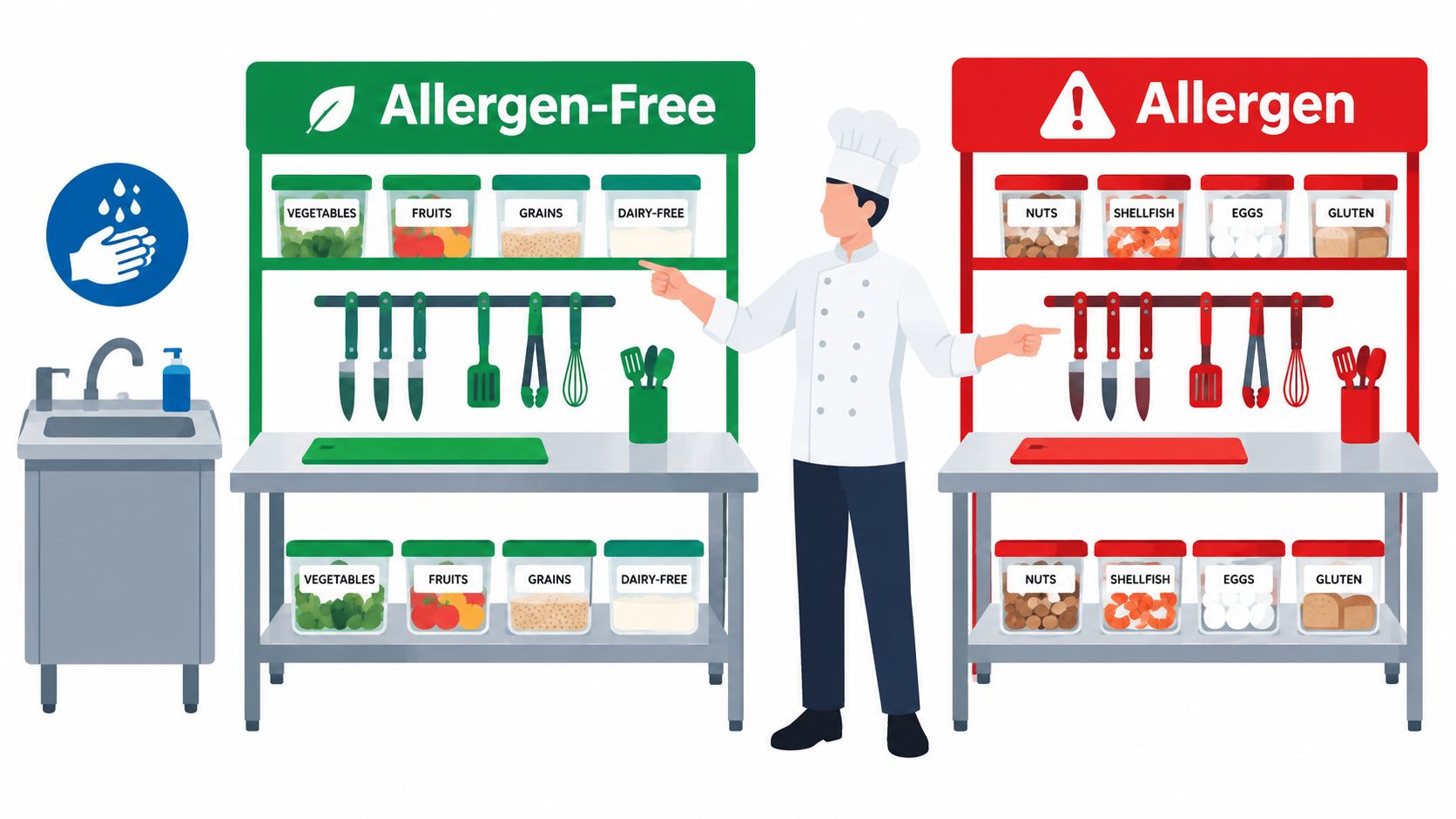
Most allergen failures at large events don't start with a malicious act or a dramatic mistake. They start with small shortcuts. Shared tongs. A wiped board instead of a cleaned one. Garnish added at the end by someone who didn't attend the briefing. In banqueting kitchens, pace creates pressure, and pressure exposes weak controls.
Segregation is the control that stops one plate becoming a problem. In practical terms, that means separate work areas where possible, separate utensils for high-risk cases, disciplined cleaning, and a clear prep order.
Build the kitchen around the risk
Prepare allergen-free dishes first where the menu and staffing allow. If a guest has a severe allergy, don't slot that plate into the middle of general prep and hope everyone remembers. Mark the station, assign responsibility, and keep the ingredients and utensils dedicated to that task.
For buffets and self-serve formats, the challenge gets harder. UK guidance stresses that loose foods such as buffets and self-serve setups must be labelled with allergen information, and separate areas may be needed for allergen-free dishes, according to the allergen checklist for food businesses. The guidance is directionally right, but in hotel banqueting the weakness is often service choreography, not just labels.
Controls that actually hold up
The strongest setups use visual and physical separation together.
- Mark prep zones clearly: tape, signs, board colour and bench assignment all help under pressure.
- Control the sequence: prep allergen-safe dishes before general production where possible.
- Use dedicated kit for severe cases: boards, knives, trays and plating utensils shouldn't move back and forth.
- Clean between tasks properly: wiping down isn't the same as cleaning and sanitising.
- Brief runners too: the person carrying the plate can undo the chef's work.
Teams preparing for inspections often pair allergen controls with broader deep kitchen cleaning for brand audits, because a clean kitchen is easier to zone, easier to supervise and easier to defend.
4. Pre-service kitchen and front-of-house briefings with allergen-specific run sheets
A function sheet doesn't do this job. It tells staff when to pour prosecco and when dessert leaves the pass. It doesn't tell them which guest at table 18 must not receive the standard jus, or which canapé tray must never pass down the left side of a specific table.
Large events need a dedicated allergen run sheet and a proper briefing before service. Kitchen and front of house have to hear the same information at the same time.
What the briefing must cover
Hold the briefing shortly before guests arrive, when the latest seating, guest count and menu status are known. Review every declared allergy, the guest identifier, the agreed dish and any severe-risk notes. Confirm what happens if someone turns up late, moves seat or raises a new concern on the floor.
In one allergy-compliance audit cited by Serve Legal, 62% of customers said they did not feel entirely confident in staff allergen knowledge or the information they were given. That's a service problem and a safety problem. Briefings close part of that gap because they force a verbal check before service pressure starts.
The run sheet should be short, not clever
The best run sheets are blunt. Guest name or identifier. Table. Allergen. Severity note if known. Approved dish. They are not buried inside a longer event pack where staff have to hunt for the critical line.
Useful briefing habits include:
- Read high-risk cases aloud: don't assume everyone scanned the page.
- Keep copies in both worlds: one in kitchen, one with front-of-house leadership.
- Confirm fallback dishes: if a plate is spoiled or dropped, staff need the safe replacement route.
- Capture attendance: if you can't show who was briefed, your process is weaker than you think.
Creventa shows the reporting side well in its guide on creating a chef report from guest pre-orders.
5. Visible allergen flagging on place cards, seating charts, and the kitchen pass
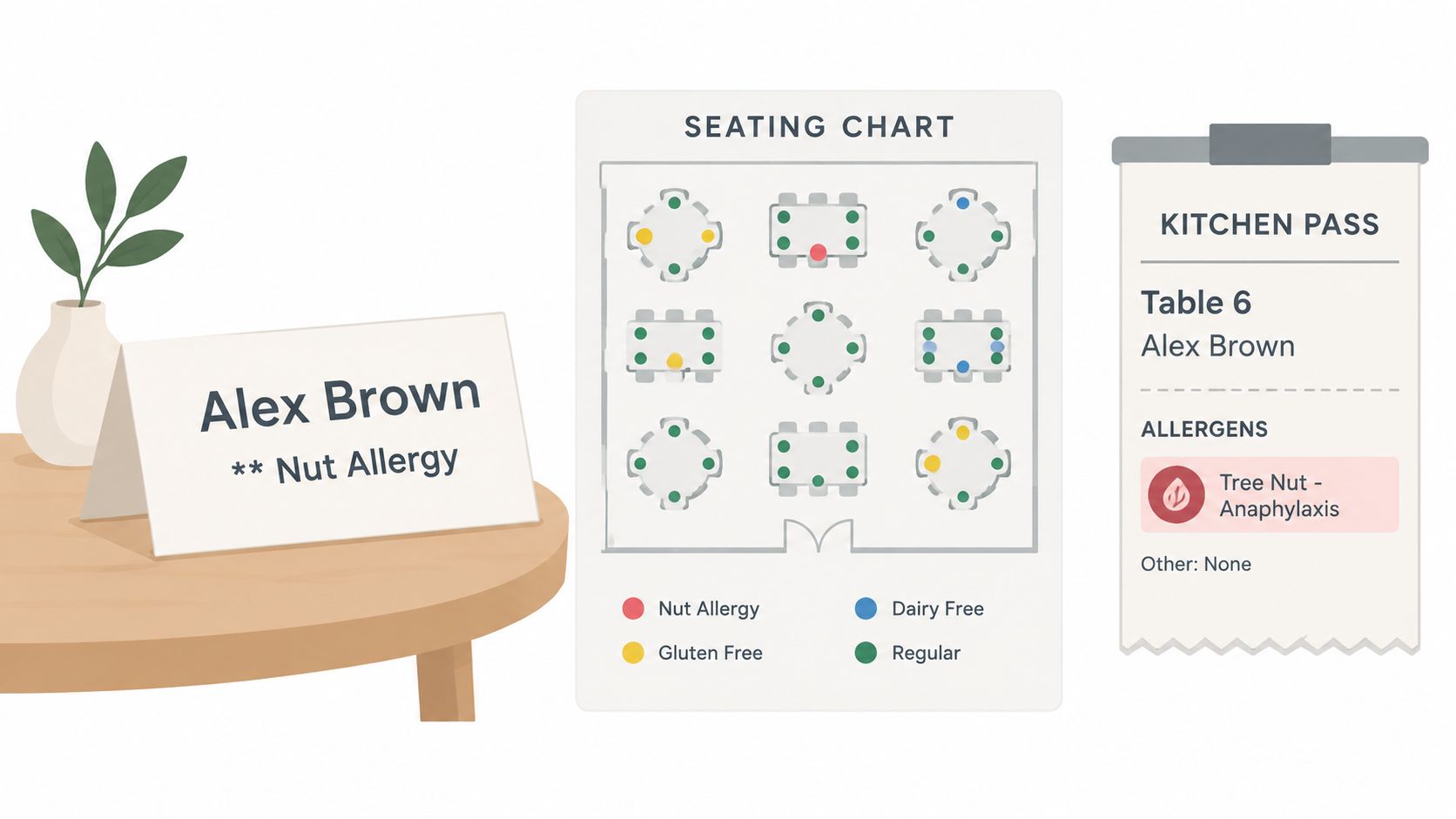
Allergen information fails when it becomes invisible at the moment of service. The kitchen knows. The event office knows. The guest may even have pre-ordered correctly. Then a runner picks up the wrong plate because every card on the pass looks the same.
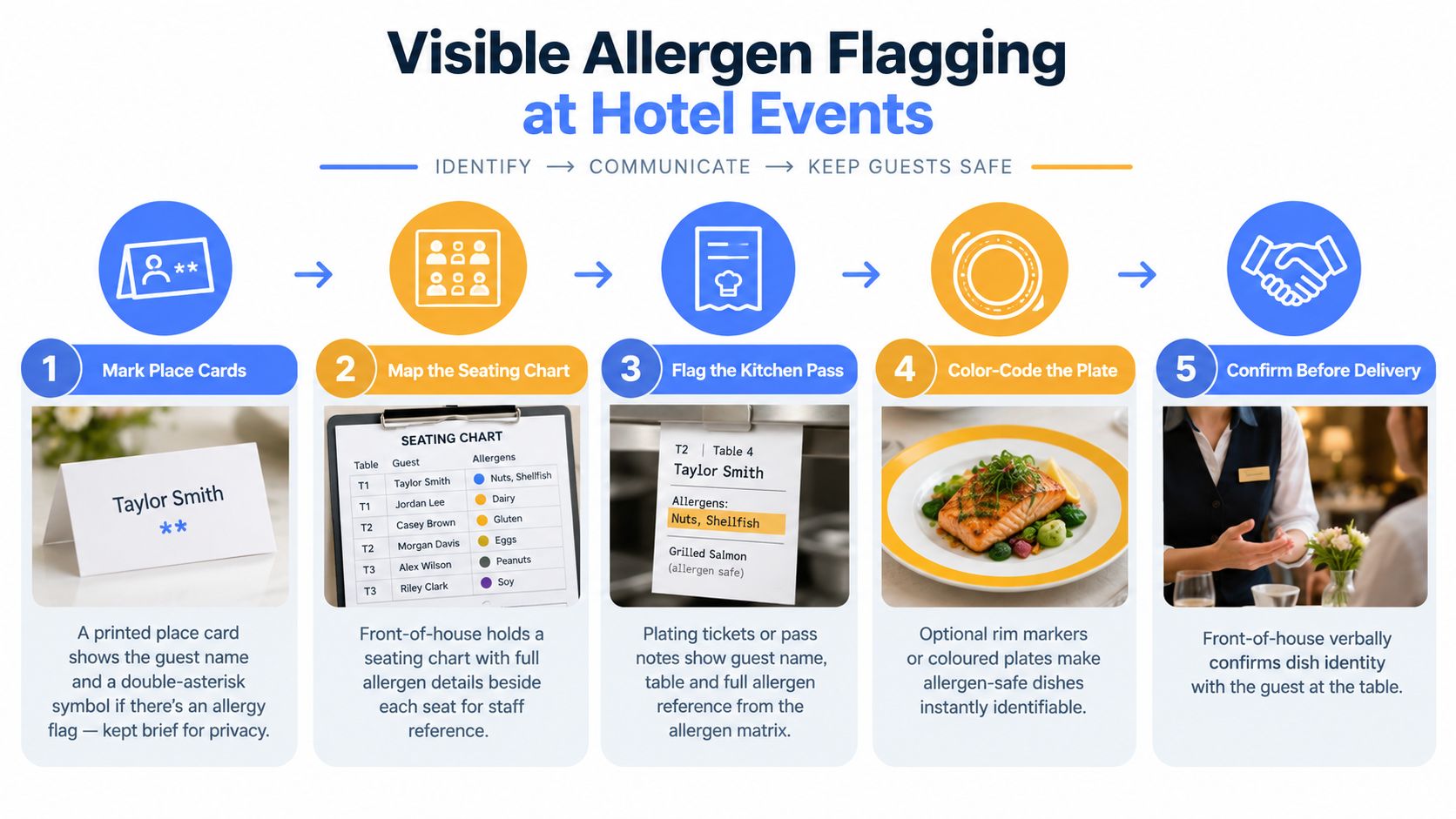
You need visible flags at every handoff point where food and guest identity meet. Place card. Seating chart. Kitchen pass. Those three points catch most service-floor errors before they reach the table.
Use one flagging language everywhere
Pick a single system and stick to it. Double asterisks work well because they're easy to spot in print and don't depend on colour alone. A place card can carry a discreet marker, while the seating chart and pass report carry the full detail for staff.
The legal point matters here too. Hotel event meals and buffets are subject to allergen information rules for non-prepacked food, and businesses must tell customers when any of the 14 main allergens are used as ingredients under best practice on allergen information for non-prepacked foods. A single generic buffet sign won't protect a plated service from a wrong-seat delivery.
Make the critical point hard to miss
A visible flag should support, not replace, verbal confirmation. Good service sounds like this: the runner checks the place card, confirms the table chart, then confirms with the guest before the plate lands.
The closer you get to plating and delivery, the more specific the allergen information needs to be.
Creventa's guide to printing place cards for events is useful because it treats place cards as an operational control, not just event stationery.
6. Protocol for late arrivals, seat swaps, and last-minute allergen updates
No matter how well the event was planned, guests will still move. The finance director swaps into a better seat. A late arrival joins after starters. Someone says, at the table, that they “forgot to mention” an allergy. If you don't have one owner for those changes, the information scatters instantly.
The rule is simple. One person approves and communicates every allergen-related change on the day. Usually that's the F&B manager or event lead working directly with the head chef.
The protocol should answer four questions
First, who receives the update. Second, who decides whether the kitchen can accommodate it safely. Third, how the printed and service documents are updated. Fourth, how the pass is told before the relevant course is plated.
This isn't just good practice. Guidance for delegated event ordering makes clear that when food is ordered before an event by one person or organisation on behalf of others, it is still treated as non-prepacked food, so mandatory allergen information must be made available to the eventual consumers, according to Food Information Regulations guidance. In other words, the booking contact's convenience doesn't remove the duty to get the information to the actual guest.
Practical controls for moving events
Good change handling usually includes a hard cut-off for normal amendments and a stricter same-day exception route.
- Use one point of contact: staff shouldn't improvise side conversations with the kitchen.
- Ask follow-up questions: a new declaration needs enough detail for a decision.
- Keep simple fallback dishes ready: plain, verifiable options help when time is short.
- Log seat swaps in real time: if the card moved but the report didn't, service is exposed.
- Document every exception: who asked, when, what was approved, and by whom.
What doesn't work is verbal relay through three people while the pass is already plating mains.
7. Automated allergen reporting and auditable records for compliance
If an environmental health officer asks how you managed allergens at a 600-cover gala, “we had a good team on” isn't an answer. You need records. Not because paperwork serves guests, but because good records prove the work was done.
A defendable event file should show the full chain. Guest declarations, kitchen verification, briefing record, seating materials used during service, and any exceptions or incidents from the floor.
What an audit trail should contain
For each event, keep the original declaration, the verified allergen matrix, the briefing checklist, the place cards or seating plan version used on the day, and the incident or change log. Keep them together so someone reviewing the file can follow the event from invitation to service close-out without asking six different people for missing pieces.
The governance problem is getting harder at multi-source events. UK guidance says organisers are responsible for compliance by exhibitors and external caterers, and updated guidance has emphasised that allergen information for non-prepacked food should be available in writing and backed by a conversation, as reflected in government allergen guidance for food businesses. At hotel scale, that means written records have to survive menu changes, multiple service points and staff turnover.
Why automation helps here
Automated reporting doesn't replace judgment. It removes the clerical risk. It stops someone rebuilding the allergen history from emails after the event, or forgetting which version of the seating chart was live during service.
Keep these principles in place:
- Assign ownership: one person should own the allergen record for the event.
- Archive promptly: complete the file while service details are still clear.
- Store records securely: allergen data is operationally sensitive and personal.
- Review for patterns: repeated substitutions or repeated floor changes usually point to a process weakness.
The best systems make the safe version of admin the easiest version of admin.
8. Guest self-service allergen declaration with allergen-aware menu filtering
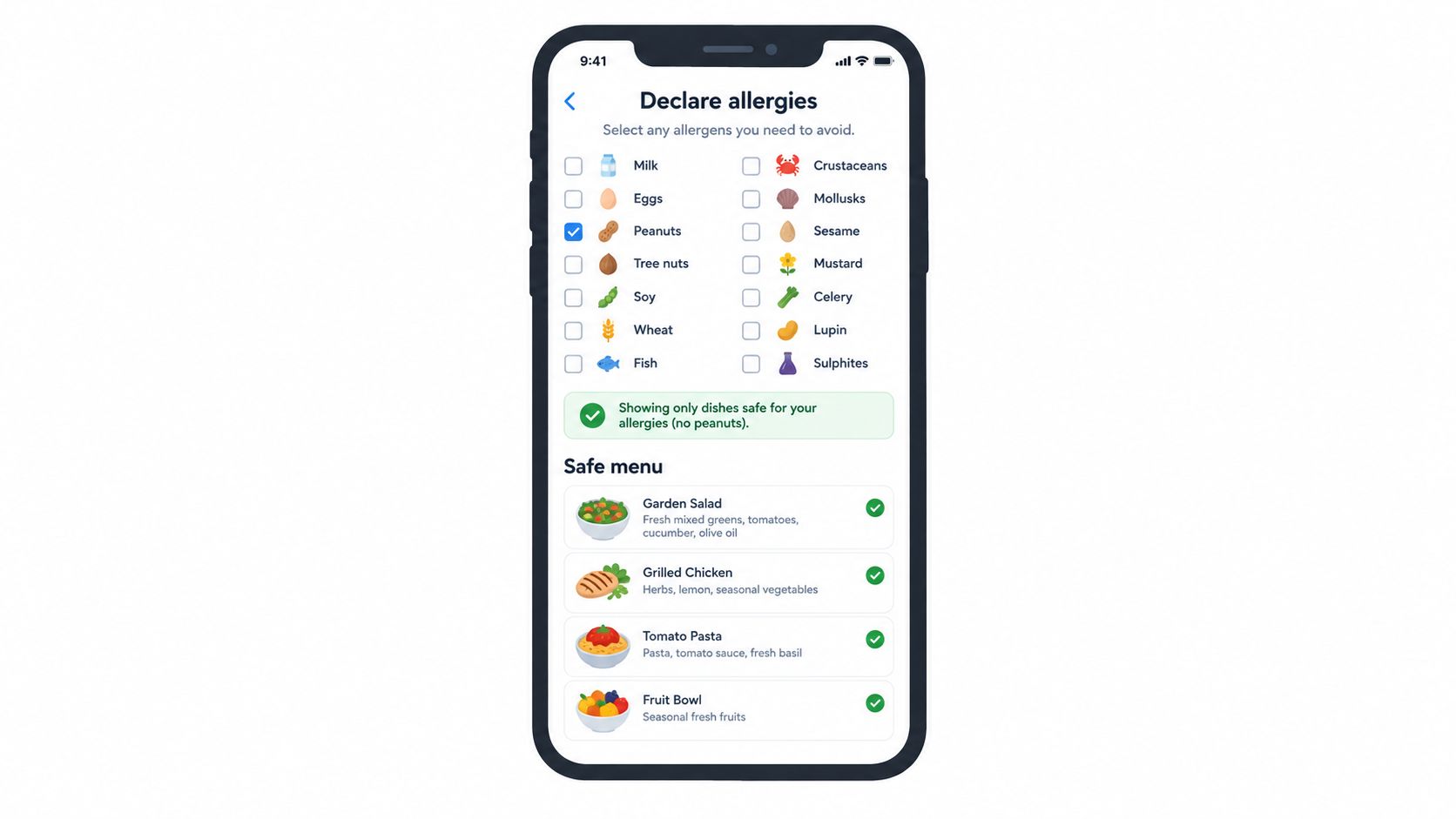
Once the operating model is right, software can remove a lot of manual failure points. The strongest improvement usually comes at the start. Ask the guest directly, in a branded invitation, and let the system carry that declaration all the way through to service documents.
That's better than collecting allergies by spreadsheet, forwarding them by email and retyping them into chef sheets later. Every re-entry is another chance to misspell, omit or flatten a serious allergy into a vague note.
What centralised guest capture changes
Creventa's white-label invitation flow lets guests declare allergies and dietaries themselves. That matters because allergy and dietary preference stay as separate data points against the named guest, not a shared organiser note. If a severe case needs a custom dish, that instruction can then flow into the reports used by kitchen and front of house.
It also supports allergen-aware menu filtering, so guests only see dishes marked as suitable for their declared allergens. That doesn't replace chef verification, but it does reduce unsafe selection before the kitchen even starts planning. For venues handling events from 10 to 1,100+ guests, that kind of filtering cuts down the amount of manual checking needed before reports are produced.
Where it fits in the workflow
Centralised software earns its place. Not by pretending to be a substitute for kitchen judgment, but by removing transcription, chasing and document production after the chef has approved the rules.
Creventa is used by Malmaison and Hotel du Vin, Wolseley Hospitality Group, Derbyshire County Cricket Club and Mercure Tunbridge Wells. Creventa also reports a 99.2% guest response rate to pre-order invitations, and supports events from 4 to 2,500+ guests, based on its published company materials. If you're using digital ordering or pre-event guest journeys, its article on QR code ordering for events shows the wider operating model.
Teams also use the same guest-led approach beyond venue operations, including consumer education such as self-testing for common allergies, though self-testing never replaces a venue's duty to manage declared food risks properly.
8-Point Allergen Management Comparison for Hotel Events
| Item | Implementation Complexity 🔄 | Resource Requirements ⚡ | Expected Outcomes ⭐ | Ideal Use Cases 📊 | Key Advantage + Tip 💡 |
|---|---|---|---|---|---|
| Separate allergen and dietary preference data collection at point of invitation | Medium, process & UX change to two-field model | Low–Medium, form updates, invitation workflow, guest education | ⭐⭐⭐⭐, clearer legal compliance & fewer classification errors | Events where legal allergen capture is required; mixed diets | Clear legal separation and guest accountability. Tip: add yes/no gate and brief guidance text. |
| Kitchen-verified allergen matrices and recipe-level traceability | High, recipe logging + chef verification step | High, kitchen time, supplier records, templates | ⭐⭐⭐⭐⭐, catches hidden allergens; strong due diligence | Complex menus, severe allergy cases, large events | Single source of truth for kitchen. Tip: use a standard template and assign a verification owner. |
| Kitchen segregation and cross-contamination control protocols | High, physical zoning and strict procedures | High, space, duplicate equipment, training | ⭐⭐⭐⭐⭐, prevents most accidental exposures | Events with anaphylaxis-risk guests; high-volume kitchens | Eliminates common contamination routes. Tip: map zones, colour-code tools, assign an overseer. |
| Pre-service briefings with allergen-specific run sheets | Medium, scheduled briefing and run-sheet creation | Low–Medium, printing, staff time, run-sheet generation | ⭐⭐⭐⭐, team alignment; fewer service errors | Any event with multiple service teams or multiple allergies | Aligns kitchen and FOH before service. Tip: auto-generate run sheets and hold 30–60 min pre-service. |
| Visible allergen flagging on place cards, seating charts, and pass | Low, consistent printing and placement process | Low, printed materials, colour coding | ⭐⭐⭐⭐, immediate at-a-glance safety cues; reduces plating errors | Seated meals, banquets, table-service events | Rapid visual cue for staff. Tip: use consistent ** or colour; keep place-card info private. |
| Protocol for late arrivals, seat swaps, last-minute allergen updates | Medium, documented decision tree & rapid comms | Low–Medium, staff point-of-contact, spare dishes, fast comms | ⭐⭐⭐⭐, reduces chaos; sets clear boundaries | Dynamic events, conferences, large gatherings | Provides clear acceptance window and verification. Tip: set a cut-off time and one single contact to approve changes. |
| Automated allergen reporting and auditable records for compliance | Medium–High, system integration and workflows | Medium, software, secure storage, role controls | ⭐⭐⭐⭐⭐, audit-ready evidence; reduces manual admin | Venues subject to inspections, high-volume operators | Centralised, timestamped audit trail. Tip: assign record owner, ensure GDPR controls, retain 6 years. |
| Guest self-service allergen declaration with menu filtering | Medium, invitation UX + menu tagging | Medium, platform setup, menu allergen tagging, communications | ⭐⭐⭐⭐⭐, accurate guest-declared data; fewer ordering errors | Ticketed events, RSVP-based seating, large banquets | Personal accountability + safe menu filtering. Tip: make declaration mandatory, use clear wording and free-text for severity. |
Make the safe process the easy process
The safest large-event workflow is still the simplest one to describe. Collect each guest's allergy separately from preferences. Verify every menu at recipe level before it is locked. Control cross-contamination in prep and plating. Brief kitchen and front of house together. Flag the right guest at the pass and on the floor. Route changes through one owner. Keep the evidence afterwards.
That sequence matters because food-induced anaphylaxis admissions in the UK increased from 1.23 to 4.02 per 100,000 population per year between 1998 and 2018, with an average annual rise of 5.7%, and food-induced anaphylaxis accounted for 29.4% of reported anaphylaxis admissions over that period, according to the Food Standards Agency summary of NHS trend data. The same source notes that food hypersensitivity causes more hospitalisations each year than foodborne disease. For hotel banqueting, that justifies defence in depth. Not one check. Several.
A short pre-service checklist keeps that defence practical:
- Declarations complete: every guest has either declared or confirmed no allergy.
- Matrix signed off: the kitchen has verified recipes and ingredients for the live menu.
- Segregation ready: prep areas, utensils and plating controls are in place.
- Reports printed or live: chef, pass and front-of-house documents match the final version.
- Place cards and seating charts checked: visible flags are in the right seats.
- Pass communication set: runners and pass chefs know the handoff method for allergen plates.
- Briefing attendance recorded: the team heard the same plan before service.
The most common failure points are nearly always operational, not technical. Organiser-only collection. One combined dietary field. Last-minute substitutions that never made it back to the matrix. Seat swaps that front of house forgot to tell the kitchen about. Verbal-only handovers. Missing records after the event.
Creventa fits sensibly. It centralises the parts that are easy to get wrong by hand. Guests declare allergies and dietaries themselves through white-label, venue-branded emails. Allergen-aware filtering only shows dishes they can safely eat based on the setup. Custom dishes for severe cases flow into the chef report, food pass report, front-of-house report and printable place cards automatically, with allergens flagged using double asterisks for at-a-glance visibility during service. Setup typically takes a couple of days rather than weeks.
Creventa reports roughly 20 percent less food waste from more accurate pre-ordering, and its published materials also state that over 2 million festive dishes were ordered through Creventa at Christmas 2025. It's used by Malmaison and Hotel du Vin, Wolseley Hospitality Group, Derbyshire County Cricket Club and Mercure Tunbridge Wells, and it supports smaller and larger formats across the event spectrum already noted above. That said, software still sits underneath chef verification, not above it.
If you're comparing software with spreadsheets and email, or with generic event tools, the question isn't whether a system can “do allergens”. Most can store a note. The question is whether the system preserves guest-level detail, keeps allergies separate from preferences, filters menu choice, generates service-floor documents automatically, and leaves you with an audit trail you'd be comfortable showing an officer or insurer. Creventa's pricing is public and transparent on its website, which helps if you want to assess the operational fit without a long sales cycle.
Creventa gives hotel events teams one place to collect guest pre-orders, capture allergens by named guest, filter menus, generate chef and front-of-house reports, and print flagged place cards for service. If you want the safe process to become the easy process for banquets, conferences and gala events, it's worth looking at how the workflow works end to end.
Claire Gaskell, Customer Success, Creventa. Claire helps venues onboard and get the most from Creventa, from menu setup and branded guest invitations to reporting on event day.