You're usually not trying to solve this in ideal conditions. You've got a couple getting final numbers over the line, a sales office chasing deposits, a chef changing a garnish because one ingredient didn't arrive, and a floor team that needs to know exactly which guest on table 9 can't have nuts, gluten, or dairy. That's where dietary collection stops being a polite RSVP question and becomes an operations job.
The biggest mistake venues make is treating all food requests as if they carry the same weight. They don't. A guest who prefers vegetarian is not the same as a guest with a severe allergy. If you want to understand how to collect dietary requirements for weddings and functions properly, start there. Separate preferences from medically significant risks, capture the detail early, and move that information into service documents the kitchen and front of house can use.
Table of Contents
- The Legal and Operational Reality of Event Catering
- Designing a Compliant Guest Intake Process
- Managing Reconciliations and Day of Service Execution
- Scaling Operations with Automated Event Software
- Final Verification and Service Readiness
The Legal and Operational Reality of Event Catering
A busy wedding breakfast exposes every weak process in the building. If dietary information lives in somebody's inbox, on a half-updated spreadsheet, or in the organiser's memory, you'll feel it at service.
In the UK, this isn't just about good hospitality. The Food Information Regulations 2014, which came into force on 13 December 2014, require caterers to provide information on allergenic ingredients used in the food they prepare, including non-prepacked foods in settings such as restaurants and canteens. The law covers 14 specified allergens, which is why allergen capture has to sit inside event intake, menu planning, and kitchen communication rather than being left to ad hoc verbal checks. The operational background is set out in this briefing on the Food Information Regulations 2014 and allergen labelling.
Why verbal handoffs fail
Event teams often still rely on a chain that sounds workable on paper.
- The organiser tells sales about “a few allergies”
- Sales tells events in a note
- Events tells the chef at the final meeting
- Service staff hear about it at pre-brief
That chain breaks constantly. Names get missed. Preferences get mixed up with allergies. Late substitutions never make it back to the kitchen sheets. By the time the plates leave the pass, nobody is fully sure which version goes to which guest.
Practical rule: If a dietary need isn't documented against a named guest and tied to a named dish, assume it can be lost.
For weddings in destination settings, some planning advice still focuses mostly on style, guest experience and menu fit. That's useful, but it needs a strong intake process behind it. If you're reviewing broader planning advice such as these Italian wedding caterer selection tips from Princess, add one extra test of your own. Ask exactly how dietary data will be collected, updated and issued to the kitchen.
Why the volume now matters
This work isn't occasional anymore. A 2024 report linked to the Food Standards Agency found that more than 30% of adults reported some form of adverse reaction when eating food, and around 6% of the UK adult population, about 2.4 million people, were estimated to have a clinically confirmed food allergy. The same research summary also reported, in a separate adult sample, that about one third had food intolerance, 30% had food allergy, and 18% had coeliac disease. The report is summarised by the University of Manchester in this update on food allergy prevalence in UK adults.
That changes how venues need to work. Even a modest guest list can include several people with genuine dietary risks, and those risks won't all fit into neat standard categories.
If you want a good practical checklist for avoiding failures at scale, this guide on preventing allergen mix-ups at large catering events is worth reading alongside your own SOPs.
Designing a Compliant Guest Intake Process
The best time to ask is at invitation stage, not the week before service. If you wait until final details, guests rush their answers, organisers chase people manually, and the kitchen ends up planning around uncertainty.
You also need to ask every guest directly, not just the lead organiser. Organisers often know the obvious requests and miss the rest. They might remember that one guest is vegan, but not that another can't eat kiwi, chilli, mushroom or tomato. Those non-standard allergies and intolerances are exactly why a free-text field matters.
What to collect and when
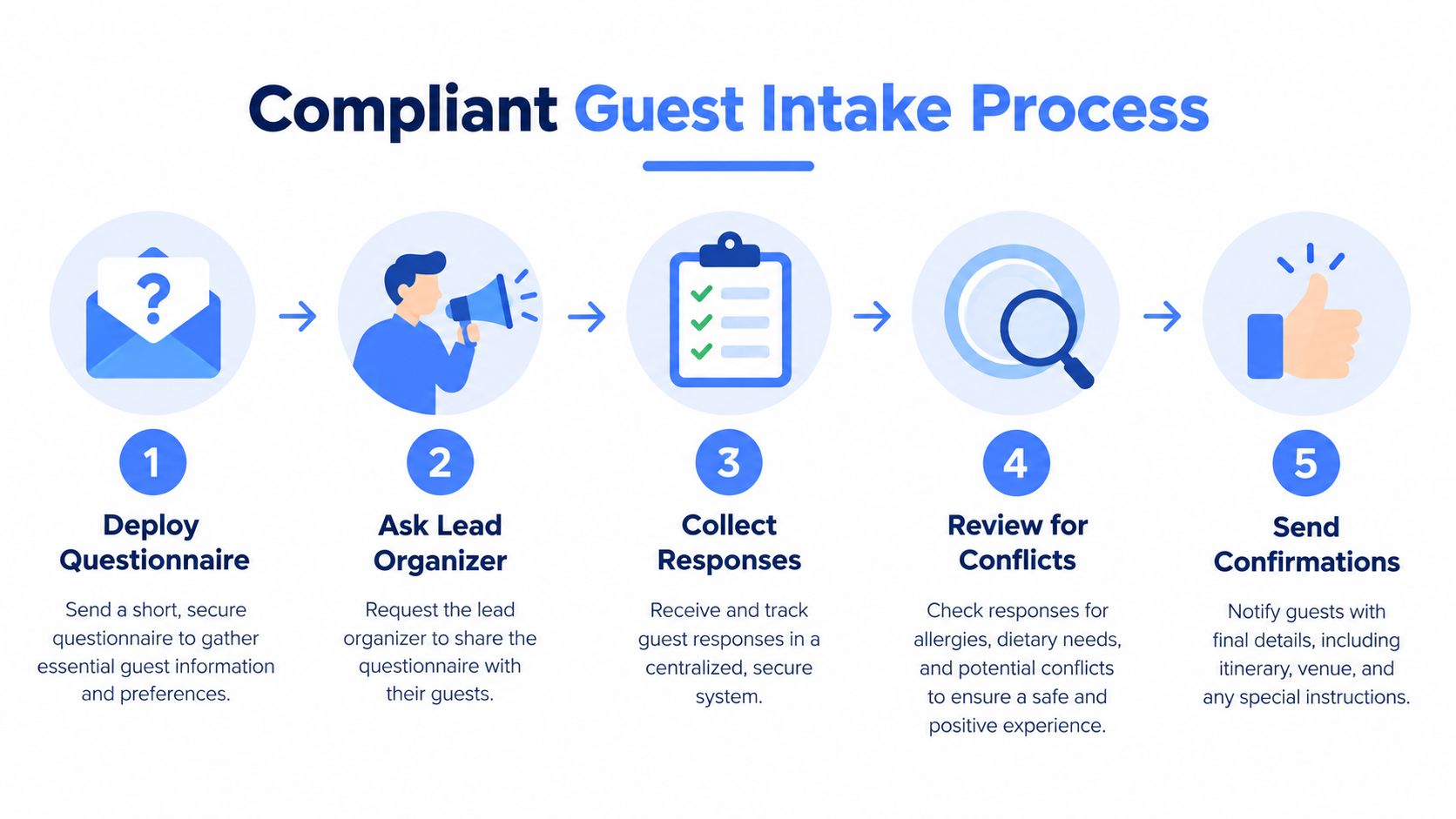
A workable intake process has two checkpoints.
| Stage | What you collect | Why it matters |
|---|---|---|
| Initial invitation | Guest attendance, menu choice if relevant, allergies, intolerances, dietary preferences, religious requirements, no-alcohol or no-pork notes | Gives the kitchen and events team an early planning picture |
| Final details stage | Confirmation of guest name, dish choice and dietary notes | Catches changes before reports and place settings are finalised |
UK guidance is clear that allergen information should be available for each non-prepacked food item, not treated as one generic notice for the function. For events, that means collecting the guest's name, dish choice, and every relevant allergen or requirement in a structured form, then reconciling it against recipe-level allergen information. The operational guidance is in the government's allergen guidance for food businesses.
A solid planning rhythm helps. If you're building your wider event schedule, this event planning timeline is a useful reminder that dietary capture has to happen well before seating plans and final menu lock.
The wording that gets better answers
Most poor data starts with poor wording. “Any dietary requirements?” is too vague. Guests lump allergies, preferences and dislikes into one field, and staff then have to interpret the risk level.
Use wording that forces a distinction. This is the version I'd put in front of guests:
Please tell us about any food allergies, intolerances or dietary requirements for each guest.
Medical allergy or intolerance: Please list the ingredient and any important detail we should know.
Dietary preference: vegetarian, vegan, halal, kosher, no pork, no alcohol or similar.
Other requirement: Please use the box below for anything not covered above, including less common ingredients such as tomato, mushroom, chilli, pineapple or kiwi.Please complete this for each named guest. If anything changes after you reply, tell us in writing as soon as possible.
That wording does three useful things.
- It separates risk from preference so the team knows what can be handled as a menu choice and what needs stricter control.
- It prompts uncommon ingredients that won't appear in standard tick boxes.
- It puts the update duty in writing so nobody assumes one reply is final forever.
What works better than a simple RSVP tick-box
A simple RSVP card or one-line email can work for a very small private dinner. It's weak for a wedding, banquet or corporate function with multiple courses and service handoffs.
Use this field structure instead:
- Named guest field so the requirement isn't tied only to the organiser
- Dish choice field where plated options are being selected
- Medical allergy field for allergy-critical information
- Intolerance field for non-allergy exclusions
- Preference field for vegetarian, vegan and similar
- Free-text other field for edge cases and detail
- Written confirmation field where guests confirm the information is correct
If you want the meal-choice side of that process laid out cleanly, this guide on collecting pre-orders for group bookings is a good operational companion.
Managing Reconciliations and Day of Service Execution
At 11:30 on the morning of a 180-guest wedding, the organiser forwards three last-minute messages. One guest has swapped from fish to the vegan main. One says they are "gluten-free and dairy-free". One says they have a severe nut allergy and need the kitchen informed. Those are not the same type of change, and treating them as one admin task is how service errors happen.
Reconciliations are the point where preference management ends and risk control starts. A guest choosing vegetarian is a menu allocation issue. A guest declaring an allergen is a safety issue that has to flow through kitchen prep, plating, service briefing and substitution control.
Chasing non-responders without creating chaos
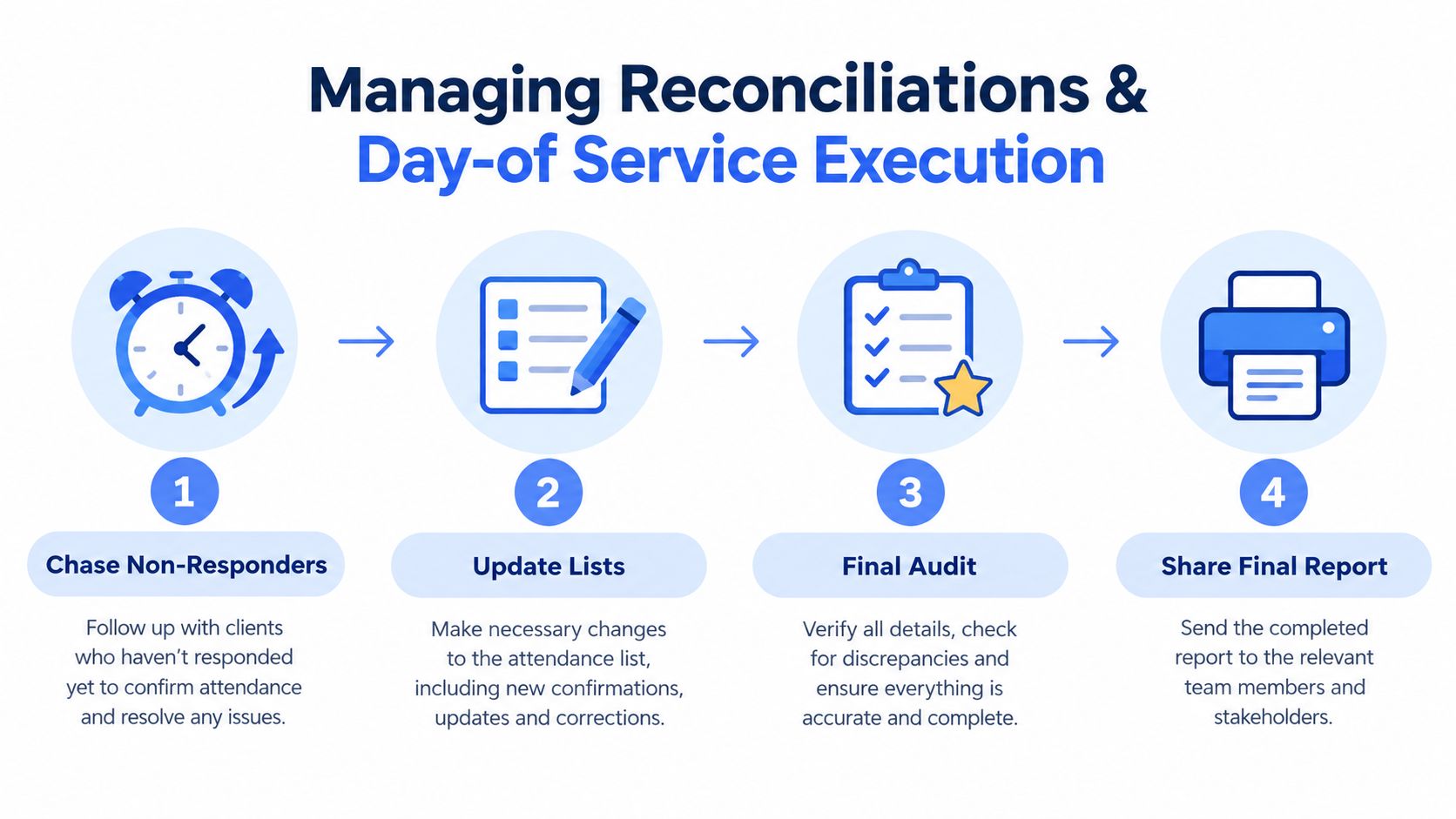
The cleanest process is a staged close-down, with written cutoffs and no guessing.
First chase after the reply deadline
Send a direct written reminder to each non-responder.Second chase before final numbers go to the kitchen
Ask for either full dietary details or written confirmation that none have been provided.Organiser escalation for the final few
Use the organiser to reach stragglers, but keep the named guest as the intended source wherever possible.Close the file and record the gap properly
Mark "no information received" if a guest still has not replied. Do not convert silence into "no dietary requirements".
One missing form is an annoyance. Fifteen missing forms can force the kitchen into assumption-based prep, and that is where avoidable risk creeps in.
Change control has to be just as disciplined. If a guest moves table, changes dish, or is added after the first reconciliation, the dietary record must follow the person across every live document. That means chef sheets, pass sheets, table plans and place cards all need the same final version. Teams that rely on separate spreadsheets and handwritten updates usually lose accuracy here.
A practical way to keep that aligned is to review your key event reports for hotels and venues against the actual handoff points between events, kitchen and front of house.
For teams that want to see a short walkthrough, this video covers the reporting and handoff side clearly.
What the kitchen and floor actually need
Service teams do not need a pile of email screenshots. They need one current operating version.
Issue at least four outputs:
Chef report
Named guest, course, chosen dish, declared allergen or dietary requirement, and any approved alternative.Food pass sheet
Total dish counts plus named exception plates, so the pass can check each special meal before it leaves.Front of house report
Table-by-table service list with guest names, dish allocation and delivery notes staff can act on quickly.Place card or seating cue
A discreet identifier that helps the right plate reach the right guest without announcing private medical information in the room.
Keep allergen risk visible but controlled. Front of house needs enough information to serve safely. They do not need vague notes, old versions, or verbal messages passed across a busy pass.
Buffets, substitutions and audit trail
Buffets create a common failure point because teams assume choice solves the problem. It does not. Guests still need accurate item-level allergen information, and staff still need to know which requests are preferences and which involve a medically significant risk. A buffet sign that says "please ask about allergens" does not rescue poor internal control if the dishes on the table have changed since the last print run.
Substitutions need a hard rule. No day-of swap for an allergen-affected guest should be approved until the chef has confirmed the replacement dish and the service team is working from the updated written version. Verbal assurances are weak under pressure.
Keep the audit trail. Save the original guest response, every later amendment, the final reconciled report, and the version issued on the day. If there is a complaint, an incident, or a dispute about what was disclosed, that record is what shows whether the venue captured the information properly and passed it through the operation correctly.
Scaling Operations with Automated Event Software
Manual systems can work for a small private dinner where one coordinator knows every guest by name. They start to fall apart when you're running multiple weddings, festive parties, awards dinners, or large functions at the same time.
That's the reality behind the trend most operators are already seeing. Dietary volumes have roughly doubled in the last ten years and are highest in London, so the old method of chasing notes by email and tidying them into a spreadsheet becomes fragile very quickly. It isn't that spreadsheets are useless. It's that they aren't built to keep guest-by-guest dietary data aligned with menu logic, seating moves, kitchen paperwork and reminder workflows at scale.
What automation fixes
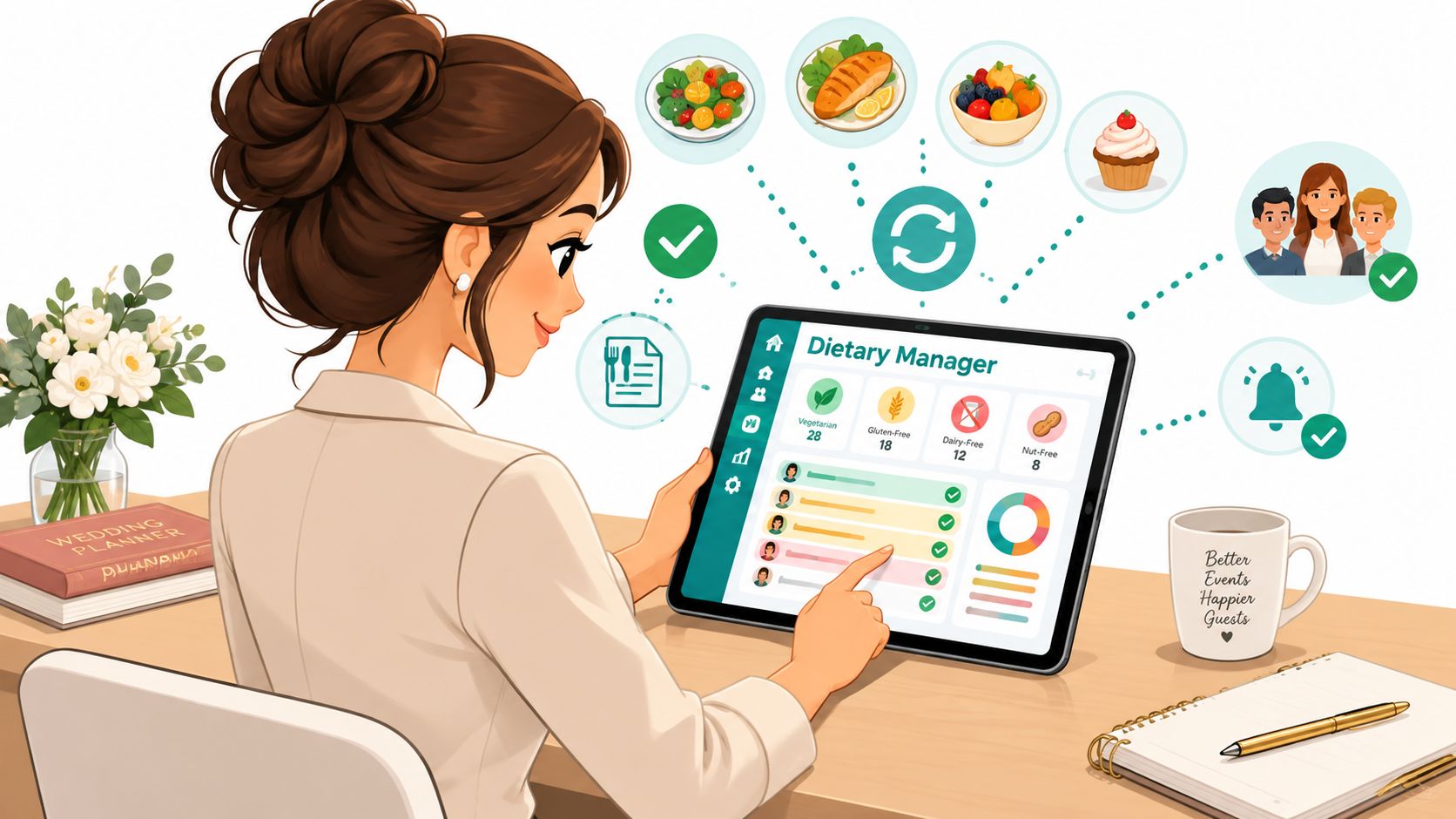
A proper hospitality workflow does the following without relying on staff to copy and re-copy data:
- Sends venue-branded invitations to each guest once a booking is confirmed
- Collects allergies and dietaries directly from the guest, not second-hand through the organiser
- Filters menu choices against declared allergens so guests are only offered dishes they can safely eat
- Creates custom dishes for severe cases when no standard option is suitable
- Pushes those choices into every downstream report so the kitchen, food pass and front of house are reading from the same record
Software built for hospitality earns its keep. Creventa, founded in June 2020 by Luke Ireland and Andrew Norton, centralises pre-orders, allergens, seating, place cards and reports, and it can also handle enquiries and proposals through CreventaFlow, guest order-and-pay journeys through Prinq, plus post-event feedback and guest insights. For venues handling weddings and functions, the practical point is simpler than the feature list. One system should hold the guest, the dish, the dietary note and the final service output in the same place.
The response rate and reminder problem
The guest experience matters more than is often realized. If forms are clunky, response rates drop and staff spend their week chasing basic information.
Creventa reports a 99.2% guest response rate to pre-order invitations, supports events from 4 to 2,500+ guests, and uses three automated reminders at invite, 7 days out and 2 days out. That reminder rhythm matters because it reduces the classic final-week scramble.
Real venue groups including Malmaison and Hotel du Vin, Wolseley Hospitality Group and Mercure Tunbridge Wells use these workflows to move away from fragmented emails and spreadsheets. Setup typically takes a couple of days, which matters for operators who don't have months to rebuild process.
You can see the wedding-specific workflow here: wedding pre-order system for venues.
Better compliance usually means better margins too
Operators often buy into dietary process for safety reasons first, then realise the planning gains are just as valuable.
Creventa reports roughly 20 percent less food waste from accurate pre-ordering. A Holiday Inn hotel using Creventa reported 251% wet spend uplift from drink pre-orders. The platform also reports over 2 million festive dishes ordered through Creventa at Christmas 2025. Those numbers aren't just sales metrics. They show what happens when the guest answers are complete, early and tied directly to production.
The legal side matters too. The Food Standards Agency says mandatory allergen information must be available to the customer before the purchase is concluded, and it must be provided for free. That principle is especially relevant for advance meal selection and pre-ordering around weddings and functions, and it's set out in the FSA's distance selling allergen guidance.
Final Verification and Service Readiness
At 48 hours out, the risk shifts. Guest intake should already be done. The job now is to confirm that every allergen instruction, meal choice and service note matches the version the kitchen and floor team will use.
This is the point where venues get caught out. A vegetarian preference can usually be recovered with a late adjustment. A peanut allergy, coeliac requirement or severe dairy allergy cannot be treated as a casual note on a spreadsheet. If the team is still relying on free-text emails, marked-up PDFs or two different seating plans, service is running on memory instead of control.
Run a short readiness audit against the live event file.
The 48-hour check
Guest record check
Every named guest with a dietary requirement is tied to a final dish, not just a category label.Allergen risk check
Any guest marked with an allergen has a clear service instruction, and any unresolved item is escalated before prep starts.Menu change check
Any revised recipe, garnish or substitute has been checked against the latest guest record.Kitchen issue check
Chef notes are current, readable and closed out. No open free-text queries remain for service day.Floor briefing check
Front of house knows who is receiving special meals, how those meals will be identified, and who to ask if a guest challenges a plate at the table.Document check
Place cards, pass sheets, seating plans and the event pack all match the same final data set.
The legal standard matters here, but so does the operational one. Teams need to distinguish between preference and risk. "No mushrooms" is a menu preference. "Nut allergy" is a safety control. If those sit in the same format with the same visual weight, mistakes happen fast during a busy plated service.
One document usually decides whether the process holds up under pressure. The function sheet. It needs to connect the client promise, the final guest list, the kitchen plan and the service briefing in one version the team trusts. If your packs still leave room for interpretation, this guide to what a function sheet is in hospitality is a useful reference point.
The safest events are the ones where the final check is strict, boring and documented. No guesswork. No verbal-only handoffs. No allergy information living in someone's inbox.
Creventa gives venues a practical way to run this workflow in one place, from guest invitations and dietary capture through to seating, chef reports, place cards and post-event follow-up. If you want a cleaner process for weddings and functions without relying on spreadsheets and inboxes, visit Creventa.
Andrew Norton, Founder, Creventa. Andrew founded Creventa after years working with hospitality venues on the admin gap between a confirmed booking and event day.