At 8:30am on a major society day, the club office is already behind. Tee-time changes sit in one spreadsheet, player balances in another, dietary requests are buried in email, and the wedding coordinator is chasing a final table plan while the kitchen asks which guest count is correct. Everyone is working, but nobody is looking at the same event record.
That's the operational case for event management software for golf clubs. A golf club isn't just a venue with a booking calendar. It runs competitions, tee sheets, weddings, corporate golf days, member socials and food service, often with the same rooms, staff and facilities. A practical overview of event management for golf clubs shows why those workflows need to connect rather than live in separate inboxes.
Marketing teams also need clean operational data before they can promote events effectively. A resource such as MapLeads for marketing agencies is useful context for understanding how better lead information supports campaigns, but the club still needs its event system to turn an enquiry into a delivered function.
Table of Contents
- Why Golf Clubs Are Rethinking Event Operations
- What Event Management Software for Golf Clubs Actually Does
- Five Event Types Every Club Software Must Handle
- Must-Have Features for Club Event Software
- Benefits and ROI Clubs Actually See
- Rolling Out Event Software Across Your Club
- Comparing Your Options Without Naming Names
- Questions to Ask Before You Sign Anything
Why Golf Clubs Are Rethinking Event Operations
Golf clubs are dealing with larger and more active member bases than many legacy processes were designed for. English golf club membership reached 737,021 affiliated members in 2022, up by 89,797 from 647,224 in February 2021, a 13.9% increase, according to Golfshake's membership analysis. That growth creates more society days, internal competitions, dining events, charity functions and member communications to coordinate.
The same source reported that, by 2024/25, 59% of surveyed members' clubs had more than 600 playing members, compared with 56% in 2023. At that scale, a spreadsheet can still hold information, but it struggles to control version history, permissions, payment status, dietary changes and operational ownership.
The club has more than one operation
A wedding may share a clubhouse with a competition. A corporate golf day may require breakfast before the first tee time, halfway refreshments, branded registration and a dinner service later that evening. The events team, golf operations, kitchen, finance staff and greenkeeping liaison each need different information, but they need that information to describe the same booking.
Email chains and paper forms create handoffs. Handoffs create re-keying. Re-keying creates the familiar failures, a missing allergen, a duplicate invoice, a stale guest count or a table plan that no longer matches the catering sheet.
Practical rule: If two departments maintain separate versions of the guest list, the club doesn't have control of the event.
The answer isn't another dashboard for its own sake. It's one event timeline that connects enquiry, booking, guests, payments, menus, seating, service instructions and post-event follow-up. The tee sheet can remain authoritative for course movements, while hospitality manages the function without rebuilding the same data elsewhere.
What Event Management Software for Golf Clubs Actually Does
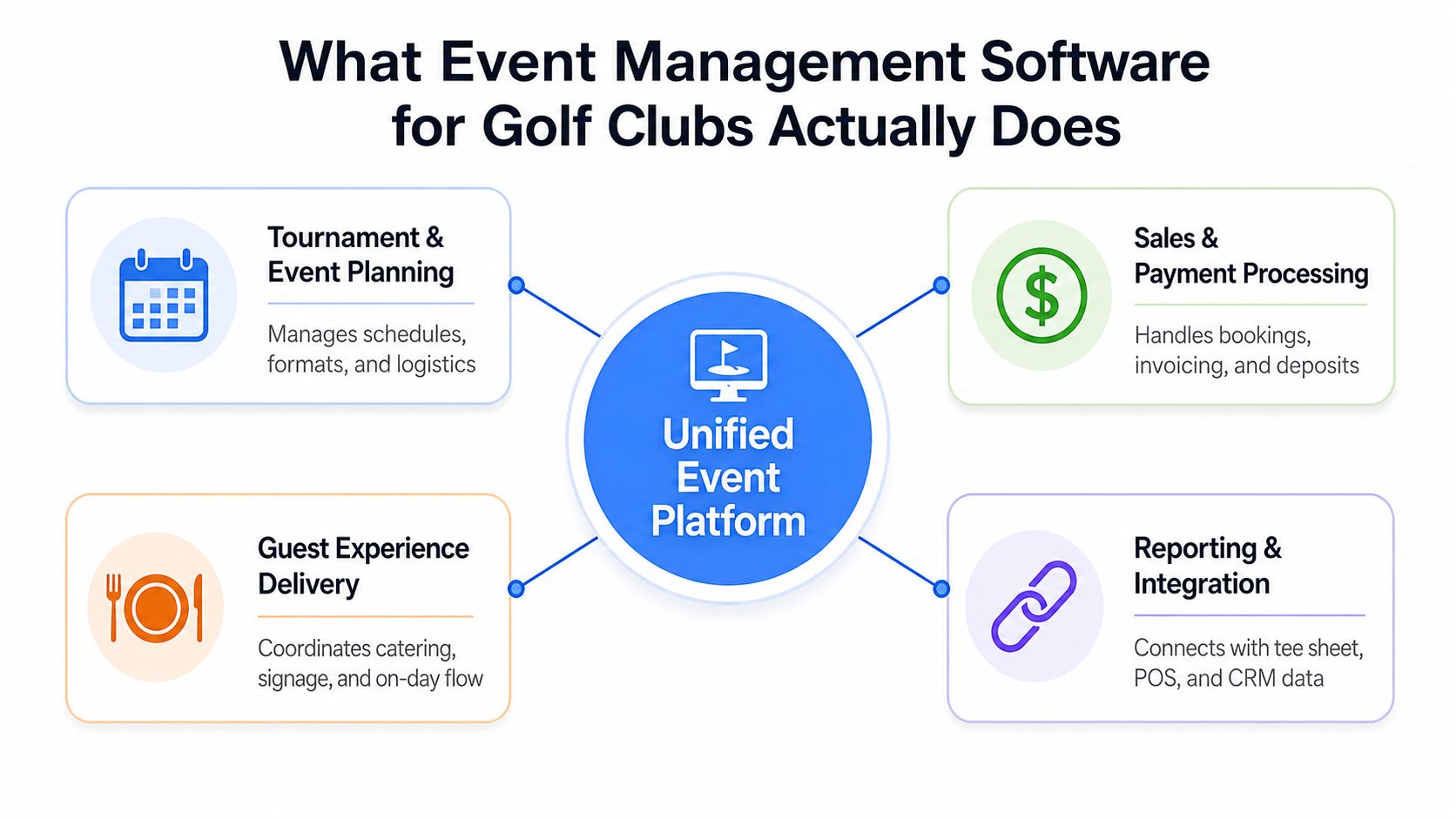
Event management software for golf clubs is a shared operating system for planning, selling and delivering events. It doesn't replace the tee sheet, EPOS or CRM. The tee sheet should continue to control course availability and player movements, EPOS should record food and drink transactions, and the CRM should preserve member relationships and commercial history.
The event layer connects those systems through a booking journey and a structured guest record. An enquiry can become a provisional booking, then an invitation, a paid registration, a menu selection, an allergen record, a table assignment, a final cover count and an invoice without staff copying the same details into several files.
Preserve system boundaries
Golf operations shouldn't have to manage wedding seating, and the kitchen shouldn't have to interpret competition notes from a general booking spreadsheet. Strong software gives each team an appropriate view while keeping management connected to the combined status.
That means:
- Golf operations: Course access, competition logistics, formats and player movements.
- Events and hospitality: Enquiries, proposals, menus, guest communication, seating and service timing.
- Finance: Deposits, balances, refunds, reconciliation and event-level reporting.
- Management: Capacity, revenue, attendance, outstanding tasks and operational risk.
The demonstration standard is simple. Ask the supplier to follow one real event from the first enquiry through to final reconciliation. A feature list can look impressive while the full workflow still depends on exports, emails and manual corrections. Teams comparing broader corporate event technology solutions should apply the same test, then judge whether the system understands the particular overlap between golf and hospitality.
A connected approach gives the club one event record, one guest list and one operational source of truth. That's what the event management platform should deliver, not a collection of attractive screens that leave staff to complete the difficult work manually.
Five Event Types Every Club Software Must Handle
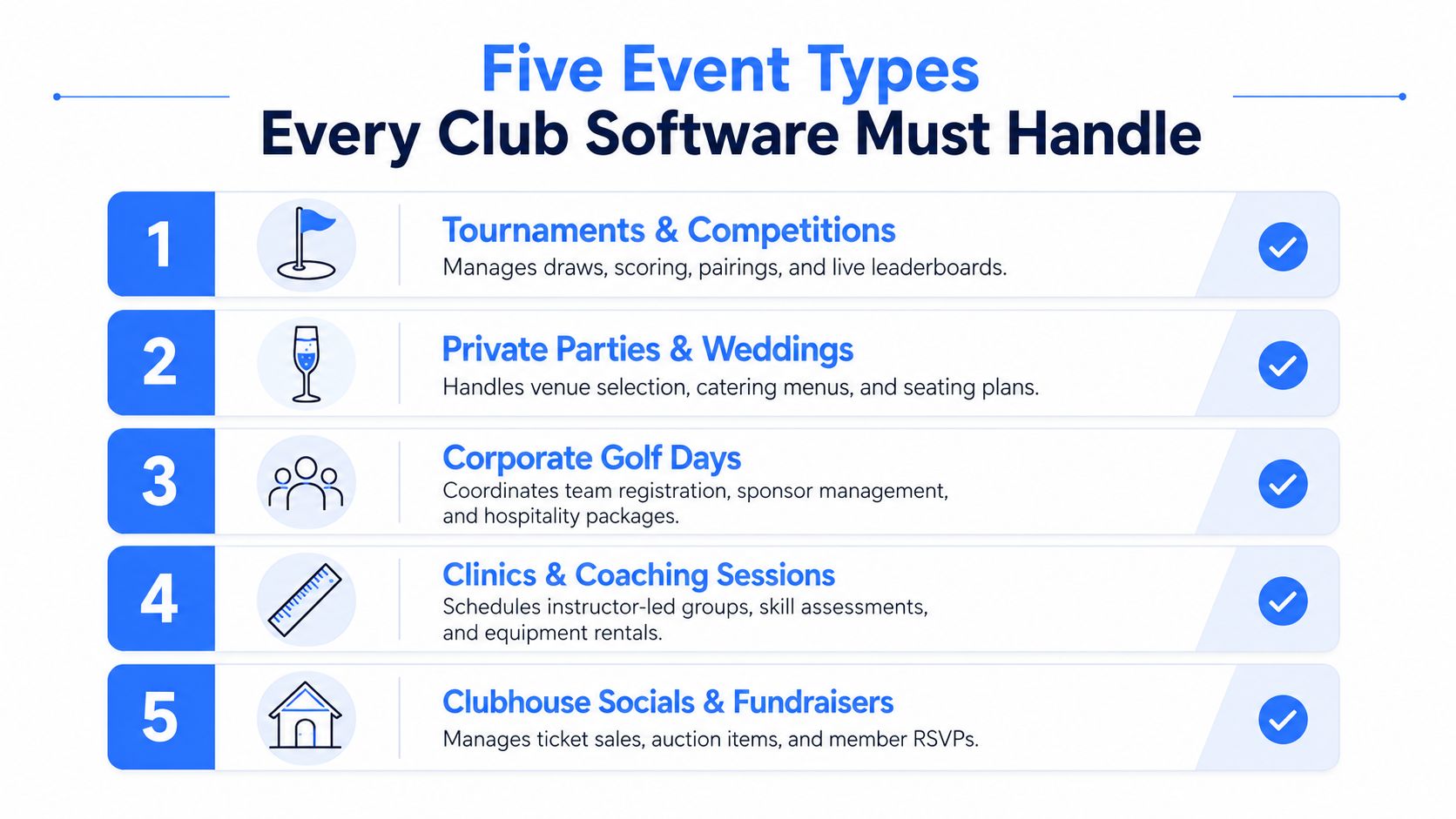
The software earns its place by handling different events without forcing staff to flatten every booking into the same ticketing template. A tournament, wedding, corporate day, member dinner and F&B service share data, but their rules and deadlines differ.
Tournaments and society days
A society day needs online entry, individual or team ticket types, membership or handicap validation, payments, tee-time coordination and competition reporting. The organiser may buy a package centrally, while the club still needs every player's name, contact details and catering choices.
The event record should connect the player list to the competition schedule without making the golf team maintain a second hospitality register. If the organiser changes a team, the update should reach the relevant operational views rather than requiring several follow-up emails.
Weddings and private functions
Weddings expose weak systems quickly. The venue enquiry leads to a viewing, a proposal, a deposit, menu decisions, guest-list changes, table planning, supplier deadlines and a final billing summary.
Dietary responses must be captured as structured guest data. A note reading “vegetarian, maybe” in an email isn't an operational control. The kitchen needs a clear, current record of the guest requirement and the service team needs it connected to the correct place setting.
Corporate golf days
A corporate day may combine branded registration, sponsorship inventory, package payments, team allocation, room hire, breakfast, halfway refreshments and dinner. The company contact often pays centrally, but individual delegates still need to submit names, menu choices and dietary information.
The system should separate the commercial purchaser from the event guest. That distinction prevents the finance record from becoming confused with the operational guest list.
Member events
Member events have their own rules around eligibility, guest permissions, capacity and communication. A captain's charity dinner, quiz night, coaching session or seasonal function may require member status checks, personalised invitations and a clear RSVP deadline.
The club's membership history should inform the event journey without forcing staff to retype known information. New members also need consistent onboarding communications, especially as clubs welcomed an average of 94 new members in 2023, while only 24% of members' clubs reported more leavers than joiners in the 2023/24 survey covered by The Golf Business.
Food and beverage service
F&B is where an event booking becomes a real operational commitment. Pre-orders, allergens, table plans, kitchen counts, stock requirements and payment status must remain tied to the same event.
The club should be able to generate kitchen-ready sheets, place cards and service reports from current guest data. That removes duplicate printouts and makes late changes visible to the people who need to act on them.
The volume matters. Members' clubs ran an average of 15 social events in 2024, while proprietary clubs averaged 8, according to the Hillier Hopkins 2024/25 UK golf clubs survey. This isn't occasional administration. It's a recurring operating workload.
Clubs refining their event proposition can also review proven strategies for golf clubs, particularly where marketing promises need to match what the events and F&B teams can deliver.
Must-Have Features for Club Event Software
Don't score vendors on the length of their feature list. Score them on whether staff can complete a booking without leaving the system to rebuild information elsewhere.
Seating and layouts
A proper seating planner must support banquet, theatre and cabaret layouts, not just a basic table grid. Staff should be able to arrange tables visually, record guest positions and export a PDF for client approval and venue use.
Good software also handles practical constraints, including access routes, service areas, top tables and shared parties. The marketing-line version says “drag and drop”. The useful version gives the front-of-house team a current plan that matches the place cards and catering information.
Pre-orders and allergen control
Pre-ordering should work per guest, not only per booking. A company organiser may purchase a package, but each delegate still needs to select a meal and record dietary requirements.
Allergen governance deserves particular attention in the UK. Government guidance for food businesses highlights allergen information, cross-contamination controls and good practice in handling allergens through the official allergen checklist. Software should produce clear records for the kitchen and service team, while the organiser agreement should still define menu scope, deadlines and responsibility for late changes.
Look for ingredient-level allergen flags, structured dietary tags, multi-choice menus and a kitchen-ready export. A generic notes field isn't enough.
Ticketing and check-in
Ticketing needs to reflect the club's access rules. Member-only dinners, society-day packages, public tournaments and charity events may each require different ticket types, capacity controls and eligibility checks.
Mobile-friendly registration and QR check-in reduce queues, but only if staff can see the booking, payment and guest status together. A check-in tool that doesn't update the event record is just another isolated list.
Payments and deposits
A payment link alone isn't an event payment workflow. The platform should support deposits, instalments, reminders, refunds, adjustments and PCI-compliant card capture.
Finance needs to know what has been paid, what remains due and which event or booking the transaction belongs to. The events team needs automated reminders without chasing every organiser manually.
Integrations
Integrations are the quiet dealbreaker. The system should read the tee sheet to identify conflicting bookings and connect event information with membership, EPOS and accounts processes. If staff still re-key names, amounts and menu selections, the club has bought another admin task.
Ask the supplier to show the actual data movement, not a logo wall. A club software features overview is a useful starting point, but the buying decision should rest on a live workflow test using the club's own event types.
Benefits and ROI Clubs Actually See
The finance case should focus on operational outcomes, not vanity metrics. Time saved matters, but so do fewer errors, cleaner reconciliation, controlled food production and faster responses from guests.
Creventa reports a 251% wet spend uplift from drink pre-orders, reported by a Holiday Inn hotel using Creventa, and approximately 20% less food waste, reported by a global hotel chain. Creventa also reports over 2 million festive dishes ordered through its platform at Christmas 2025, events ranging from 4 to 2,500+ guests, and a 99.2% guest response rate to pre-order invitations. These figures are company-reported examples, so clubs should validate the relevant baseline and measurement method during procurement.
The practical improvement comes from moving decisions earlier. Confirmed meal choices help the kitchen plan. Automated reminders reduce unanswered invitations. A central payment record reduces reconciliation work. Post-event feedback and guest insights give managers evidence about what to repeat and what to remove.
The most useful year-one dashboard is small:
| Metric | Baseline with spreadsheets | Target with club software | How to measure |
|---|---|---|---|
| Coordinator administration | Manual copying across files | Fewer repetitive handoffs | Record preparation time by event |
| Food production accuracy | Estimates and late changes | Production against confirmed choices | Compare ordered covers with prepared covers |
| Payment collection | Manual chasing | Scheduled deposits and reminders | Track outstanding balances by due date |
| Guest response | Email replies and phone calls | Structured online responses | Measure invitations sent against completed responses |
| Event accuracy | Corrections on the day | Current guest, seating and dietary records | Log service incidents and late amendments |
For a direct explanation of the commercial role of pre-orders, see how pre-orders can increase event revenue. The point isn't to promise a fixed return. It's to measure the specific leakage the club currently accepts as normal.
Rolling Out Event Software Across Your Club
A club-wide rollout fails when the supplier configures a system in isolation and staff meet it for the first time on a busy event day. Give one person ownership, start with a limited pilot and make the team prove the workflow before expanding it.
Week 0 and week 1
Appoint one accountable owner, usually the events or hospitality manager. Lock the pilot around one upcoming wedding and one society day, then import usable guest history, configure the menu catalogue, add ingredients and allergen tags, and establish read access to the EPOS and tee sheet.
Don't let every department request customisation before anyone has used the core workflow. The pilot should expose where the existing process breaks.
Weeks 2 and 3
Run both pilot events live. Record every friction point in one shared document, including unclear permissions, missing reports, payment exceptions and kitchen requirements.
Freeze new customisation requests until the pilot review. Otherwise, the project turns into an endless attempt to reproduce every old spreadsheet habit.
Weeks 4 to 6
Refine the workflow, then train each role separately:
- Front of house: Check-in, seating, place cards and on-day changes.
- Kitchen: Menu data, allergens, quantities and service sheets.
- Finance: Deposits, refunds, reconciliation and reporting.
- Golf operations: Competition details, tee-sheet conflicts and player movements.
- Management: Event status, performance reporting and escalation.
Go live with weddings and corporate days first, then member events and society packages. Brief the membership committee, update enquiry templates and hold a weekly 30-minute stand-up until the first full quarter closes cleanly.
Comparing Your Options Without Naming Names
The right comparison is operational, not cosmetic. Score each route against tee-sheet awareness, dietary controls, member data, payment timing and the day-of-event run sheet.
| Approach | Tee-sheet awareness | Dietary and allergen tracking | Member CRM sync | Payment speed | Typical cost |
|---|---|---|---|---|---|
| Spreadsheets and email | Manual and fragile | Notes and attachments | Manual exports | Manual chasing | Low licence cost, high staff effort |
| Generic event tools | Usually limited | Often form-based | Depends on configuration | Basic links or separate workflows | Moderate subscription and integration effort |
| Bespoke build | Can be designed | Can be designed | Can be designed | Can be designed | High build and maintenance burden |
| Hospitality-built platform | Designed around venue constraints | Structured guest-level records | Usually connected through integrations | Deposits, reminders and reconciliation workflows | Subscription plus implementation |
Spreadsheets buckle when several people edit the same event, especially once guest counts, table plans and dietary details change repeatedly. Generic event tools may handle registration well but miss the relationship between a competition, a clubhouse function and a kitchen production sheet.
Bespoke development looks attractive when the club has unusual rules. It also creates ownership, testing, upgrade and support responsibilities that many clubs underestimate. Platforms built by hospitality specialists tend to fit the service workflow more closely, but the club still needs to test integration depth and data ownership.
Use this event software alternatives guide to structure the conversation. The winner is the route that removes the most re-keying without forcing the club to abandon its established golf systems.
Questions to Ask Before You Sign Anything
Put these questions directly to the salesperson:
- How are tee-sheet conflicts identified before a booking is confirmed?
- Can allergen data reach the kitchen in a clear operational export?
- What happens when a guest pays a deposit and changes a menu choice?
- Who owns the club's member and guest data if the contract ends?
- How do payments reconcile with the club's EPOS and finance process?
- Can reports separate weddings, society days, corporate events and member functions?
- What will the implementation team configure during the first week?
- What support response can the club expect during a live event?
- What is the full cost, including implementation and payment processing?
- Is pricing public and transparent, or does every answer require another sales call?
A vague answer is a procurement signal. Ask for the workflow in writing, request a demonstration using one of your actual events and make the supplier show the kitchen, finance and golf-operations views, not only the organiser-facing screen.
Creventa brings enquiries, proposals, pre-orders, allergens, seating, payments, ticketing, communications and reporting into one hospitality-focused event workflow for golf clubs. Visit Creventa to review its public, transparent pricing and see how the platform can support your club's next wedding, society day or corporate function.
Jake Crimmin, Hospitality Events Specialist, Creventa. Jake works with hotels and venues on event operations, focusing on how pre-orders and allergen data flow from the guest through to the kitchen.