The first sign your venue pipeline is drifting is usually ordinary chaos. An enquiry lands by email, someone else forwards a WhatsApp message, a planner rings reception, and the Instagram DM never quite makes it into the same place as the website form. By the time sales checks the spreadsheet, one lead has been duplicated, another has no next step, and a third is sitting in an inbox waiting for someone to remember it.
That's the problem with spreadsheet-led event sales. The sheet looks organised until you need speed, ownership, and a clear handover between sales, operations, kitchen, and finance. Industry guidance for event sales management recommends keeping every lead in one system with standard fields, because that removes the emailed-around spreadsheet problem and gives the team live visibility across the pipeline. For a practical view on where AI-driven workflow support is already heading, AI automation examples for 2026 is a useful external read alongside the operational changes venues are already making. For a broader hospitality operations lens, streamlining operations and minimising errors in hospitality shows why centralising process beats scattered admin.
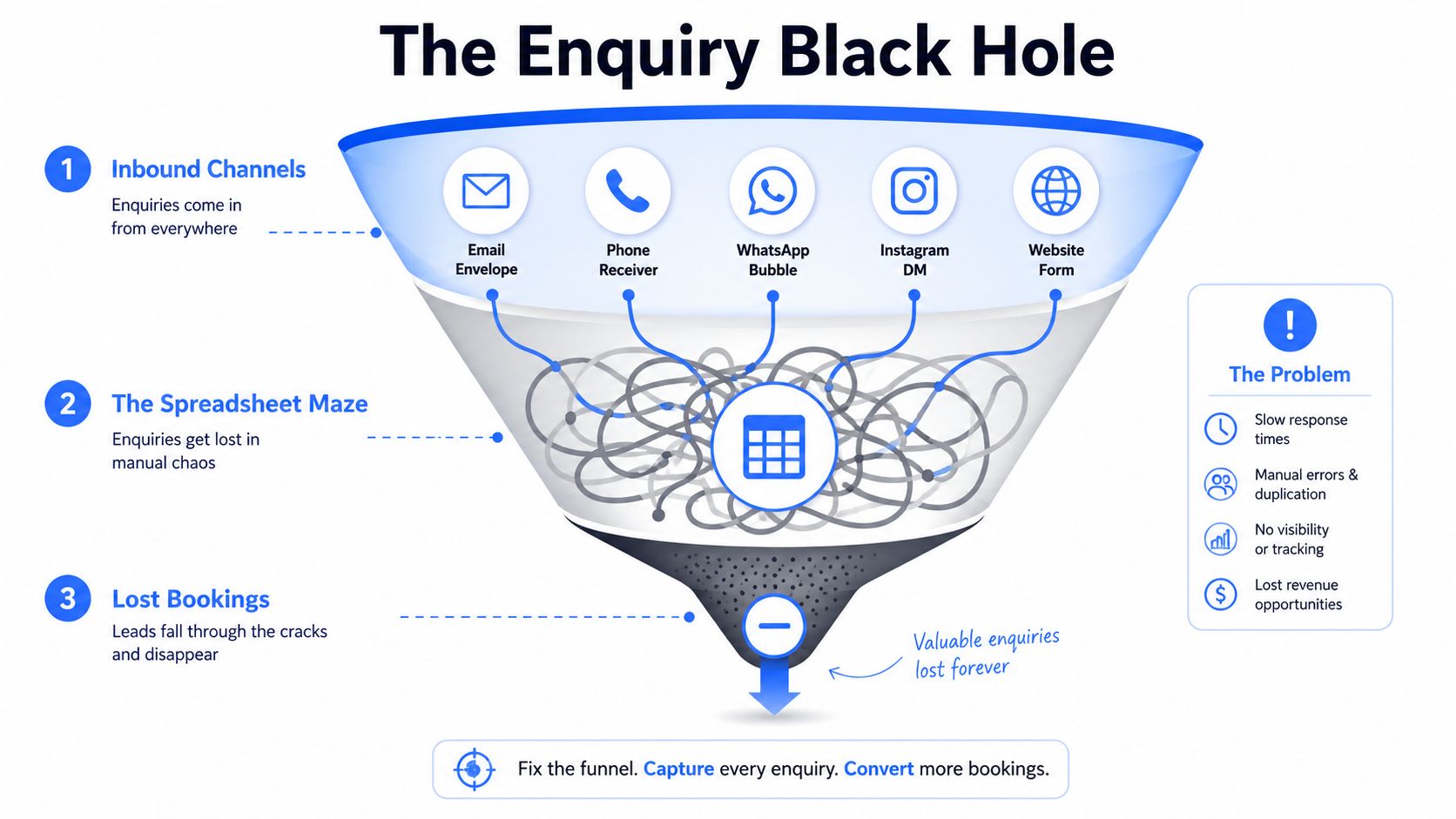
Table of Contents
- Why Spreadsheets Keep Costing Venue Teams Bookings
- Defining the Pipeline Stages That Match How Venues Actually Sell
- Capturing Every Enquiry in One Consistent Format
- Automating Follow-Ups, Deposits and Check-Ins
- Connecting the Pipeline to a Live Function Diary
- Reporting on Conversion, Pace and Average Deal Value
- Migrating from Spreadsheets and Standing Up the New Workflow
Why Spreadsheets Keep Costing Venue Teams Bookings
The trouble starts the moment enquiries arrive faster than humans can reconcile them. A wedding planner emails, a corporate booker calls back after lunch, someone else sends a WhatsApp voice note, and a colleague says, “I've got it” without logging it anywhere. A spreadsheet can record the result, but it can't reliably manage the moment of capture, ownership, or timing.
The hidden losses are usually handover losses
Spreadsheets fail in venues because the pipeline isn't linear. Sales might update a row, but operations still work from yesterday's version, finance waits for deposit status, and front of house never sees the revised guest count. That fragmentation is why a centralised CRM-style workflow matters, with one record per lead and visible fields for event date, attendance status, account type, interaction summary, owner, and next step, as recommended in venue pipeline guidance from BoomPop.
Practical rule: if a lead needs more than one person to remember it, it needs one system, not a shared file.
The other spreadsheet problem is that it encourages passive ownership. Rows sit there until someone decides to update them. Venue sales doesn't work like that, because deposits expire, planners compare options quickly, and a deal can cool off while nobody notices.
Why this becomes revenue leakage, not admin inconvenience
Manual tracking is slow at exactly the points where speed matters most. Industry guidance on venue sales automation says no-shows can cost a rep up to 5% of weekly income for each missed appointment Planning Pod, which is a good reminder that missed follow-up is not just messy, it's expensive. The same source also recommends a simple cadence of reminders before calls and site visits, which spreadsheets can't push on their own.
That's why the fix isn't a prettier spreadsheet. It's a live pipeline where every enquiry has one owner, one status, one next action, and one place to check before the day gets away from you. The rest of this article is the practical version of that shift.
Defining the Pipeline Stages That Match How Venues Actually Sell
The quickest way to tidy venue sales is to stop relying on vague labels. “Waiting,” “proposal sent,” and “follow up later” all sound harmless, but they blur the buying journey and make forecast data hard to trust. A better structure starts with an action you can see, then moves the deal only when that action has happened.
A seven-stage structure that maps to real venue behaviour
A workable venue pipeline usually starts with New Enquiry, then moves through Site Visit, Proposal Sent, Negotiation, Deposit Pending, Confirmed, and Post-Event. That sequence follows how a booking normally progresses, from first contact through to delivery, without forcing every event into the same shape. It also matches Rework's pipeline stage guidance, which recommends mapping the buyer journey first, defining stage entry and exit criteria as observable facts, and checking the model against past deals before rollout.
The simplest test is whether each stage answers a yes-or-no question.
- New Enquiry: Has the lead been captured with enough detail to qualify?
- Site Visit: Has the planner attended or confirmed a walkthrough?
- Proposal Sent: Has the venue issued a proposal the buyer can review?
- Negotiation: Are terms, menu, space, or timings still being adjusted?
- Deposit Pending: Has the client accepted in principle, but payment is still outstanding?
- Confirmed: Has the deposit been received and the terms been signed?
- Post-Event: Has the event happened and the follow-up process begun?
A deal should never move because somebody feels optimistic on a call. It should move because the buyer took a visible step.
Calibrate the structure before you launch it
Do not add extra stages just to mirror old spreadsheet columns. If one column says “proposal sent,” another says “quote with client,” and a third says “waiting,” that is not a pipeline, it is a filing cabinet. The stage count should stay close to the way venue deals move, and the win chances should be reviewed regularly so the pipeline reflects how different event types and seasons behave.
Once the stages are simplified, map the old spreadsheet rows into the new structure. Anything that does not meet the exit criteria stays where it is until it does. That discipline is what makes conversion data usable, because it stops teams from marking a booking as further along than it really is.
Capturing Every Enquiry in One Consistent Format
The front door matters more than many teams admit. If one enquiry arrives with a full event brief and another comes in as “Need a room for 80 in June,” you do not really have two leads, you have one usable record and one guess. The fix is a single intake format that every channel feeds into, even when some fields are filled in later.
Build the same baseline every time
Every enquiry should enter the pipeline with the same core data so the team can compare opportunities properly. That usually means event date, approximate guest count, budget range, preferred space, dietary or allergen notes, decision timeline, and source. For venue-specific selling, I would also include hold date, multi-room requirement, and whether the enquiry is corporate, wedding, or private social, because those details change both the proposal and the handover.
If existing enquiry handling is already fragmented, compare it with the workflow described in this enquiry-to-menu intake alternative, then reduce it to the fields needed for sales control.
Get every channel into one capture point
The channel does not matter. The system does. Website forms should feed straight into the same record structure, email enquiries should be logged into the same template, phone calls should be entered immediately after the conversation, and social messages should be copied in before the lead goes cold. Sales guidance also points to logging new lead data quickly, and Hoy Vendemos recommends registering it within 2 hours, which is a sensible service-level target for venue teams too.
A good habit is to separate the intake question from the qualification work.
Capture first. Perfect later. If the lead is not logged, it cannot be followed up.
That matters because event sales usually involves several people. Sales needs the brief, operations needs the space requirement, kitchen needs dietary context, and finance needs to know whether a deposit discussion is approaching. A single intake form stops those details from being rebuilt from memory every time a manager asks for an update. It also reduces the handover errors that lead to lost enquiries between email and WhatsApp, proposals built from partial notes, and deposits that sit in inboxes instead of moving the deal forward.
Automating Follow-Ups, Deposits and Check-Ins
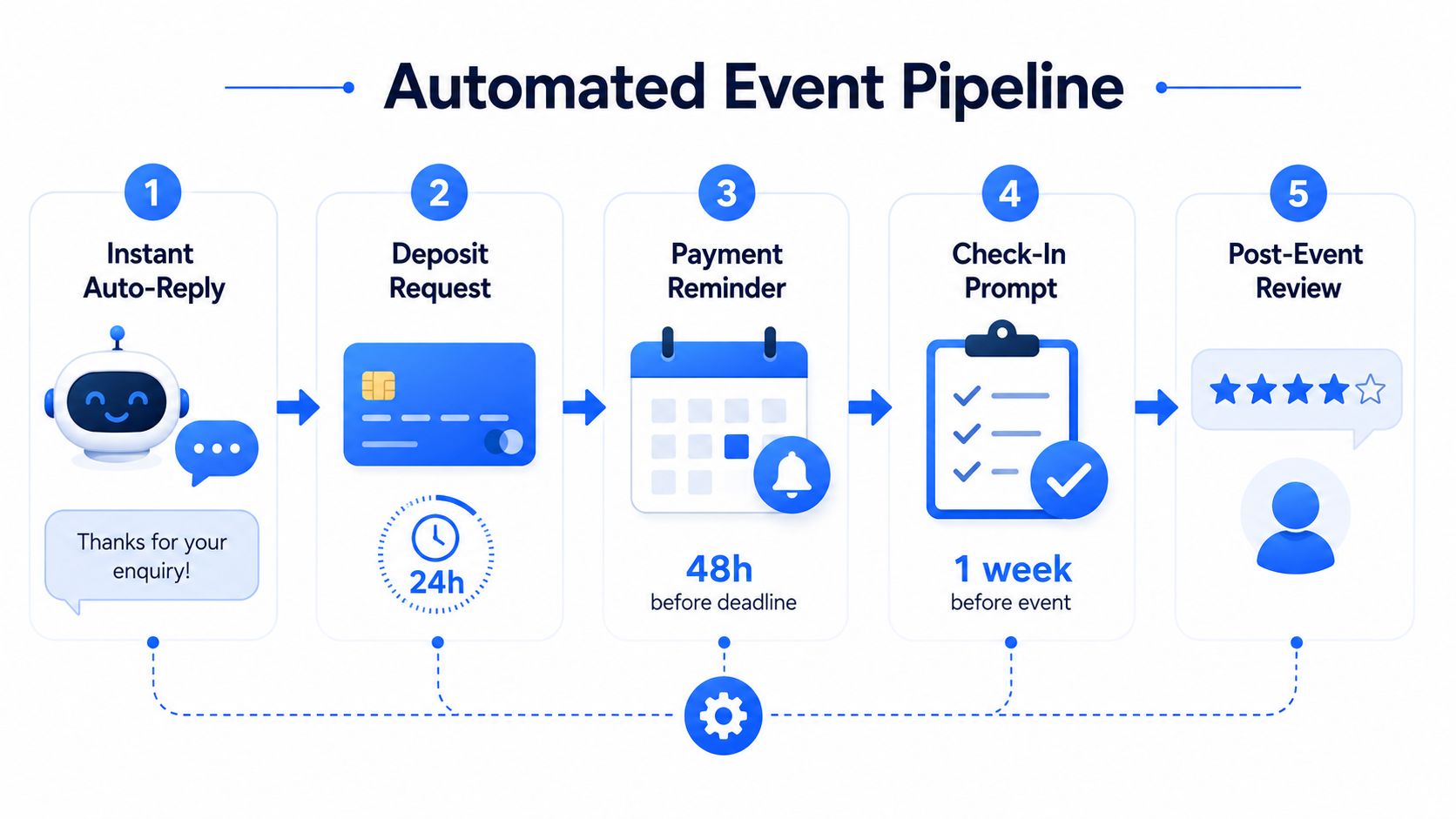
Automation is where the pipeline starts paying back the admin it removes. A spreadsheet can list tasks, but it can't reliably send the reminder, pause the sequence when the planner replies, or trigger a deposit message the moment terms are accepted. That gap is exactly where venue revenue leaks away.
The cadence that stops leads from going stale
The most reliable sequence starts with an immediate acknowledgement, followed by a qualification follow-up, then a proposal reminder, a deposit prompt, and finally event-day check-ins. Venue email workflows commonly use a three-touch reminder pattern, an immediate confirmation after booking, a reminder 48 hours before the event, and a final message on the morning of the reservation Team Connect. That pattern works because it keeps the booking warm without needing manual chasing.
Industry guidance on venue sales automation also recommends automated reminders 1 day, 6 hours, and 1 hour before a call or site visit, plus rapid re-contact within 20 minutes after a no-show Planning Pod. For qualification and proposal management, another useful benchmark is to follow up in under 24 hours during qualification, within 48 hours during proposal, and within 72 hours at close, with daily and weekly reviews of activity and stuck opportunities Hoy Vendemos.
Keep the message human, not robotic
Templates work when they sound like a capable coordinator wrote them. That means short subject lines, a clear next action, and a reason for the message. If a planner replies, the automation should pause immediately so the team doesn't send a reminder to someone who already answered.
For deposits, the cleanest approach is to link the request to the moment the buyer accepts the proposal, then send a payment link rather than asking finance to chase by email. If the payment is tied to the booking record, the deposit status updates the pipeline as soon as money lands. That saves time for finance and removes the awkward “just checking whether you saw my last email” routine from sales.
A wedding enquiry is the classic test case. The couple asks for a Saturday date, the venue responds once, and then the thread goes quiet for a week because someone is on leave. With a basic automation sequence, the enquiry gets acknowledged, the qualification follow-up lands on time, the proposal reminder goes out if nothing happens, and the deposit request is triggered the moment terms are accepted. That's the difference between a stalled thread and a live booking path.
For a deeper look at how venues remove recurring admin from event workflows, this guide on reducing admin time for weddings and events at hotels is worth a read.
Connecting the Pipeline to a Live Function Diary
A pipeline that never updates the diary leaves the venue guessing. Sales may think a date is being held, while operations still sees it as open, and kitchen only hears about the booking after the room has already been spoken for. That is how venues end up selling promises instead of real availability. The function diary turns pipeline status into the working record the whole site relies on.
Use one shared view for holds and confirmations
The diary should show soft holds, deposit pending bookings, and confirmed events in one place. Then everyone can see which dates are under pressure, which rooms are close to being committed, and which bookings still need payment before they are safe to lock. Creventa Flow links enquiry stages directly to availability, so the team works from one live view instead of a separate sales list and operations diary.
A practical handover follows a clear chain.
- Proposal Sent to Deposit Pending: place a soft hold with an expiry date.
- Deposit Pending to Confirmed: lock the slot and trigger downstream prep.
- Confirmed to Post-Event: hand the record to delivery, guest management, and reconciliation.
Hold expiry needs to be defined. Without it, the diary fills with ghost bookings that block genuine demand. Confirmed events need to be locked properly as well, because otherwise two teams can assume they own the same space. Once you are handling weekends, private dining, or multi-room functions, both mistakes become expensive very quickly.
Keep sales, kitchen and operations looking at the same truth
The diary should not be a spreadsheet copy dressed up as software. It needs to mirror the pipeline in real time, so the moment a deal moves forward, the room status changes with it. The chef, banqueting team, and front of house then work from the same record instead of different versions of reality.
A live diary also makes accountability much clearer. If a booking sits in negotiation for too long, the gap is obvious. If a date fills up, the team can see what else is still available around it. That visibility helps the venue avoid overselling the same prime slot twice, and it keeps the handover from sales to operations clean enough to trust.
Reporting on Conversion, Pace and Average Deal Value
A live pipeline only matters if the numbers are honest. The goal is not to admire activity, it is to see where enquiries turn into bookings, where momentum drops, and where the team is losing opportunities before they reach deposit. Venue managers usually only need a small set of dashboards to get that picture clear.
The three numbers that matter every Monday
The core metrics are pipeline value, stage-to-stage conversion rate, and average closing time. Those three show how much business is active, how efficiently it moves through the pipeline, and how long it takes to turn an enquiry into revenue. In venue sales, they form the base layer of reporting because they connect sales effort to real booking flow.
From there, add measures that reflect how venues sell. Enquiry-to-deposit conversion shows whether the front end of the process is healthy. Average guests per confirmed booking helps forecast kitchen demand, staffing pressure, and room setup. Revenue per available event date gives a clearer read on diary performance than counting bookings alone, because one large function can matter more than several small ones.
Build a dashboard that flags problems, not just totals
A Monday report should surface deals with no next step, deals stuck in Negotiation for too long, and deposits that are overdue. Teams also need regular reviews to catch stalled enquiries and missing tasks, while daily updates by individual reps keep the record current enough to trust. That rhythm matters because a venue cannot wait until month-end to find out that a run of weekend enquiries never moved past the first reply.
If a record has no next action, it isn't really open, it's drifting.
Forecast percentages also need scrutiny. Stages should carry win probabilities that match how the venue sells, and those probabilities need to be checked again as booking behaviour changes. Event sales rarely follows a neat straight line, and stale assumptions make forecasts look tidy while the diary stays messy.
Migrating from Spreadsheets and Standing Up the New Workflow
Moving off spreadsheets works best when the data is cleaned before it's imported. If you lift every row straight across, you just recreate the mess in a new system. Start by deduplicating contacts, standardising event-type labels, retiring dead leads, and separating live opportunities from historical records that only need to be archived.
A simple first 30 days
Week one should be about structure, not volume. Configure the pipeline stages, set the intake form, define ownership rules, and decide what counts as a soft hold versus a confirmed booking. If you're planning the switch carefully, the switching event software checklist is a useful companion to the practical work.
Week two is for migration and parallel running. Bring over live enquiries, log new ones into the central system, and keep the old sheet only as a temporary reference. Week three is where the team stops relying on the spreadsheet view and the first two reminder sequences go live. Week four is for dashboards, follow-up discipline, and small fixes to stage definitions or intake fields.
A good rollout usually feels slightly uncomfortable at first, because the team can see where the old process hid problems. That's normal. The point is to expose the gaps while the stakes are still manageable.
A short FAQ that usually comes up
What happens to deposits? Keep them tied to the booking record and status changes, so finance isn't chasing separate lists.
How do multi-room proposals work? Build them from one enquiry record with room-specific options, not separate rows that drift apart.
How often should reporting run? Daily for activity, weekly for pipeline review, and quarterly for stage probability checks.
Creventa is one option for this workflow. Its core platform covers pre-orders, allergens, seating, place cards and reports, while Creventa Flow handles enquiries, proposals and quotes, and can hand bookings into post-event guest management once the sale is confirmed. It's quick to implement, usually in days rather than weeks, which matters when your team is already juggling live bookings and can't afford a long admin project.
If your venue is still running events through spreadsheets, the fastest fix is to replace the handoff points first. Visit Creventa to see how a centralised enquiry, proposal and guest-management workflow can help your team stop losing leads between inboxes, calendars and deposit reminders.
Jake Crimmin, Hospitality Events Specialist, Creventa. Jake works with hotels and venues on event operations, focusing on how pre-orders and allergen data flow from the guest through to the kitchen.