You've probably got the same problem every venue team gets sooner or later, a booking is confirmed, the date is on the diary, and the money is still sitting in somebody's inbox instead of your account. That's when a deposit policy stops being admin and starts being a control system. If you want event bookings to stay profitable, you need a payment schedule that follows the event date, protects cash flow, and gives your team a clean process they can run on a busy week.
Table of Contents
- Why Event Deposits Protect Cash Flow, Not Just Bookings
- Anchoring Payment Stages to the Event Date
- Turning Policy Into System Rules Your Team Cannot Misuse
- Choosing Card Capture, Bank Transfer or a Mix
- Reminder Cadence That Actually Gets Replies
- Handling Cancellations, Reschedules and Part Payments
- Reconciliation, Reporting and Daily Digest
Why Event Deposits Protect Cash Flow, Not Just Bookings
A £14,000 wedding two weeks out with no deposit collected is not a sales win, it's a risk sitting on your diary. The room is blocked, the chef has started planning, and suppliers are already being lined up. If the guest disappears or cuts numbers late, you absorb the cost.
That's the primary job of a deposit. It is not just a signal that a booking is “real”, it is an early cash collection that matches the money coming in with the money you will spend on staffing, food orders, and supplier commitments. For hospitality teams, that timing matters more than the headline booking value because event margin gets hit by empty covers and prep that can't be recovered.
Practical rule: if a booking creates real cost before the event happens, the payment schedule has to pull cash forward before those costs land.
Design the schedule around that reality, and the chase becomes easier because the policy itself is doing the heavy lifting. Design it around the booking date, and you end up with random deadlines that don't line up with supplier lead times or service preparation. That's why event payment logic should sit alongside your wider booking workflow, not in a separate spreadsheet or a late-night email thread. A useful reference point is this guide on improve collections in UAE business, which reinforces the same basic principle, collections work best when the schedule is built into the process rather than left to manual follow-up.
For venues trying to link deposits to revenue, there's another commercial reason to tighten the schedule. Once guests have committed, they're more likely to stay engaged with the rest of the booking journey, including pre-orders and add-ons, which is why a structured deposit policy pairs naturally with pre-order revenue workflows. The deposit protects the booking, the rest of the workflow protects spend.
Anchoring Payment Stages to the Event Date
Event date anchoring beats booking date anchoring because your liabilities are tied to the occasion, not the moment the contract was signed. A venue can take the first payment on the day of signing, but the second and third payments should be set against the event timeline so the money arrives when the costs are getting real. That keeps the schedule aligned to staffing, produce, and supplier deadlines instead of arbitrary calendar drift.
Use a three-stage shape, then tune the amounts
The practical baseline is simple, 30% deposit, a second payment 90 days before the event, and a final balance 14 days before the event. On a £6,000 booking, that becomes £1,800, £2,100, and £2,100. It works because it collects cash in step with the event lifecycle and leaves a 14-day buffer for chasing any balance that slips.
| Stage | Trigger | Typical Amount | Cash Outflow It Covers |
|---|---|---|---|
| Deposit | Contract signing | 30% or £1,800 on a £6,000 booking | Early commitment, diary hold, initial admin, and first supplier exposure |
| Interim payment | 90 days before the event | Remaining balance split forward, £2,100 in the example | Supplier deposits, menu planning, staffing forecasts, and confirmed guest numbers |
| Final balance | 14 days before the event | Final £2,100 | Last changes, final ordering, and the cash you need before service delivery |
If you want a schedule that actually holds, don't set “due on booking” for everything. That creates a lump of admin and ignores the fact that some of the cost lands much later. Anchor each instalment to the event date, then let the booking system calculate the due dates from contract signing, the 90-day point, and the 14-day point. That is the cleanest model for hospitality because it mirrors how events are delivered.
A good deposit policy should answer one question clearly, when does the venue need the money, not when is it convenient to ask for it?
For groups and mixed party types, you can use the same shape and adjust the amounts to match minimum spend or lead time, but keep the date logic consistent. The method matters more than the exact split. A venue that changes the triggers every time a salesperson gets nervous ends up with an unmanageable mess.
If you need a simple working reference, this guide on how to organise hen party payments shows how structured milestones make group collections easier to follow. That same discipline belongs in event bookings, especially when the final guest count is still moving.
The most practical pattern is to keep the schedule visible from the start, with the deposit, the interim payment, and the final balance all attached to the event record. That way the team sees the same timetable the guest sees, and nobody has to reinterpret a contract every time they open a booking. A venue that wants to reduce chaos should standardise the schedule before it standardises the wording.
Turning Policy Into System Rules Your Team Cannot Misuse
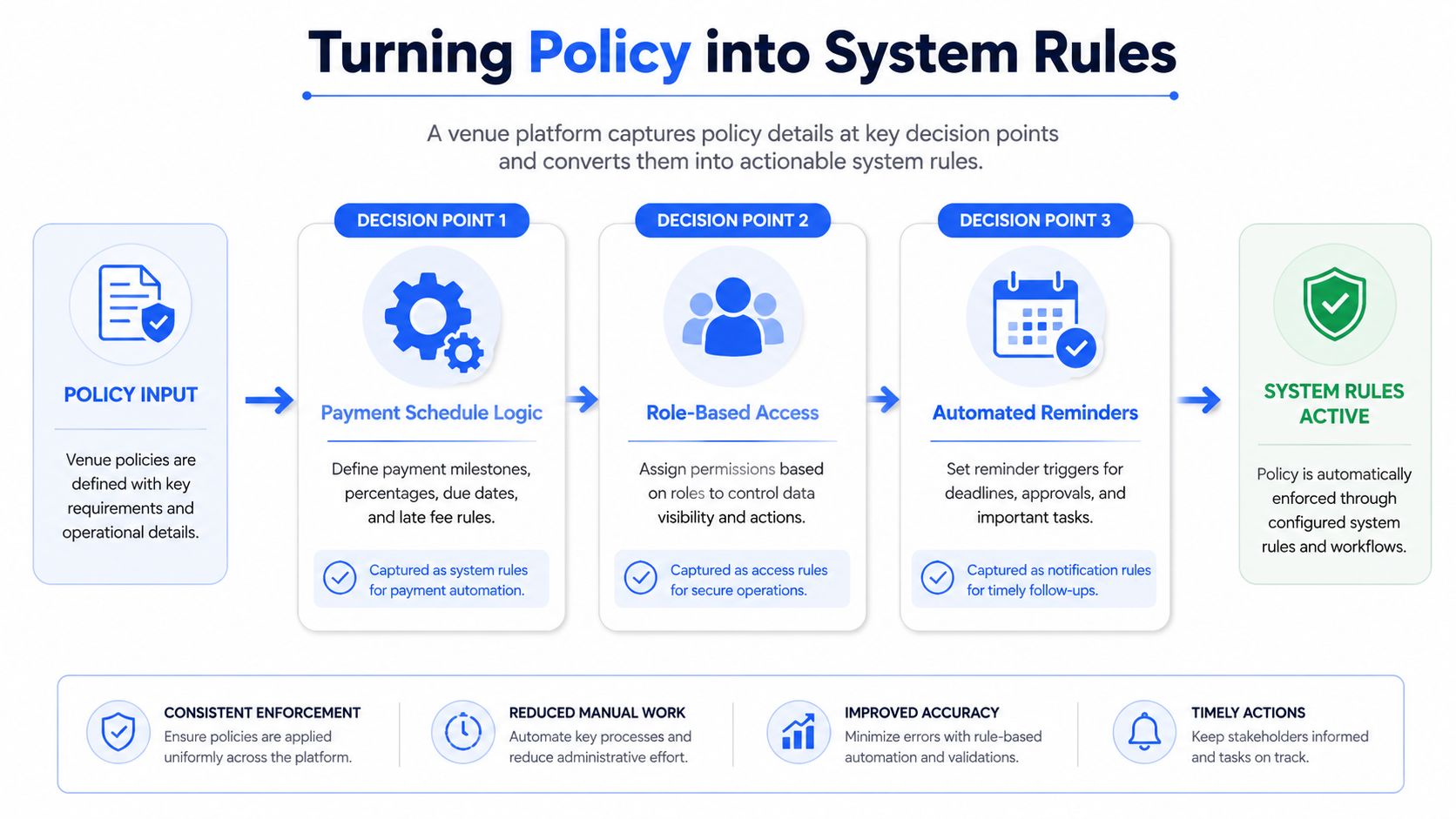
The fastest way to ruin a deposit policy is to let every coordinator interpret it differently. One person calls for the balance early, another forgets to move the due date after a reschedule, and finance has to clean up the mess later. You avoid that by turning the policy into explicit system rules with fixed calculation types, fixed triggers, and fixed booking behaviour.
Lock down the three rule decisions
First, decide how each stage is calculated. Use a percentage, a flat amount, or a remaining balance rule, and don't mix wording in the contract if the system is doing the maths. Enterprise event billing setups support those calculation types and let you define the due date from contract signing, days before event start, or days after event end, which is the right technical model for deposits, interim payments, and final settlement.
Second, decide what triggers the due date. Tie the deposit to a milestone such as signed contract or decision due date, then anchor later instalments to the event timeline. If a booking changes, the system should move the due date automatically, because manual date editing is exactly how teams lose track of money.
Third, decide what the booking can do before the deposit is paid. My view is blunt, unpaid bookings should not sit there as if they are confirmed. Gate the event details, block the calendar slot only when your policy says so, and keep menus or sensitive booking information hidden until the deposit lands. That stops staff from treating an unpaid reservation like a finished sale.
A strong setup also records each payment as a separate transaction with the amount, timestamp, method, and gateway reference. If you don't structure it that way, reconciliation becomes guesswork and cancellation handling becomes a debate. That is how venues end up with deposits that were paid, but not clearly attached to the booking.
Check the configuration before you launch it
- Calculation method: Confirm whether each instalment is a percentage, a fixed amount, or the remaining balance.
- Trigger logic: Decide whether the due date comes from contract signing, a named milestone, or days before the event.
- Access control: Set what the client can see before the deposit is paid, including event details and attached documents.
- Inventory behaviour: Confirm whether the calendar holds the slot as tentative or blocked.
- Transaction logging: Make sure each payment is stored separately with reference data and timestamps.
- Amendment handling: Test what happens if the event date moves or the booking is reduced.
- Reminder ownership: Confirm which messages are automatic and which ones staff still need to send manually.
This is the point where a venue platform matters. Creventa supports deposits and payment schedules within the event booking workflow, so a team can set payment amounts and due dates per event, keep access gated until payment lands, collect balances online through Stripe, Adyen or PlanetPay, record manual payments, and see a daily payment digest in one place. That's the operational difference between a policy that lives on paper and a schedule that survives service pressure. For booking teams building the rest of the workflow around this, the pre-order setup flow is the next layer to standardise.
Choosing Card Capture, Bank Transfer or a Mix
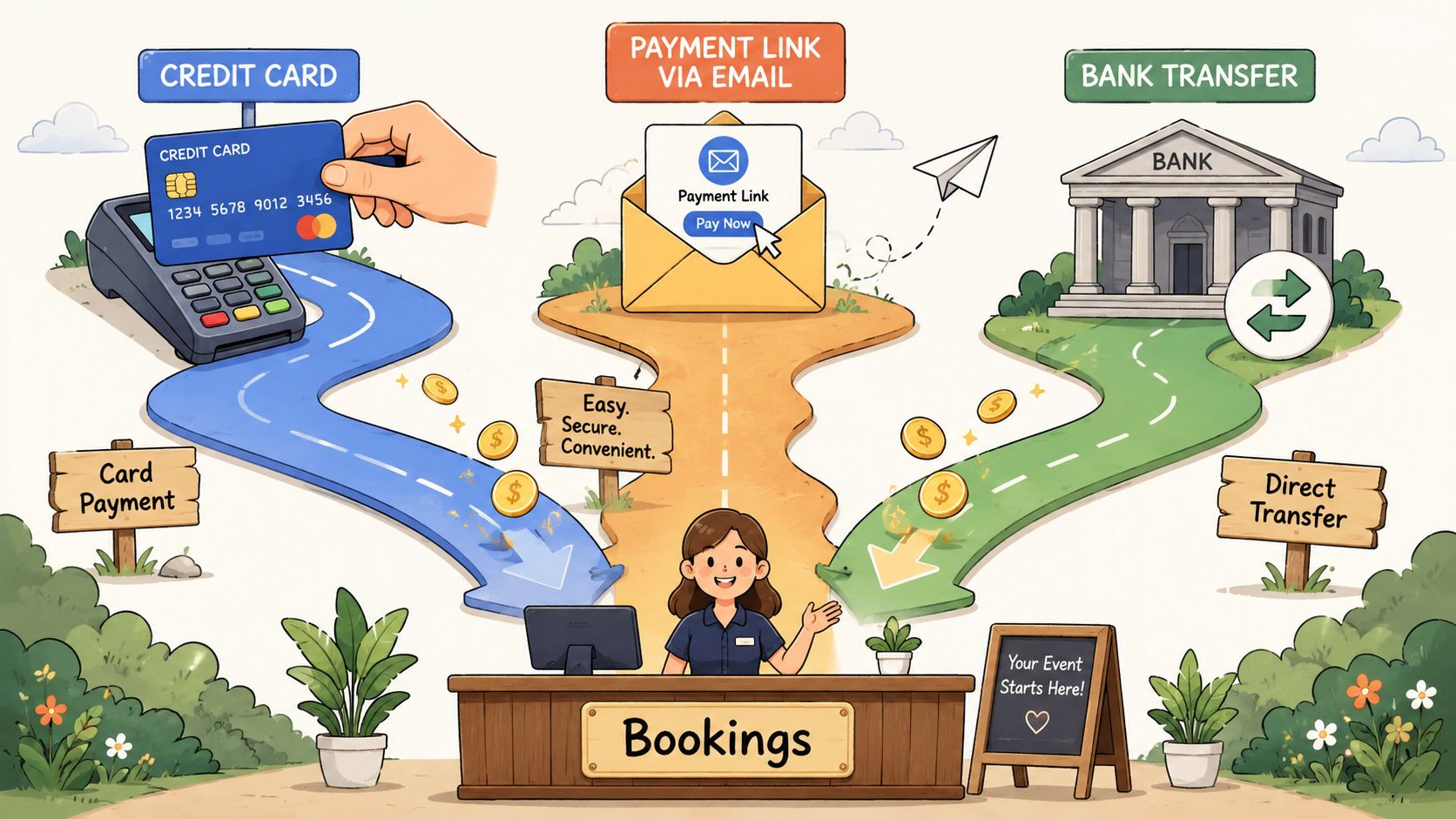
The payment method should match the booking type, the finance process, and how much chasing your team can absorb. If you run a high-volume events calendar, card-based collection usually wins because it reduces friction and gives you cleaner timing. If you work with clients who prefer BACS, you still need a structured way to post receipts against the booking without losing control of the ledger.
Card collection is the cleanest option when you want fast settlement and fewer manual touchpoints. The trade-off is processing cost, which is why the earlier guidance about timing and instalment size matters. Event invoicing guidance also recommends reminding guests 7 days before a due date, on the due date, 3 days after, and 7 days after, and it notes that major processors such as Stripe and PayPal charge 2.9% + $0.30 per transaction; that fee pressure is exactly why venues should think carefully about whether a booking needs two, three, or four instalments. For a useful parallel on structured payment handling, see this guide to managed payment tools for churches, which makes the same basic point about putting payment flow into a repeatable system.
Bank transfer still has a place, especially where the guest is finance-led or the event value is being approved internally. The downside is manual reconciliation, because a transfer without a clear reference can waste time and cause double chasing. That's why any venue using BACS should record the receipt against the exact instalment, not just note that “payment arrived”.
Online payment links sit between those two extremes. They make it easy for the guest to pay quickly, but they still need to land in a system that ties the payment back to the booking and the due date. In Creventa, online balances can be collected through Stripe, Adyen or PlanetPay, while manual payments can be posted into the same booking record, which keeps both card and transfer workflows aligned. If your team wants the technical view, the Stripe payments integration shows how online collection fits into the broader event flow.
My rule is simple. Use card capture for speed, use BACS when the client demands it, and use both when you need flexibility without losing reconciliation control. If the venue's finance team spends more time matching payments than serving guests, the process is wrong, not the people.
Reminder Cadence That Actually Gets Replies
The reminder sequence should be predictable and boring. That is the point. If your team has to decide whether to chase, they'll delay it, and delayed chasing is how a final balance slips past the event date.
Use a four-step cadence
Start with a gentle nudge 7 days before the due date. That message should be low-friction, polite, and action-oriented. It exists to catch the guest before the deadline becomes a problem.
Send a second message on the due date itself. This one should be shorter and more direct, because the guest already had notice. At this point the CTA should be obvious, pay now or reply if there's an issue.
Follow up 3 days after the due date if there's still no payment. The tone gets firmer here, but it should still read like an operational reminder, not a threat. Then send a final overdue message 7 days after the due date, with a clear warning that the booking may be released if payment isn't received.
Automation matters more than wording if you're running thirty-plus events a month. The best email copy in the world won't save a team that sends reminders by hand, because somebody will miss a booking, use the wrong template, or forget to escalate. That's why the schedule has to fire automatically from the due date and payment status, not from someone's memory.
Sample first nudge: “Your final payment is coming up on [date]. You can settle it online now using the link below, or reply to this email if you need to split the balance.”
Final warning example: “This balance is now overdue. If payment isn't received by [date], we'll need to release the booking according to our event terms.”
Keep the tone tied to the stage
- 7 days before: Helpful, calm, and easy to act on.
- On the due date: Clear and direct, with one obvious payment link.
- 3 days overdue: Firm, but still professional.
- 7 days overdue: Unambiguous, with a consequence stated plainly.
The mistake most venues make is using the same message for every stage. Guests ignore repeated sameness. A staged sequence works because each note matches the payment moment and gives the recipient a realistic next step. If you want the process to run without manual chasing, the automated reminders workflow needs to be part of the booking setup from the start.
Handling Cancellations, Reschedules and Part Payments
A deposit policy breaks the moment a booking changes unless the schedule updates with it. A wedding pushed back by six months, a gala cut from 180 covers to 120, or a partial payment that lands short all need the same discipline, create a new schedule against the original instalment record and keep the audit trail intact. If you overwrite the old record, finance loses the history and customer service loses the context.
Move the schedule, not just the date
When an event is postponed, the due dates should shift automatically with the new event date. That keeps the deposit, interim payment, and final balance aligned to the same logic the team used when the booking was first created. The key is to preserve the original transaction history while moving the future schedule forward.
Partial payments need the same care. If a guest pays less than the due amount, record the amount received, leave the remaining balance open, and let the reminder sequence continue against the outstanding amount. Do not treat the shortfall as if it disappeared, because it didn't.
Refunds and vouchers should also be logged against the original instalment. That way the finance team can see what was taken, what was returned, and what remains due without hunting through emails or card machine notes. It also makes it easier to explain the position if the guest queries the booking later.
A clean booking record should tell one story, what was due, what was paid, what moved, and what still needs attention.
For a corporate event, the cleanest approach is to recalculate the balance against the revised total the moment the room count drops. If the guest count falls, the invoice should reflect the new commercial terms, the schedule should update to the revised balance, and the reminder flow should restart from the new due date. That keeps the booking commercially honest and stops your team from chasing a number that no longer matches the event.
Reconciliation, Reporting and Daily Digest
Good payment setup ends in finance, not in the inbox. Manual BACS receipts should be reconciled against the booking schedule, card payouts should be matched by gateway reference, and the team should be able to see who paid, what for, and what is still overdue without opening five different systems. That is the difference between a booking workflow and a reporting problem.
Creventa keeps deposits and pre-payments alongside the rest of the event record, including seat, allergen, and ticketing data, so the same system that ran the event can also close the books. It also supports a daily payment digest, which gives teams a quick view of paid, pending, failed, and overdue items. For teams that close finance through accounting software, the Xero integration helps keep reconciliation tied to the same booking record.
FAQ
What if a payment fails? Mark the instalment as failed, keep the booking unpaid, and let the automated reminder flow restart from the failed status.
What if a chargeback opens? Match it back to the original transaction reference and keep the booking record intact so finance can see the full timeline.
What if a refund has to be split across multiple cards? Post each refund against the original payment line and preserve the gateway reference for each part.
The clean rule is simple, if the payment status changed, the record has to show exactly how and when it changed. Anything less becomes guesswork the next time a guest calls.
If you want this to stop living in spreadsheets, use Creventa to set deposits and staged payment schedules against the event date, collect balances online, and keep manual payments and reminders in one booking record. Visit Creventa to see how it handles deposits, pre-orders, seating, and reconciliation in the same event workflow.
Andrew Norton, Founder, Creventa. Andrew founded Creventa after years working with hospitality venues on the admin gap between a confirmed booking and event day.