Around 10% of food ordered for UK weddings is estimated to be wasted, at an average cost of £488 per event. Scaled across marriage and civil partnership volumes, that represents an estimated £130.3 million in wedding food waste each year, according to reported UK wedding catering estimates. The uncomfortable conclusion is that food waste usually starts long before the kitchen turns on a combi oven. It starts with an uncertain guest count, an unrecorded dietary change, an oversized buffer, or a menu designed around anxiety rather than demand.
Reducing waste at weddings and large events isn't about leaving guests hungry. It means replacing guesswork with a controlled forecast, then checking that forecast against what people eat. The practical sequence is clear: lock down RSVPs, collect menu and dietary choices, calculate portions and yields, run service tightly, handle surplus safely, and report the results so the next event is planned from evidence rather than habit.
Table of Contents
- The Real Cost of Food Waste at UK Weddings and Large Events
- Lock Down the Numbers with Accurate RSVPs and Guest Counts
- Collect Pre-Orders, Allergens and Menu Choices in Advance
- Plan Portions and Production Against Real Demand
- Run Service So Less Hits the Bin
- Redistribute, Donate or Compost Surplus Safely in the UK
- Measure, Report and Improve Event After Event
The Real Cost of Food Waste at UK Weddings and Large Events
The wider UK hospitality and food-service sector has historically been responsible for about 10% of the UK's total food waste, while avoidable waste has been estimated to cost between 38p and £1 per meal served, as documented by WRAP's events guidance. At a wedding, the visible cost is the ingredient that goes into the bin. The hidden cost includes labour, energy, preparation time, refrigeration, transport, disposables and the kitchen capacity used to produce food nobody serves.
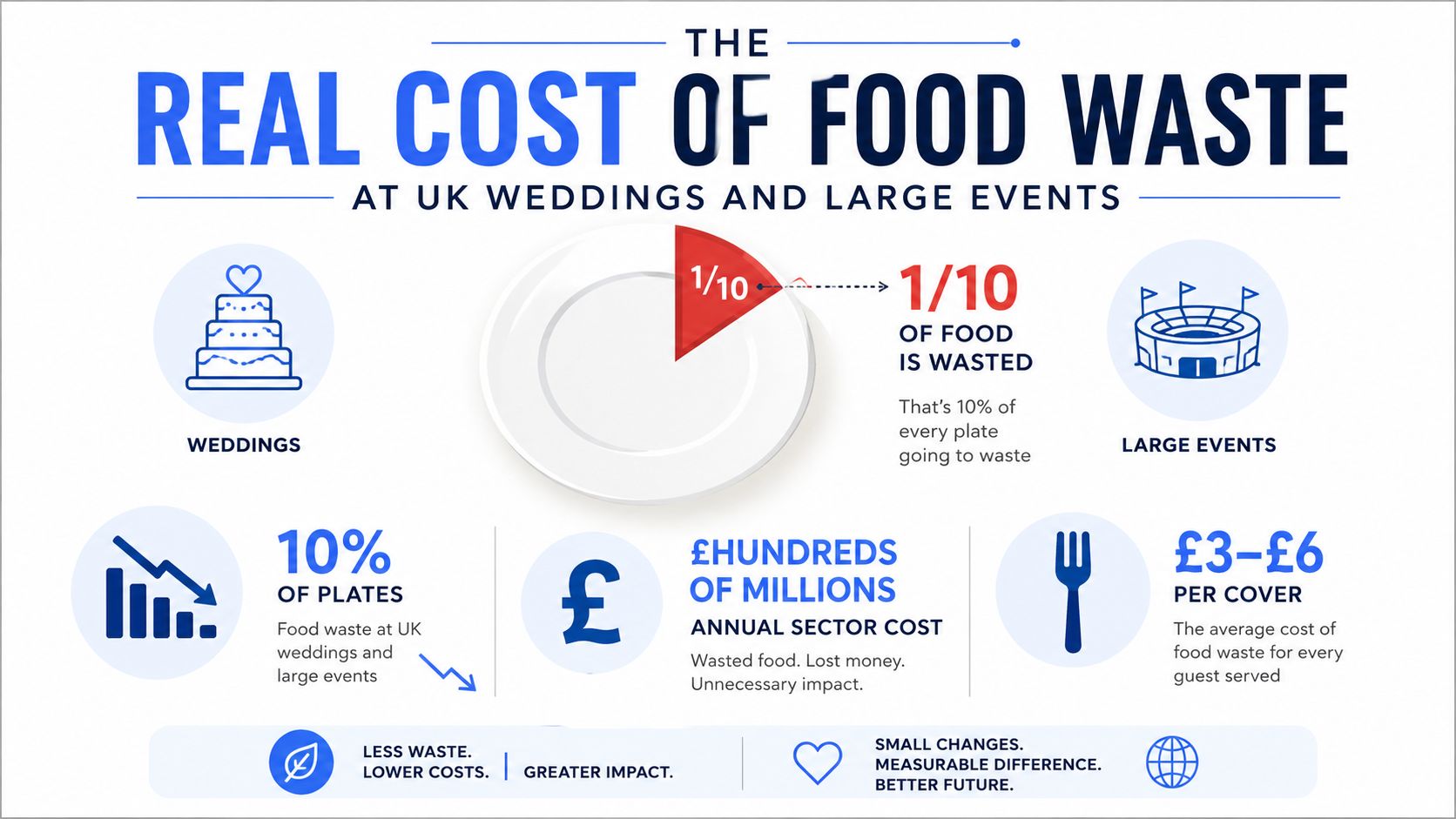
The useful operational reframing is this: food waste is first a forecasting failure and only then a sustainability problem. A no-show isn't just an empty chair. It's an unadjusted cover, a plated main, a dessert portion and potentially an evening buffet place that the team prepared without a current decision. A late plus-one, an unconfirmed child, or a guest who changes from meat to vegan can create the same problem at a smaller scale.
Four waste streams need four controls
The kitchen and event team should separate waste into four categories rather than record one vague “food waste” figure:
- Prep waste: trimmings, spoilage, damaged stock and preparation losses. This points towards purchasing, storage or yield problems.
- Plate waste: food returned uneaten by guests. This reveals portion size, menu suitability and service issues.
- Buffet-line waste: food placed on display or replenished but not consumed. Display volume and timing usually drive this stream.
- End-of-service surplus: safe, untouched food left after the planned service. This is the stream most suitable for redistribution when controls are in place.
Each category requires a different response. Smaller purchases won't fix oversized portions. Better guest communications won't repair poor trimming yields. A donation partner won't solve a buffet that is continuously topped up when demand has already fallen.
For a practical planning framework, this guide to reducing over-catering at hotel events is useful alongside a venue's own production records. The next step is to build a reliable data layer from the invitation list, then turn it into dish-level pre-orders, production quantities and service instructions. The final control is the feedback loop, where weighed waste and actual attendance change the next purchase order.
Practical rule: never ask the kitchen to cook against the number invited. Cook against a closed, documented production number with a named owner and a recorded confidence level.
Lock Down the Numbers with Accurate RSVPs and Guest Counts
The guest list is a production forecast, not an administrative formality. If the list is incomplete, every later decision becomes unstable, including ingredient purchasing, room layout, staffing, drinks ordering and allergen preparation.
Start with a tiered RSVP cut-off. Send the initial invitation or save-the-date with a clear response route. Issue a reminder at eight weeks, then set a final hard close between 10 and 14 days before service, followed by a phone chase for anyone still outstanding. The final close needs to be treated as an operational deadline, not a polite suggestion.
Build a register the kitchen can trust
Use one live register, whether that's a shared sheet or an event system. WhatsApp messages, individual emails and handwritten notes can provide useful alerts, but they shouldn't become the source of truth. Every change needs to be transferred to the register, dated and assigned to someone responsible.
Your register should include distinct rows for:
- Named guest and partner: don't assume a partner is attending because an invitation permits one.
- Children: record the child separately, including the appropriate meal and portion.
- Suppliers and crew: photographers, entertainers, planners and production staff may need feeding, but they shouldn't be hidden inside the guest total.
- Late additions: maintain a separate late-add buffer row instead of changing the main count.
- Attendance status: invited, accepted, declined, chased or cancelled.
Compare the live register with the original invitation list every day during the final planning period. A daily delta shows exactly who has changed status and prevents a late email from disappearing into a crowded inbox.
Capture dietary information once
Ask about the meal choice, dietary pattern, allergen information, accessibility needs and children's requirements in the same response. A separate dietary form creates another reconciliation task and increases the chance that a guest appears in the seating plan but not in the allergen report.
The seating plan should reflect the operational data. A resource such as this wedding seating chart guide can help planners structure the layout, but the final chart still needs to connect each place to a confirmed guest, meal choice and service instruction.
At the hard close, issue the kitchen and bar a single production number. Include the confirmed count, the unresolved cases and the agreed buffer. The invited number belongs in the event history. It shouldn't drive prep.
For a deeper data workflow, see how to forecast event catering needs using guest data. The principle is simple: a count becomes useful only when every person in it has a status, a meal requirement and a clear place in the service plan.
Collect Pre-Orders, Allergens and Menu Choices in Advance
An RSVP tells you whether someone intends to attend. A pre-order tells the kitchen what that attendance means. It converts a headcount into dish-level demand, which is the difference between buying for 120 people and buying for a defined number of fish, meat, vegan and child portions.
Spreadsheets and email can work for a small, simple event, but control deteriorates as choices and changes multiply. The problem isn't that a spreadsheet is bad. It's that the team has to keep translating messages into cells, cells into reports and reports into kitchen instructions.
Where each pre-order method loses control
| Data point captured | Email confirmations | Shared spreadsheet | Structured pre-order form |
|---|---|---|---|
| Guest choice | Buried in messages and subject lines | Possible, but depends on manual entry | Captured against the named guest |
| Allergens | Often described inconsistently | Can be recorded, but needs checking | Collected in a consistent field |
| Kids' meals | Easy to overlook | Requires a separate row or note | Built into the guest response |
| Vegan, halal and kosher splits | Reconciled manually | Visible if maintained accurately | Reported as defined menu categories |
| Last-minute changes | Spread across inboxes | Updated manually | Changed in the guest record |
| Report export | Requires copying and formatting | Depends on sheet structure | Produces a production-ready report |
A structured form also reduces menu sprawl. If guests can choose from four buffet mains without a demand forecast, the kitchen may prepare all four to protect against the possibility that one will be popular. Pre-orders allow the chef to set a portion target for each dish and decide where a controlled contingency is justified.
Allergen collection is essential. Under the UK's food information requirements, including Natasha's Law for relevant prepacked foods, the venue needs a reliable way to identify the 14 declarable allergens and communicate the information through the service chain. The response should capture the guest's stated requirement, while the kitchen still follows its own recipe checks, cross-contamination controls and sign-off process.
This guide to collecting dietary requirements for weddings and functions covers the planning side. The practical payoff comes when the same dataset feeds the seating plan, allergen list, pass sheet, place cards and post-event report. Re-keying is where errors and omissions enter. A single guest record removes one avoidable translation step.
Creventa supports this workflow with fully white-label, venue-branded links for food and drink pre-orders. It captures dietaries and allergens, including all 14 allergens plus custom requirements, then produces chef reports and food-pass sheets. Customers report around 20% less food waste from accurate pre-orders, a customer-reported result that should be treated as an operational benchmark rather than a guaranteed outcome.
Plan Portions and Production Against Real Demand
Once pre-orders close, translate them into a mise en place sheet. The sheet should show the confirmed demand by dish, the recipe yield, the number of portions available after cooking, the approved contingency and the person who checked the calculation.
Don't apply a blanket buffer to every dish. A no-show affects a fish portion and a dessert portion differently, while a buffet starch may be replenished in smaller quantities. The buffer should reflect the certainty of the count, the service style, the cost of the ingredient and how safely the item can be held or reused.
Two planning examples
| Variable | 100-guest wedding | 1,000-guest gala |
|---|---|---|
| Confirmed production count | 88 covers | 870 confirmed guests |
| Contingency approach | 12 buffer plates | Tiered 5 to 10% buffer |
| Main calculation | Build the menu around confirmed covers plus controlled buffer | Apply different buffers by course and demand certainty |
| Key check | Reconcile late changes 24 hours before service | Separate high-volume menu categories and monitor uptake |
| Service record | Buffet replenishment log and final reconciliation | Course-by-course production and service reconciliation |
These examples are planning models, not universal ratios. For the 100-guest wedding, the chef would prepare against 88 confirmed covers and hold the agreed 12-plate contingency, rather than producing 100 full portions across every component. For the gala, the confirmed 870 should be the starting point, with the buffer applied in tiers instead of multiplying every ingredient by the same factor.
Yield matters just as much as headcount. Record the raw weight, trimmed weight, cooked weight and usable portions. Cooking loss varies by product and method. If a beef item loses 20 to 25% during cooking, or poultry loses 25 to 30%, those ranges must be tested against the venue's own recipe and equipment rather than copied blindly into a costing sheet. The UK food cost calculation guide can support the commercial side, but the head chef's yield records should control the production decision.
Sign off the final production pack
The head chef should sign the mise en place sheet, buffet replenishment log and final headcount reconciliation form 24 hours before service. Bulk starches should be produced in smaller replenishable quantities, including half-portions where practical, rather than held as a full-service reserve.
The recurring wedding errors are familiar: late RSVPs, undeclared plus-ones and the late evening drop that changes dessert or evening-food demand. Treat each as a forecast variance, record it, and adjust the next event's rule. Don't absorb the same error into another oversized order.
Run Service So Less Hits the Bin
Food can be accurately ordered and still wasted during service. The pass, floor and kitchen need a shared loop that controls what leaves the kitchen, what remains on display and what can still be safely used.
For plated service, the pass sheet should show table, guest, course, dietary marker and ticket time. The expediter checks the plate against the order before it leaves the pass. Colour-coded markers can support the visual check, but they must tie back to the recorded guest requirement rather than act as a substitute for an allergen control process.
Control the buffet by replenishment, not appearance
A buffet doesn't need to look completely full throughout the event. Continuous topping-up creates fresh surplus when guest demand has already slowed. Use a timed replenishment cadence, checking demand roughly every 20 to 25 minutes, and place smaller trays on the line where the service format allows it.
The service style changes the waste profile. Plated service generally gives the team the strongest portion control. Family-style service can create more uncertainty because food is placed on tables before consumption is known. Buffet waste is heavily influenced by the amount displayed and how often trays are refreshed.
Guests considering venues for larger celebrations may find useful ideas in this guide to private dining spots for large groups, but whichever format is chosen, the venue should ask how food is portioned, held and reconciled during service.
Apply the safety clock
The Food Standards Agency's buffet guidance says buffet food shouldn't sit out for more than four hours. Build the service plan around that limit, distinguishing between hot-held food, ambient display and food removed for rapid chilling. A dish that has been on display isn't automatically suitable for donation or later service just because it looks untouched.
Hot leftovers should be cooled at room temperature, covered and placed in a fridge or freezer within one to two hours, according to UK food-safety guidance. Large quantities should be split into smaller portions so they cool faster. Leftovers should be eaten or frozen within two days, or within one day for rice dishes, under the same guidance.
The floor manager's food-waste log should record what was cleared, when it was cleared and why. Runners should rotate through tables and wait for the floor manager's release rather than prematurely clearing trays. At the end of the night, reconcile served, held, returned and discarded quantities against the prep sheet.
Redistribute, Donate or Compost Surplus Safely in the UK
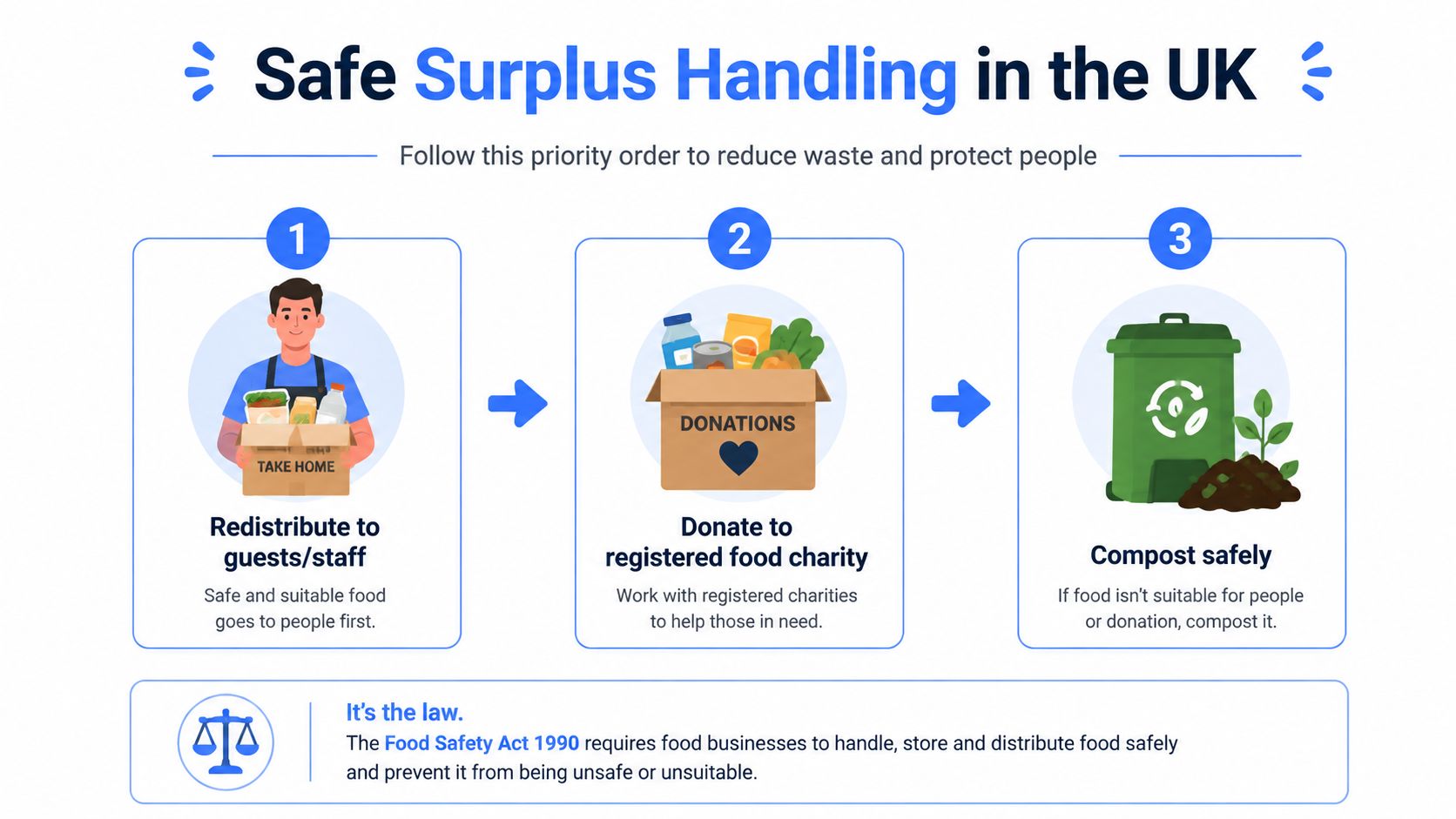
Surplus handling must be planned before the wedding, not improvised when the last guest leaves. The safest priority is to redistribute suitable food to guests or staff, then donate eligible surplus through an approved food redistribution partner, and finally compost or dispose of what cannot be safely used.
University guidance on reducing event food waste shows that redistribution is feasible when final numbers are updated close to the event, suitable food is identified and responsibility is documented. Read the practical UK guidance on reducing and preventing food waste before writing the venue's procedure.
Agree the donation route in advance
The caterer and venue should agree:
- Eligible food: identify untouched, correctly handled food that the receiving organisation has agreed to accept.
- Collection responsibility: name the approved partner and confirm who collects, when, and from which refrigerated area.
- Written agreement: document the donor and recipient responsibilities, including handling and transport.
- Traceability: record the dish, preparation time, storage conditions, collection time and recipient.
- Handover evidence: obtain a collection note or signed transfer record.
Food-safety obligations remain central under the Food Safety Act 1990 and Food Hygiene Regulations. A written donor agreement doesn't make unsafe food safe, and a charity's willingness to collect doesn't override the venue's temperature, time or traceability controls.
The handover record should include the time food was cooked, the time it left hot holding, its temperature at handover and the charity's collection note. If the food cannot reach an approved recipient within the safe window, don't stretch the rule to save the food. Dispose of it through the correct waste route.
Compost only what the system accepts
Separate catering waste from general waste at the venue. Confirm whether the local collection accepts the relevant food waste, or whether the waste contractor provides a dedicated service. On-site aerobic systems may suit some venues, but only when the operator can control contamination and accept the materials involved.
Don't assume every food item belongs in a compost stream. Cooked meat, dairy and oils require a route approved by the venue's waste contractor and applicable animal by-product controls. Keep packaging, cutlery and other contamination out of food waste, and train the floor team before service begins.
The venue's event food-waste process should include named owners, signed records and a fallback disposal route. If nobody knows who makes the decision at 11.30pm, the default outcome will usually be a mixed bin.
Measure, Report and Improve Event After Event
Measurement closes the loop. Without it, a team can reduce one dish by instinct while continuing to overproduce another, or congratulate itself on fewer bins without knowing whether the event served fewer covers.
Track four KPIs at every event:
- Total covers: record confirmed attendance and actual attendance separately.
- Prepared versus served: report quantities by dish, not just total kitchen output.
- Plate waste: weigh returned food in kilograms and separate it from prep waste.
- Redirected surplus: record what went to donation, guest take-home, composting or disposal.
WRAP's hospitality and food-service work recommends prevention and measurement as the sector's core method. Its Guardians of Grub programme provides free tools and guidance for organisations of different sizes, including structured support for recording food-waste changes.
Use ratios that change the next order
For example, if a team weighs 18 kilograms of plate waste after serving 120 actual covers, the waste-per-cover ratio is 0.15 kg per cover. That figure isn't a universal pass or fail threshold. Its value comes from comparing the same service style, menu and guest profile over time, then reducing the specific source that caused it.
| Service style | Avg plate waste (kg/cover) | Main driver of waste |
|---|---|---|
| Plated dinner | Record venue baseline | Portion size and menu mismatch |
| Buffet | Record venue baseline | Display volume and replenishment timing |
| Bowl food | Record venue baseline | Portion design and multiple small servings |
Don't fill the table with invented industry benchmarks. Populate it from weighed venue data, using the same scales, categories and definitions at each event.
The debrief should answer five questions: how accurate was the forecast, which three dishes were wasted most, which three ingredients were over-ordered, how much food was donated, and how much was composted. Pair the kitchen report with pre-order exports, seating versus actual attendance and dietary capture records to create an auditable account of the decisions behind the waste.
Enter the data within 72 hours of the event. The kitchen team can still remember why a tray was replenished, why a dish was rejected, or why a buffer was used. That context disappears quickly, leaving only a number that can't improve the next purchase order.
Creventa centralises guest pre-orders, allergen and dietary capture, seating, chef reports, food-pass sheets and post-event feedback in one hospitality workflow. If your team is still reconciling spreadsheets and email before every wedding or banquet, visit Creventa to see how a single event record can support more accurate forecasting and waste reporting.
James Nixon, Product, Creventa. James works on the Creventa platform, including guest pre-ordering, seating plans, ticketing and the reports venues rely on during service.