A run sheet is the live delivery timeline for an event. It records what happens, when it happens, who owns each task, and which handovers or contingencies matter across the day, with practical UK guidance recommending buffers of at least 5 minutes between major transitions and 10 minutes before doors open (UK event run sheet guidance).
You're probably dealing with the familiar pre-event scramble: the client has changed the running order, the kitchen has a different guest count, the AV technician is waiting for a cue, and three versions of the schedule are circulating in email. On event day, those small discrepancies become visible very quickly. A run sheet gives every person involved one operational view of the day, so the venue can make decisions before a delay becomes a guest-facing problem.
Table of Contents
- Why Every Event Needs a Run Sheet
- Key Components of an Effective Event Run Sheet
- Roles and Responsibilities on Event Day
- Sample Run Sheet Timeline for a Hospitality Event
- Common Run Sheet Mistakes to Avoid
- Automating Run Sheets with Event Management Software
- Building Your First Run Sheet Today
Why Every Event Needs a Run Sheet
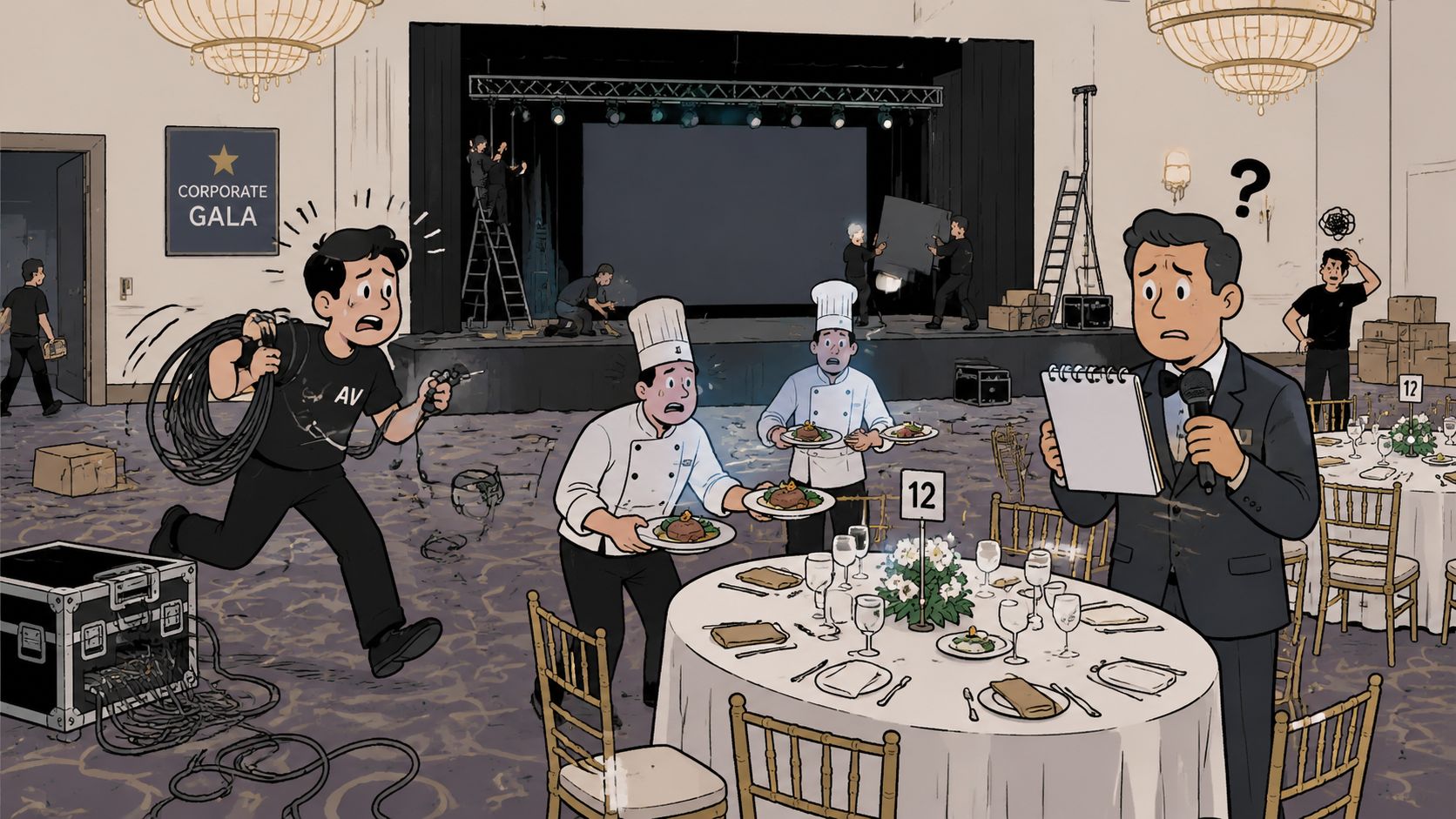
At 08:00, a venue team prepares for a corporate gala. The room is dressed, the kitchen is getting ready for service, and the event manager expects the production crew to finish setup. Then the AV team arrives late. Catering begins plating while speeches are still running. The master of ceremonies has no dependable cue times, and the next announcement comes before the room is ready.
The staff may be working hard, yet the operation still loses control. The usual gap is one agreed document that shows what happens, when it happens, who owns it, and what to do when the plan moves.
A timetable omits the operational detail a run sheet requires
A simple timetable tells you dinner is at 19:30. A working run sheet shows who releases the kitchen, which team confirms that guests are seated, which AV cue precedes the service announcement, and what happens if the previous speech overruns.
That detail matters in hospitality, where several teams must move together while handling different immediate priorities. Kitchen, floor staff, venue operations, security, production and the client liaison need one shared sequence, with clear handover points between their tasks. If one team cannot complete its action, the next team needs an agreed response rather than a last-minute decision.
UK event guidance describes a run sheet as a document mapping sequence, responsibilities and timing, alongside contact lists and other event control documents (Institute of Event Management timeline tools). That makes it a live control document for the venue, covering ownership, compliance checks and contingency decisions as conditions change.
Operational rule: If a person under pressure cannot quickly find the next action, its owner and its fallback, the run sheet is unfinished.
The operational cost of disconnected plans
Without a central version, teams make local decisions. The kitchen follows an earlier service time, the floor manager works from a printed schedule, and the client assumes an email change reached everyone. The result can include wasted labour, avoidable guest complaints, supplier disagreements and a poor impression of the venue.
A run sheet also records decisions as they happen. If a supplier changes its arrival time or a speaker requests an amended cue, the event manager can log the update, communicate it to the affected teams and assign responsibility. That record helps staff distinguish an approved change from an outdated instruction.
The UK events industry was valued at £68.7 billion in the UK Events Report 2025 (ABPCO report announcement). For venue operators, the relevance lies in the coordination required across commercially important work, including conferences, banquets and large hospitality programmes.
The run sheet becomes the day-of source of truth. It supports bump-in, briefings, guest arrival, service, programme cues and pack-down. Kept current, it lets the event manager lead the operation instead of chasing information.
Key Components of an Effective Event Run Sheet
A useful run sheet is designed for scanning, not reading. Every row should show one action, one start time, one named owner and enough context for the next person to act without opening another document. A practical UK format includes the exact time, action or cue, lead, backup contact and contingency notes (event logistics guidance).
Build columns around decisions
Start with time. Use the resolution that matches the event's complexity. Smaller events may work in 5 to 15-minute increments, while stage production can require second-level precision (local council event checklist). Add buffers around major handovers rather than filling every available minute.
Write tasks as actions. “Begin plating mains” tells the kitchen what to do. “Food prep” describes a broad activity but doesn't establish a trigger, outcome or accountable person.
The owner must be a named individual or a clearly identified role holder, not just "catering" or "AV". Add the resources needed to complete the task, such as microphones, lectern, staging, linen, table numbers, printed menus or specialist service equipment.
The contacts field should hold current mobile numbers for key suppliers and internal leads. A contact name without a usable number sends staff back to the office or their inbox when the pressure is highest.
Treat contingencies as working instructions
Contingency notes are often the weakest column, yet they're where the document earns its value. Record what happens if the keynote speaker is late, rain moves an outdoor ceremony indoors, a supplier delivery is short or a dietary requirement appears after the final order.
A contingency should identify the decision-maker and the next action. “Check with manager” is too vague. “Client liaison confirms whether the second speaker moves forward, then AV technician updates the cue order” gives the team a route through the problem.
For kitchen handovers, clarity matters just as much. A practical resource on Relief Chefs UK handover documentation is useful when temporary or changing kitchen teams need concise information about unfinished tasks, service priorities and responsibilities.
| Poor Entry | Effective Entry |
|---|---|
| 19:30, Dinner | 19:30, Banqueting supervisor confirms speeches have ended, then releases kitchen to plate main course. |
| Setup room | 14:00, Venue coordinator places six round tables, ivory linen and numbered menus according to approved floor plan. |
| AV check | 16:00, AV technician tests lectern microphone, presentation playback and backup microphone with client liaison present. |
| Speaker late | Speaker late, client liaison confirms revised order with event manager, AV technician updates cues, floor lead holds service. |
The table works because each effective entry can be understood in seconds. If staff need to interpret a row, search for a contact or ask who owns it, the run sheet has become another source of delay.
Roles and Responsibilities on Event Day
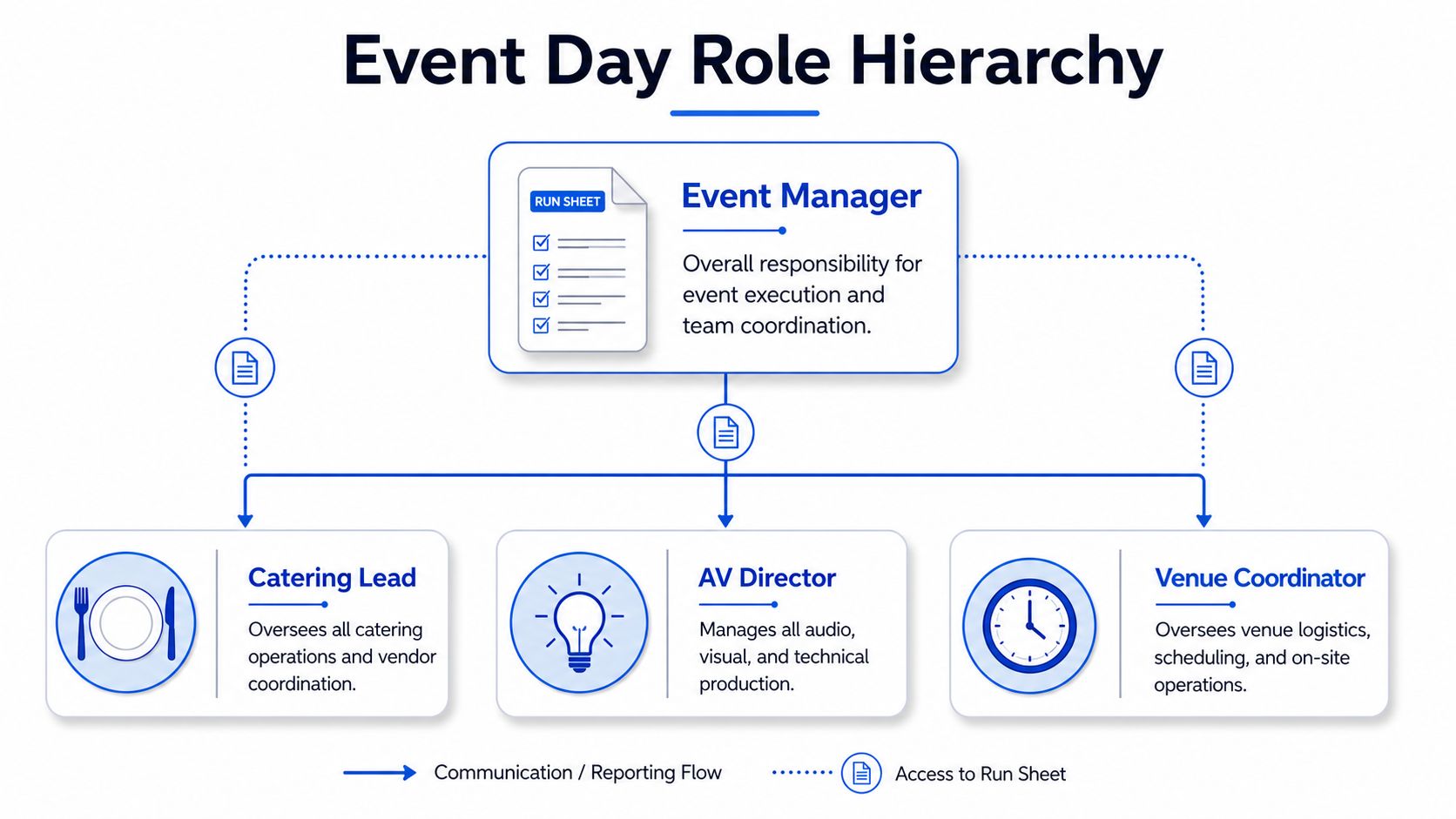
Ownership and contribution are different jobs. The event manager owns the master run sheet. Other people contribute timings, requirements and changes, but one person must control the approved version and decide when an amendment affects the wider operation.
Map the operational chain
The event manager maintains the overall sequence, chairs the briefing and authorises material changes. The venue operations lead turns that sequence into floor activity, checking room readiness, access routes and guest movement. The F&B supervisor connects kitchen readiness with front-of-house service, confirming when courses can leave the pass.
The AV technician manages cue points, playback, microphones and technical fallback actions. The client liaison handles programme changes and client requests, but shouldn't promise a change without checking its effect on service, staffing or safety.
Each role needs a useful view rather than an identical data dump. The kitchen needs course timings, dietary information, plating instructions and service release points. AV needs cues, speakers, equipment and rehearsal details. Security needs access, crowd movement and emergency information, not plating notes.
Make handovers explicit
The riskiest moments are usually handovers. A day shift leaves before the evening team understands a supplier delay. The kitchen assumes the floor has confirmed guest numbers. The AV technician receives a revised presentation but not the new speech order.
Put the handover on the run sheet as an action with a time and an owner. For example, “17:15, F&B supervisor briefs evening service team on dietary exceptions and revised course release order.” The receiving person should acknowledge the information, not merely appear on a distribution list.
A strong ownership model includes:
- One accountable owner: Assign one person to each line, even when several people help.
- Named contributors: Record who supplies information, equipment or approval.
- Visible handover points: Mark where responsibility moves from one person or department to another.
- Escalation route: Identify who makes the decision when the planned action can't proceed.
The team can share the work, but it must never share uncertainty about who acts next.
That approach also makes post-event review more useful. If a service release was missed, the team can examine the handover and decision path rather than blaming an entire department.
Sample Run Sheet Timeline for a Hospitality Event
The following example shows how a run sheet might control a 150-guest corporate dinner at a hotel venue. The times are illustrative, but the structure reflects the level of detail needed for a live hospitality operation. It separates preparation from delivery and keeps contingency instructions beside the milestone they affect.
| Time | Task | Owner | Contingency Note |
|---|---|---|---|
| 08:00 | Open loading access and complete venue walk-through with production and catering leads. | Event manager | If access is delayed, prioritise AV and kitchen-critical deliveries, then notify suppliers of the revised sequence. |
| 08:30 | Receive equipment, linen and service deliveries. Check quantities against the event pack. | Venue operations lead | Short delivery is photographed, logged and escalated to the event manager before room setup changes. |
| 09:30 | Begin kitchen preparation and confirm dietary and allergen information with the F&B supervisor. | F&B supervisor | Late dietary information is isolated, verified and communicated to the chef and floor lead before plating. |
| 11:00 | Set room, tables, place settings, stage and registration point against the approved layout. | Venue coordinator | If the room layout changes, the event manager approves the revision and updates the master document. |
| 13:00 | Test presentation playback, lectern microphone, handheld microphone and backup equipment. | AV technician | If playback fails, use the approved backup file and confirm the speaker's revised cue. |
| 15:00 | Brief floor, kitchen, registration, security and client teams. | Event manager | Each lead confirms their own actions, contacts and escalation route. |
| 16:30 | Complete final room check and hold a short operational pause before guest arrival. | Venue operations lead | Any unresolved issue is assigned to a named person before doors open. |
| 17:00 | Open registration and welcome guests. | Client liaison | If arrival builds quickly, deploy the reserve registration position and notify floor staff. |
| 18:00 | Confirm guests are seated and release starter service. | F&B supervisor | If seating runs late, hold plating and protect food quality rather than serving in stages without approval. |
| 19:00 | Begin keynote and programmed speeches. | AV technician | If the keynote runs over, event manager and client liaison decide whether to shorten the next speech or move the service cue. |
| 20:15 | Hold a 15-minute cushion before dessert service. | Event manager | Use the buffer to absorb an overrun, reset the room or confirm late dietary requirements. |
| 20:30 | Release dessert service and resume programme. | F&B supervisor | If the programme remains behind, client liaison confirms the amended running order with AV and floor leads. |
| 22:00 | Close formal programme and begin guest departure support. | Venue operations lead | Security maintains guest routes while service teams clear only approved areas. |
| 22:30 | Begin load-out and supplier sign-off. | Production lead | Any damaged or missing item is recorded before the supplier leaves. |
The important detail is the handover language. “Dinner at 19:00” leaves teams waiting for interpretation. “F&B supervisor confirms guests are seated and releases starter service” tells the kitchen and floor exactly who makes the call.
A master schedule can also be divided into pre-production, load-in, show and load-out schedules, with load-in handled minute by minute where the production requires it (master production schedule guidance). That separation keeps preparation tasks from obscuring the live programme.
Common Run Sheet Mistakes to Avoid
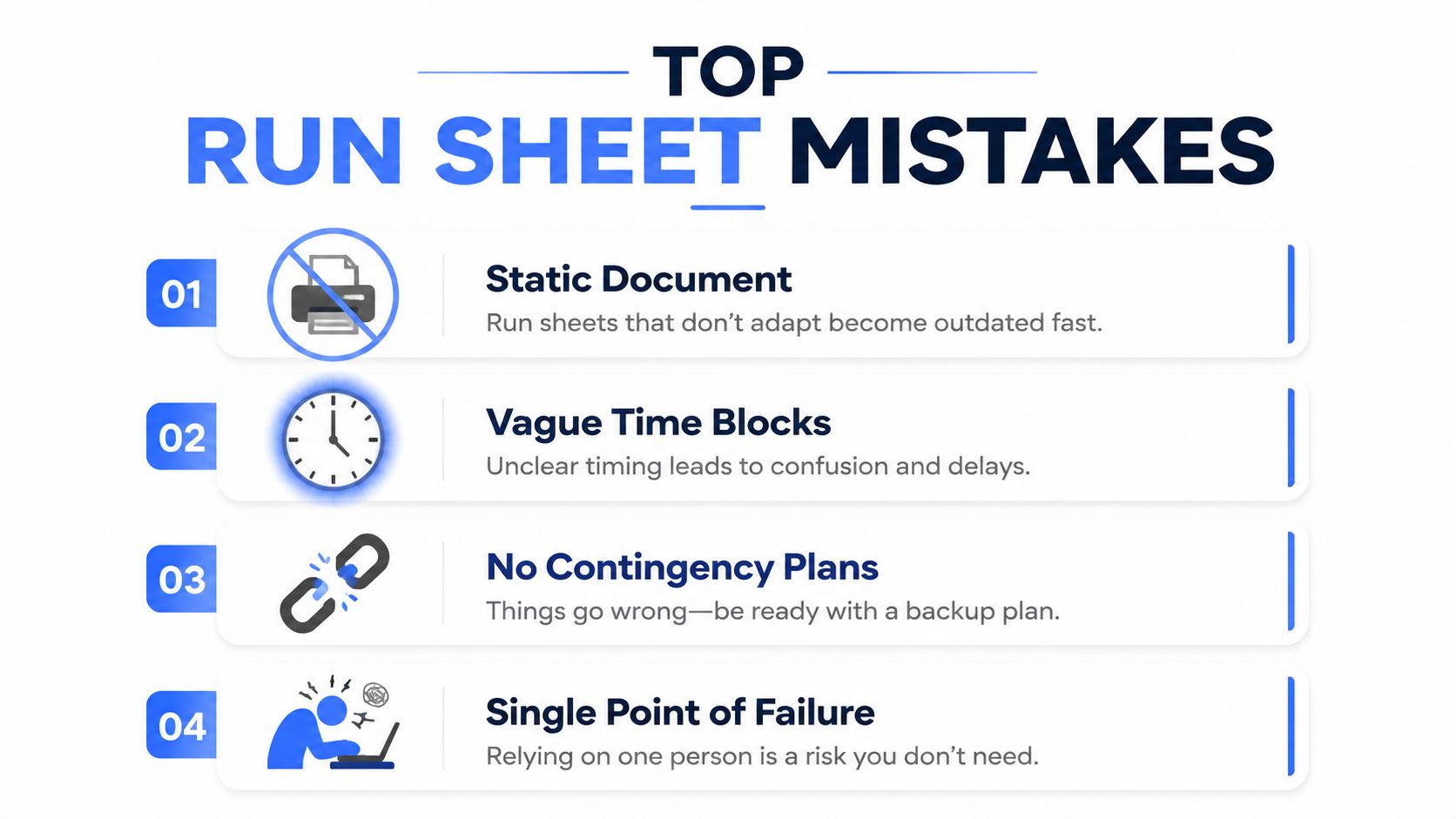
Treating a run sheet as a static planning document rather than a live control sheet is a common cause of failure. A schedule printed during planning becomes risky when timings change, compliance details shift or staff keep using old copies.
The document stays static
A late supplier, delayed speaker or changed guest count should update the live version. Mark the change clearly, notify affected owners and remove obsolete copies from circulation. This matters in hospitality venues, where one timing change can affect service, access, staffing and safety checks.
Fix: nominate one person to control revisions. Use a visible version label or live access method, then repeat material changes during the briefing. Record approvals and unresolved decisions so the document also supports compliance.
The task sounds tidy but says nothing
“Set up room” hides the decisions that matter. Staff need the table configuration, linen, stage position, signage, equipment and completion standard. They also need to know who confirms the setup and what happens if the required item is late.
Fix: write one key action per line and order it by start time. This makes gaps, ownership and amendments easier to identify.
No buffer protects the plan
A schedule with every minute occupied assumes each handover will finish perfectly. Live events rarely behave that way, especially during load-in, supplier setup and the period before doors open.
Fix: leave deliberate space around major transitions. Allow at least 5 minutes between major handovers and 10 minutes before doors open, as recommended in UK logistics guidance (event coordination guidance). Use that time for checks, access issues and contingency decisions, not extra tasks.
Senior staff hold all the information
A run sheet seen only by the event manager and department heads leaves the people doing the work dependent on verbal relays. Instructions become inconsistent, and response slows when conditions change.
Fix: distribute filtered, role-appropriate views to floor, kitchen, AV and security teams. Each person should know their next action, their preceding handover and the person receiving their update. Keep contingency instructions visible, so staff can act without waiting for a senior manager.
Automating Run Sheets with Event Management Software
A spreadsheet can support a straightforward event. Problems start when several people edit it during the final checks. One attachment may contain the amended service time, another the revised seating plan, while a supplier update remains in an inbox the floor team does not monitor. Staff then work from different instructions, and the event manager becomes the version-control system.
Purpose-built event management software connects the run sheet with the event record. Instead of retyping guest selections, room details and service milestones, the venue can generate operational documents from structured information. When approved source data changes, the relevant documents can reflect those amendments without repeated copy and paste.
What automation should handle
A practical system should help the venue:
- Generate documents from event details: Produce function sheets, kitchen information, seating data and run sheets from one event record.
- Assign accountable owners: Link tasks to named users or roles, with access suited to each team.
- Distribute live changes: Send amended timings and instructions to connected staff instead of relying on forwarded emails.
- Protect compliance records: Retain timestamps, change history and digital acknowledgements where the venue needs an audit trail.
- Connect guest information: Carry confirmed pre-orders, allergens, seating and dietary requirements into operational reports.
Creventa brings event enquiries, proposals, quotes, guest pre-orders, allergens, seating, place cards, reports and post-event feedback into one hospitality-focused system. It includes CreventaFlow for enquiry and quote workflows, Prinq for guest ordering and payment before events, and event documents generated from the same operational data. The value lies in shortening the route from an approved event brief to the information that kitchen, floor and production teams use. Those documents can also support ownership, compliance checks and contingency decisions as the operation changes.
Automation still needs a controlled rollout. Staff may resist a new system because they expect a learning curve, duplicated work or less control than they had with a familiar spreadsheet. Start with one event type, define the minimum required fields, and run the digital document beside the existing process for a short period. Once the team trusts the workflow, remove duplicate steps and make the digital version the working record.
For venues handling complex activity, the operational case is clear. UK reporting recorded 1,154 exhibitions and conferences with exhibition elements and 6.8 million visits at main UK venues in 2025 (Events Industry Alliance report). A high-stake event needs controlled information that reaches the right person at the right time, with a record of who received and changed it.
Review Creventa's hospitality event operations to assess whether your current spreadsheet process can keep pace with live changes.
Building Your First Run Sheet Today
Start with the next event on your calendar, not an abstract template. Walk through the physical and operational touchpoints in order: access, load-in, room setup, technical checks, staff briefings, guest arrival, service windows, programme cues, handovers and load-out.
Create the document around five core fields:
- Time: Set the required precision and add buffers where a delay could affect guests or another department.
- Task: Write one action per line, beginning with a clear verb and naming the expected result.
- Owner: Assign one person, not a department. Add a backup contact for critical actions.
- Equipment and information: Record the resources, documents and approvals needed to complete the task.
- Contingency: State the trigger, decision-maker and alternative action if the original plan fails.
Stress-test the sequence
Send a draft to department heads 48 hours before the event so they can challenge timings, access assumptions, staffing and handovers. Ask specific questions: Can the kitchen meet this release time? Does the AV setup require earlier access? Who receives the delivery if the event manager is in the room? Where does the guest move if the planned space becomes unavailable?
Then use the pre-event briefing to confirm the final version. On the day, update it when reality changes. A run sheet that reflects the live operation is more valuable than a perfect-looking document that no longer matches the room.
After the event, record what caused delays, which contingencies worked and where ownership was unclear. That debrief turns the document into a reusable operating standard for future events. If the same spreadsheet needs repeated manual updates, ask whether software could automate distribution, connect guest and dietary information, and reduce version confusion.
Build one run sheet properly this week. Use it as the working template for the next event, refine it after the debrief, and make clear ownership a standard rather than a last-minute rescue.
Creventa brings event enquiries, guest pre-orders, allergens, seating, payments, reports and run-sheet generation into one hospitality workflow. Visit Creventa to see how your venue can replace disconnected event-day documents with information that teams can update and use together.
Jake Crimmin, Hospitality Events Specialist, Creventa. Jake works with hotels and venues on event operations, focusing on how pre-orders and allergen data flow from the guest through to the kitchen.