67% to 72% of UK wedding enquiries arrive outside office hours, and up to 78% of viewings are booked outside nine to five according to UK venue research. That's the reason a wedding pre-order system for venues can't be treated like a nice-to-have form, because the decisions that shape the event, meal choices, dietary notes, seating preferences, deposits, happen when the office is shut and someone's phone is the only thing left open.
A proper system sits between the signed booking and the day-of pack. It captures each guest's order, freezes it at the right point, turns it into kitchen-ready paperwork, and keeps the venue from stitching together final details across spreadsheets, email threads, and half-updated notes. When that process is manual, the risk isn't just admin pain, it's slower confirmations, missed dietaries, and a booking journey that leaks money before the wedding even reaches service.
Table of Contents
- Why Wedding Venues Need a Dedicated Pre Order System
- Must-Have Features in a Wedding Pre Order Platform
- Operational Benefits and Measurable ROI
- Managing Late Changes and Allergen Compliance
- Implementation Steps and Timeline for Venues
- Choosing the Right Vendor and Avoiding Common Pitfalls
- Building Your Wedding Pre Order Strategy
Why Wedding Venues Need a Dedicated Pre Order System
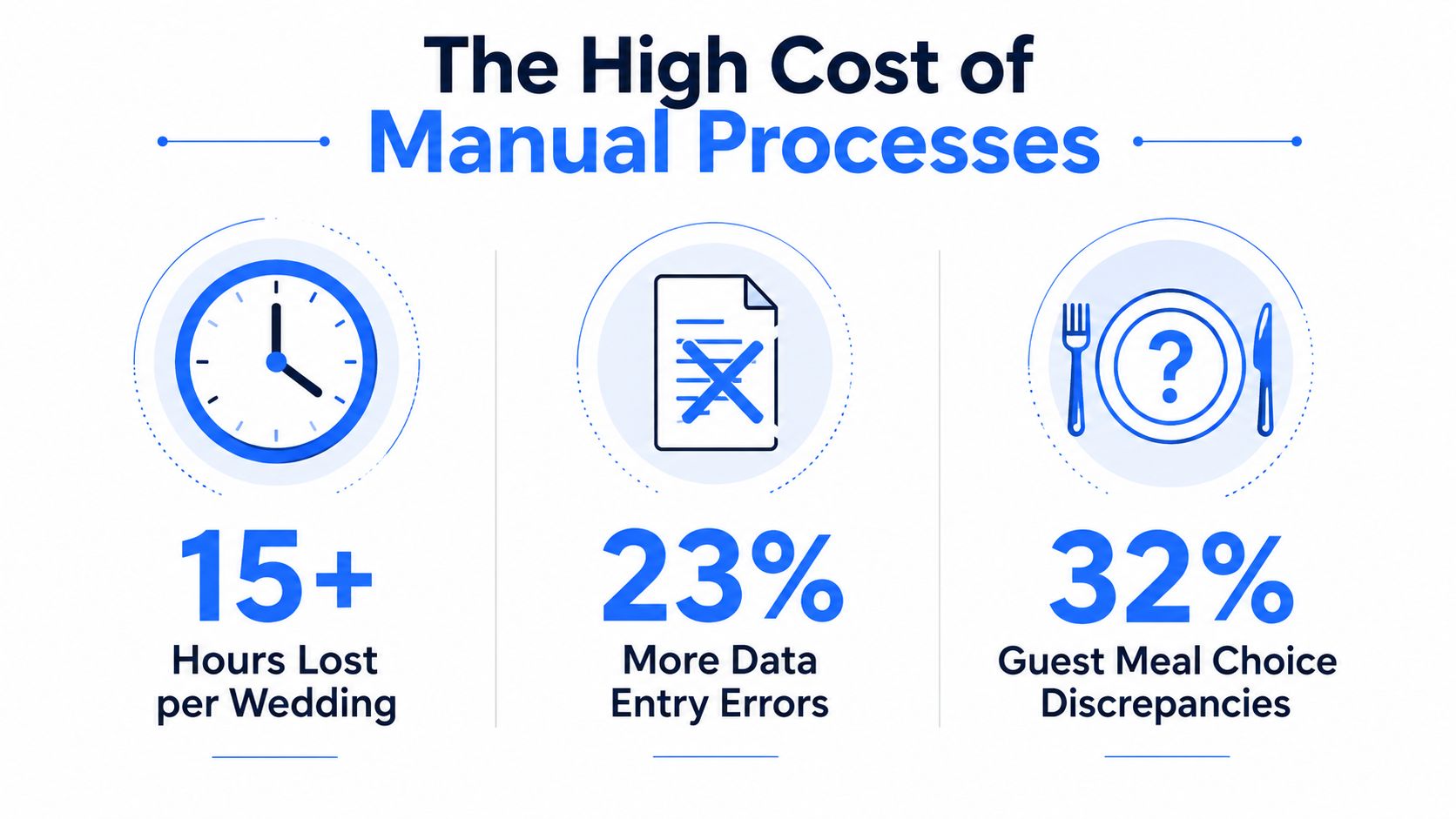
Wedding pre-orders sit inside service-critical data, because once a couple has confirmed the menu, every late edit affects kitchen timing, allergen handling, and table-level service. UK venues are estimated to lose around £1.2 billion in revenue each year because of poor enquiry handling from UK venue research, and the same weak process usually shows up again at the pre-order stage. If the venue is slow, fragmented, or unclear at the booking stage, the pre-order stage inherits that confusion.
The booking journey breaks before the menu does
Independent UK industry reporting says top-performing venues convert 10% to 12% of enquiries into bookings, while average or struggling venues convert only 3% to 6% source. Those figures point to a simple operational truth, the venues that win are usually the ones that respond faster and keep follow-up moving. If the booking journey is already inconsistent, the pre-order journey usually ends up in the same state.
A wedding pre-order system should sit between the confirmed event and the service day as the operational record, not as another form that staff have to babysit. It should hold the booking calendar, guest-level choices, and the documents the kitchen and front of house need from one source of truth, not from whichever spreadsheet was current that morning as described in technical booking workflow guidance. Otherwise, kitchen prep, seating, and service notes drift apart.
That matters because a wedding is a finite-capacity event with a hard deadline. The system has to protect that deadline. It cannot behave like a general contact form that waits for staff to manually chase responses.
If you want a practical view of how much admin disappears once the workflow stops living in inboxes and spreadsheets, this guide on reducing admin time for weddings and events at hotels shows the kind of back-office pressure venues are usually trying to remove.
For operators trying to understand the wider planning context, Max's Luxury Rides wedding planning guide is a useful companion because it shows how couples think about the day as a sequence of linked decisions, not isolated tasks. Venue operations need to work that way too.
Practical rule: if the team can't see the final guest choice without searching email or exporting a spreadsheet, the system is not centralised.
Why the system has to work after hours
Wedding enquiries do not arrive on a tidy office schedule. Venue research reports that 67% to 72% of enquiries arrive outside office hours, with up to 78% of viewings booked outside nine to five same UK research source. A venue that waits until the next morning to process decisions is already behind the guest's momentum.
Automation earns its keep here. A good pre-order flow captures data as soon as the guest is ready, instead of waiting for a coordinator to return to a desk. It also reduces the chance that a couple's special request gets lost in a chain of forwarded emails, which is exactly where manual systems start to fail.
The team at the venue should be reviewing exceptions, not retyping the same information three times. That is the difference between a process and a pile of messages.
Must-Have Features in a Wedding Pre Order Platform
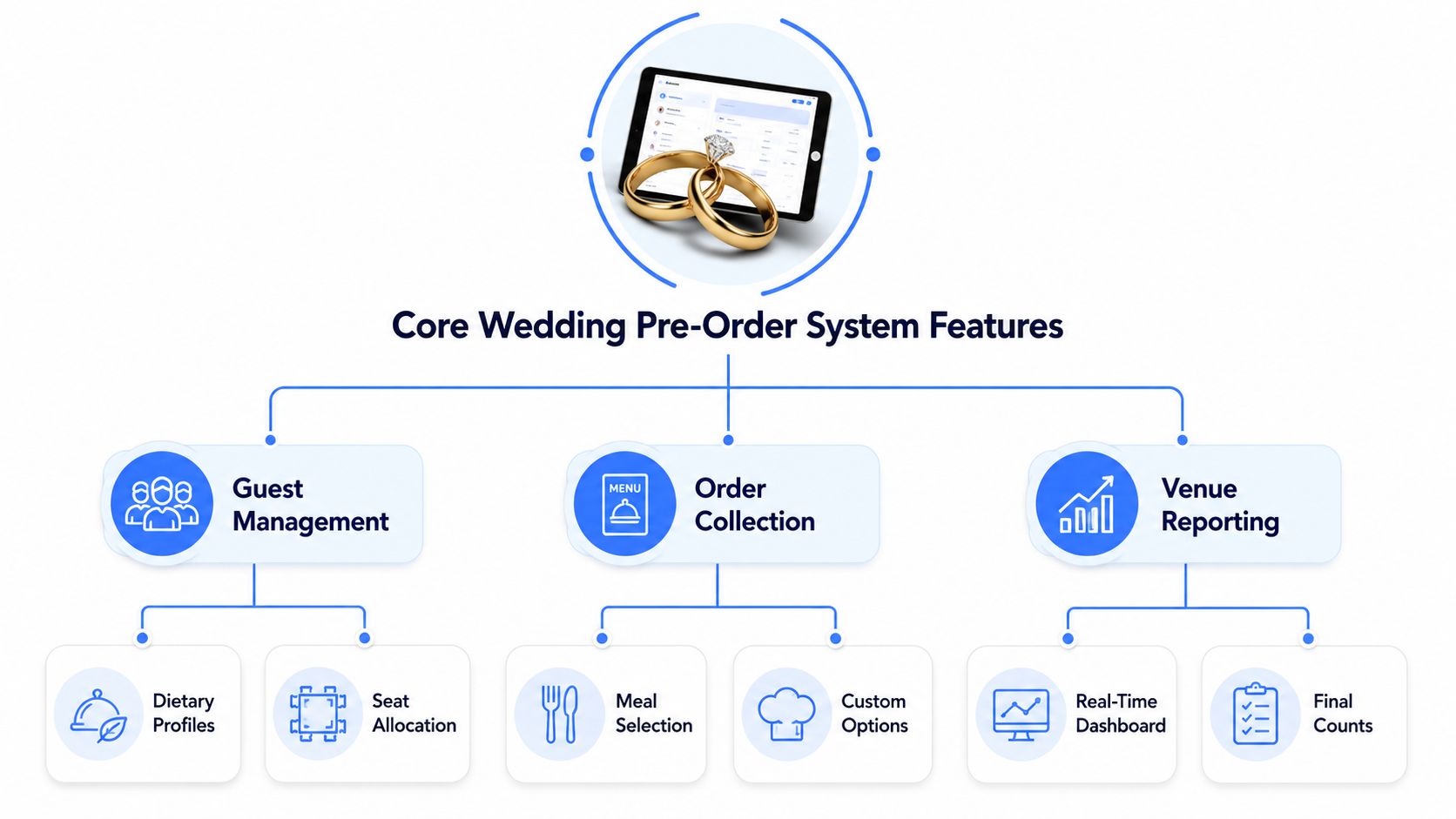
A venue-ready platform has to do more than collect meal choices. It has to keep the latest version attached to the booking, give kitchens a clean record, and stop front of house from working off assumptions.
Guest data has to stay attached to the booking
Creventa's own pre-order management model frames the workflow as a layer between booking and service, with guest choices, dietary data, seating information, and operational reports in one place pre-order management overview. That structure matters because a wedding guest is not just a name on a form, they are tied to a table, a course sequence, and often a specific dietary exception.
A venue should expect the platform to support named guest profiles, not anonymous order entries. If a guest calls two days later with a severe nut allergy, the system needs to update the record without leaving the kitchen with two conflicting versions. Controlled editing and live reporting are what prevent that breakdown.
For seating, a drag-and-drop planner is not a cosmetic extra. It is how you stop FOH from working from a stale printout while sales are still editing the guest list. If the table plan and the guest list are disconnected, the handover point becomes the weak spot.
If you need a practical reference for how table layout affects the event flow, a wedding seating chart guide is useful because it shows how much depends on clean guest allocation before service begins.
Reporting is the real output, not the form
The form is only the intake. The value is what comes out at the other end. Creventa's guide says a venue-ready workflow should produce place-cards, kitchen and FOH reporting, including prep sheets, allergen summaries, and service run sheets. A venue can also use generate kitchen reports to turn guest selections into a format the kitchen can work from without rebuilding the order from screenshots or email threads.
A strong platform should also support payment collection and reminders. If deposits still need manual chasing, the system has not removed enough friction. The process should let the venue lock the date, collect choices, and close the loop without chasing every guest one by one.
The right test is simple, if a coordinator cannot answer “what is final, what is pending, and what changed?” in one screen, the platform is too thin for weddings.
Operational Benefits and Measurable ROI
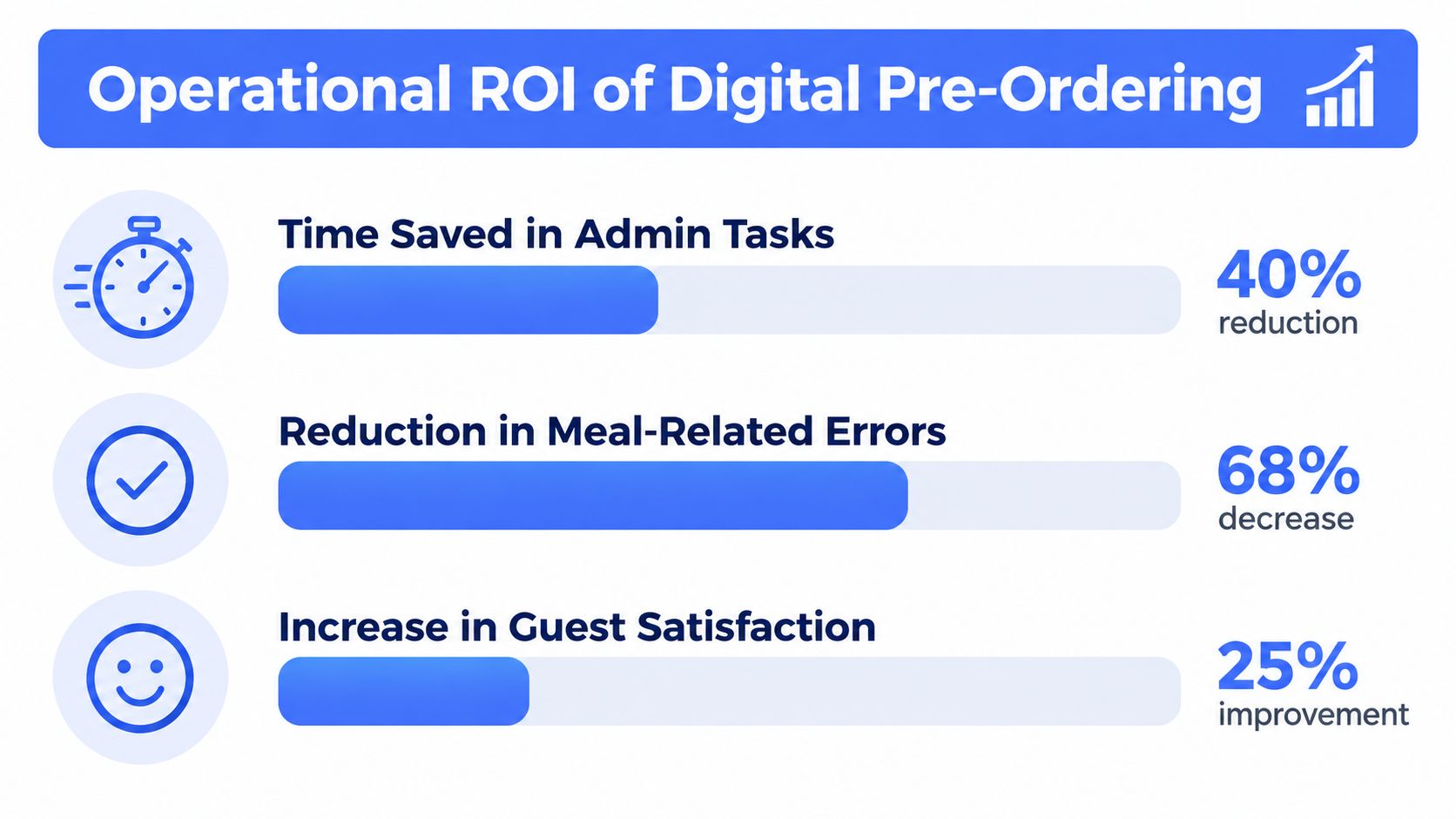
The ROI case is strongest when you look at the event as a chain of connected tasks. Better pre-ordering improves the guest experience, reduces waste, strengthens wet spend, and gives the kitchen a more predictable production plan.
Revenue and waste move in opposite directions
A Holiday Inn hotel using Creventa reported a 251% wet spend uplift from drink pre-orders, while a global hotel chain reported approximately 20% less food waste through accurate pre-ordering. Those figures sit on the same operational ledger, more revenue before the event and less waste after it reported results from Creventa materials.
Drink pre-orders are often missed in wedding planning, yet they are one of the clearest upsell points. Guests commit earlier, the venue can package options more clearly, and the service team knows what to stage. Food waste falls for the same reason, because production is based on real selections rather than rough counts.
For venues wondering whether this only pays off at scale, the answer is usually no. Smaller sites can still benefit if staff are spending too much time chasing orders or rebuilding reports manually. The return may show up less as headline revenue and more as reduced admin drag, fewer mistakes, and less pressure on service-day staff.
Guest response and planning control matter too
Creventa says it handled more than 2 million festive dishes at Christmas 2025 with events ranging from 4 to 2,500+ guests, and it recorded a 99.2% guest response rate to pre-order invitations event pre-order management guide. Those figures matter because they show the model working across very different event sizes, not just one venue type or one kind of wedding.
The operational lesson is simple. Guests usually respond when the process is easy and the reminders are clear. A venue does not need to build pressure manually, it needs to remove friction. Clear links, branded emails, and structured reminders do more work than staff chasing people by hand.
There is also a planning benefit that gets overlooked. When the final order set is clean, the kitchen can pack production more tightly, FOH can brief better, and the host is not spending the afternoon clarifying who wanted what. That saves time and lowers the stress level of the whole event.
If you are building a case internally, this revenue-focused overview of pre-orders is a useful reference point for framing the commercial upside against your own labour and waste costs.
Managing Late Changes and Allergen Compliance
Late changes are where weak systems expose themselves. A guest changes dessert after the cut-off, the host updates the seating plan, and suddenly the kitchen is looking at one email, FOH is looking at another, and nobody knows which version is final.
Freeze the order, then manage exceptions
The cleanest approach is to set a hard cut-off for standard changes and treat anything after that as an exception. That means the venue knows when to stop accepting routine edits, and staff can focus on genuine exceptions rather than drip-fed revisions that keep shifting the production line. The system should version every change so the team can see who changed what, and when.
That matters even more for allergy handling. UK venues operate in a tight food-safety and allergen environment because Natasha's Law requires full ingredient and allergen labelling for prepacked-for-direct-sale foods, and the Food Standards Agency continues to treat allergen controls as a live enforcement issue as noted in Creventa's allergen guidance. Weddings aren't exempt from that reality just because the guest list is friendly.
A venue can't rely on a note buried in a spreadsheet cell or a message left in a host's inbox. The allergen record has to sit against the named guest, flow into the kitchen report, and survive the handover from sales to operations.
Keep one rule in place, if a change isn't in the final report, it doesn't exist on service day.
Build a version-controlled paper trail
The best systems make the kitchen's working life simpler, not noisier. That means one definitive per-guest dietary record, one final guest list, and one service document that reflects the latest approved changes. If an exception comes in after cut-off, it should be logged as an exception, not merged into the main order without trace.
This is especially important in mixed-format venues such as hotels, restaurants, golf clubs, and stadium hospitality spaces, where several teams may touch the same event. A late edit needs to be visible to everyone who needs it, but not duplicated in a way that creates uncertainty. That's the balance.
The venue should also decide in advance who can approve changes. Without clear ownership, every last-minute update becomes an operational debate. With ownership, the team can move quickly and keep the paperwork auditable.
Implementation Steps and Timeline for Venues
One bad handover can turn a wedding pre order into a kitchen fire drill. The venues that avoid that problem usually start with process mapping, because software only speeds up whatever the team already does.
Start with the workflow, not the menu
Start by mapping how orders move today, from enquiry to guest chasing, then into seating changes, dietaries, and kitchen reconciliation. If a venue cannot describe where each handover happens, the new system will only automate the same gaps in a cleaner format.
Set the outcome before anyone touches configuration. That means deciding whether the priority is faster planning, cleaner service reports, tighter cut-off control, or fewer missed special requirements. Once that is clear, build the guest-facing menu structure around the operational flow, not around whatever looks neat in a demo.
Keep the menu easy to scan, label allergens clearly, and make the cut-off obvious. Guests should not need staff support just to place an order, and the kitchen should not have to interpret vague notes that arrived through three different channels. If you are changing from spreadsheets or email, use This switching checklist to confirm permissions, deadlines, and reporting paths before anything goes live.
Roll out in phases
A phased rollout keeps pressure down on the kitchen and front of house. First, audit the current workflow and write down every handover that affects the final service sheet. Second, configure the platform and train the teams who will use it. Third, run a pilot on one wedding so sales, operations, and kitchen staff can catch errors before peak dates. Fourth, go live and review the reports after each event so late changes and missing fields are spotted early.
The timeline will look different for a single-site venue and a multi-site operator. Smaller operations can move faster if the process is already clear, while larger estates need more time for central approval, consistent cut-off rules, and reporting that works across properties. The more moving parts there are, the more important it is that one guest record follows the booking all the way through service.
Before launch, confirm who can approve changes, how late edits are versioned, and where the final kitchen report is stored. If the team is still unsure which changes count, the system will not fix that on its own. It will only make the confusion easier to repeat.
Choosing the Right Vendor and Avoiding Common Pitfalls
Venue teams don't need more software that looks clever in a demo and falls apart in service. They need a platform that handles weddings as operational events, not generic bookings with a fancy form.
Compare by operational fit, not surface polish
| Approach | Allergen Compliance | Payment Integration | Scalability | Setup Effort |
|---|---|---|---|---|
| Spreadsheets and email | Weak, relies on manual handling | Manual chasing | Low | Low at the start, high over time |
| Generic event tools | Mixed, often built around broad event admin | Often partial | Moderate | Moderate |
| Bespoke in-house build | Can be strong if maintained properly | Depends on build scope | Variable | High |
| Purpose-built hospitality platform | Structured guest-level capture and kitchen reporting | Usually integrated | Strong for multi-site use | Moderate, with proper onboarding |
The key question is whether the system supports food selections, drinks, dietaries, seating, reporting, and payment collection in one flow. If it doesn't, the venue ends up stitching together the missing parts itself. That's where hidden cost creeps back in.
One option in this category is Creventa, which centralises pre-orders, allergens, seating, place cards, and reports, and also includes enquiry management, quotes, guest ordering and payment, and post-event feedback. It's an example of a hospitality-specific stack rather than a general event tool.
Watch for the mistakes that create rework
The most common failure is underestimating guest communication. Venues assume the system will speak for itself, but couples still need clear links, deadlines, and instructions. If the message is vague, response quality drops and staff end up chasing the same people again.
Another mistake is setting kitchen cut-offs that don't match system deadlines. If the service team needs a final working list by a certain time, the guest deadline has to sit earlier than that, with a buffer for review. Otherwise, the kitchen inherits the problem at the worst possible moment.
Vendor check: ask who owns late-change versioning, how allergen edits are surfaced, and what the final kitchen report looks like when a guest updates an order after deadline.
Post-event feedback also matters, because the venue needs to learn what happened, not what the initial booking said would happen. If the system can't close that loop, it's leaving useful operational insight on the table.
Building Your Wedding Pre Order Strategy
A wedding pre-order system works when it becomes part of the venue's operating rhythm, not a bolt-on that only one coordinator understands. The best setups reduce admin, tighten kitchen preparation, and make the service day more predictable because everyone is looking at the same final data.
Start with your pain points. If the biggest issue is enquiry handling and missed follow-up, fix that first, because slow lead movement will undermine the rest of the journey. If the bookings are already stable but dietaries, seating, and kitchen reconciliation are messy, pre-order automation should move higher on the list.
Use three readiness checks. First, can the team describe the current process without contradiction. Second, do you have enough recurring wedding volume to justify standardisation. Third, are FOH, sales, and kitchen willing to work from one source of truth.
If those answers are mostly yes, the next step is clear, map the workflow, define the report outputs you need, and choose a platform that handles guest orders, allergens, seating, payments, and post-event follow-up in one place. If the answers are mostly no, start with enquiry management and process discipline before you add more automation.
If you're ready to stop reconciling wedding orders across spreadsheets and email threads, visit Creventa to see how it centralises pre-orders, seating, allergens, payments, and reports for venue teams. It's built for the operational handover between booking and service, which is exactly where most wedding venues lose time and accuracy.
James Nixon, Product, Creventa. James works on the Creventa platform, including guest pre-ordering, seating plans, ticketing and the reports venues rely on during service.