You know the day already. The society captain has sent a WhatsApp message with one more dietary change, the organiser wants “just a quick tweak” to the menu, and the kitchen still needs a clean headcount before the first group turns up. By mid-morning, someone's cross-checking a spreadsheet against emails, someone else is chasing deposits, and the pro shop is trying to tell whether the last three amendments made it into the sheet that matters.
That's where golf society booking and pre order software earns its place. Not as a flashy booking widget, but as the control layer that keeps a golf society day moving from enquiry to final bill without staff retyping the same details into three different places.
Table of Contents
- What a Society Day Actually Looks Like Behind the Scenes
- What Golf Society Booking and Pre-Order Software Actually Does
- Operational Benefits for Golf Clubs and Societies
- How a Typical Society Booking Flows Through the Software
- Where This Software Sits Against Spreadsheets, Generic Tools and Bespoke Builds
- Compliance, Integrations and What to Verify Before You Buy
- ROI, Transparent Pricing and What Implementation Really Costs
- Decision Checklist and Next Steps for UK Clubs
What a Society Day Actually Looks Like Behind the Scenes
The 64-guest day usually starts long before the first tee time. One person sends a message with the rough numbers, another forwards a menu, and the club ends up holding a half-finished picture of the event across emails, phone notes, and a spreadsheet that's already out of date. By the time guest names, meal choices, and tee details have settled, the team has often handled the same booking more than once.
That's why manual admin starts to crack once guest counts climb and hospitality gets involved. A society day isn't one reservation, it's a chain of small decisions, deposits, amendments, dietary notes, seat plans, and service timings, all of which need to line up on the same day.
Practical rule: if the pro shop, events team, and kitchen are all working from different documents, the day is already riskier than it needs to be.
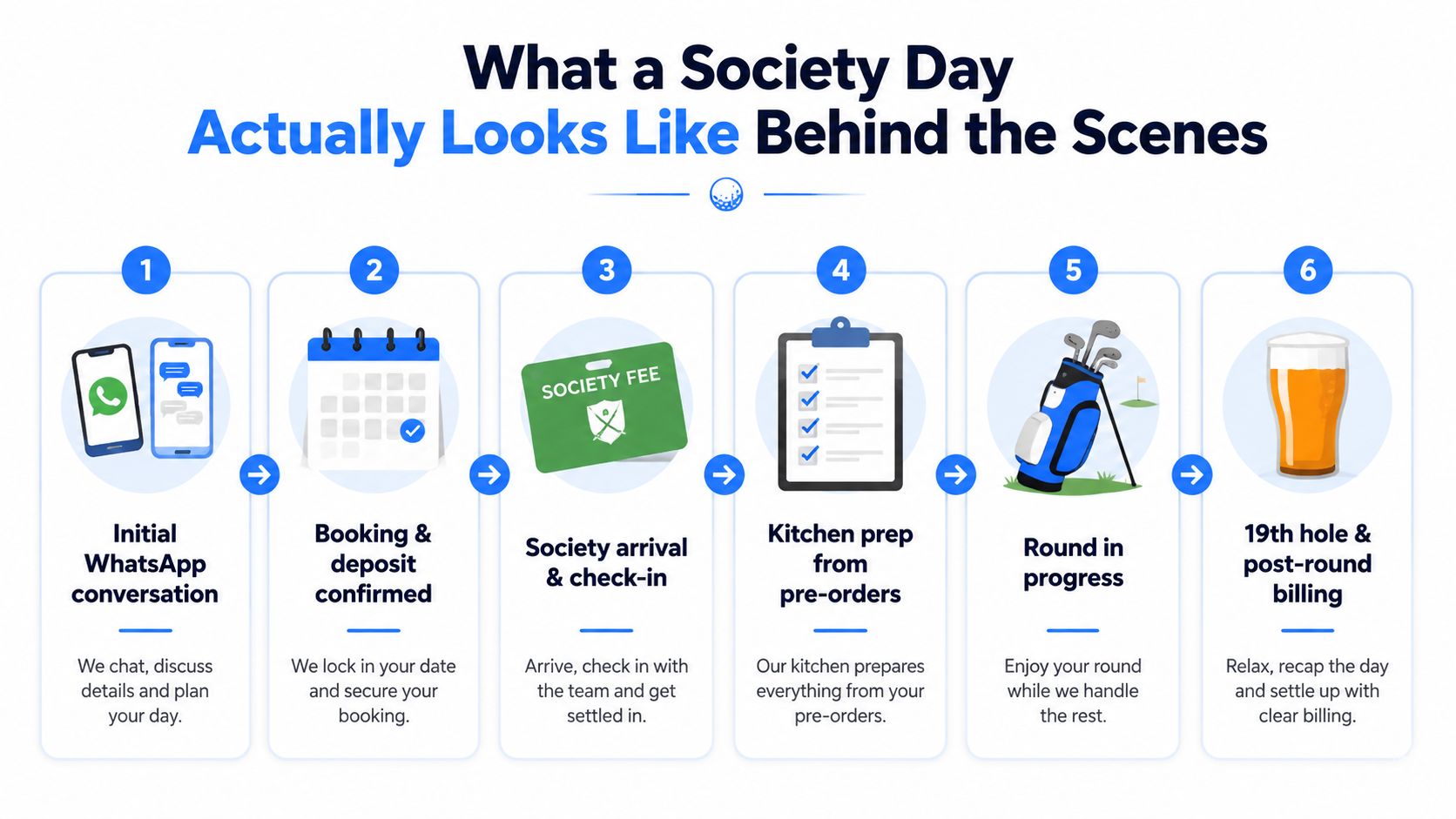
The point of software is simple, it removes the human friction created by disconnected admin. Instead of chasing information by phone, staff can work from a live record of who's coming, what they're eating, what's been paid, and what still needs attention. That matters most at the moments that usually go wrong, arrival, kitchen handover, and end-of-day reconciliation.
A good society workflow doesn't just help after the booking is made. It reduces the number of times someone has to interpret an email thread, rewrite a menu choice, or guess whether a change was confirmed. On busy UK club days, that's the difference between a service that feels controlled and one that feels improvised.
What Golf Society Booking and Pre-Order Software Actually Does
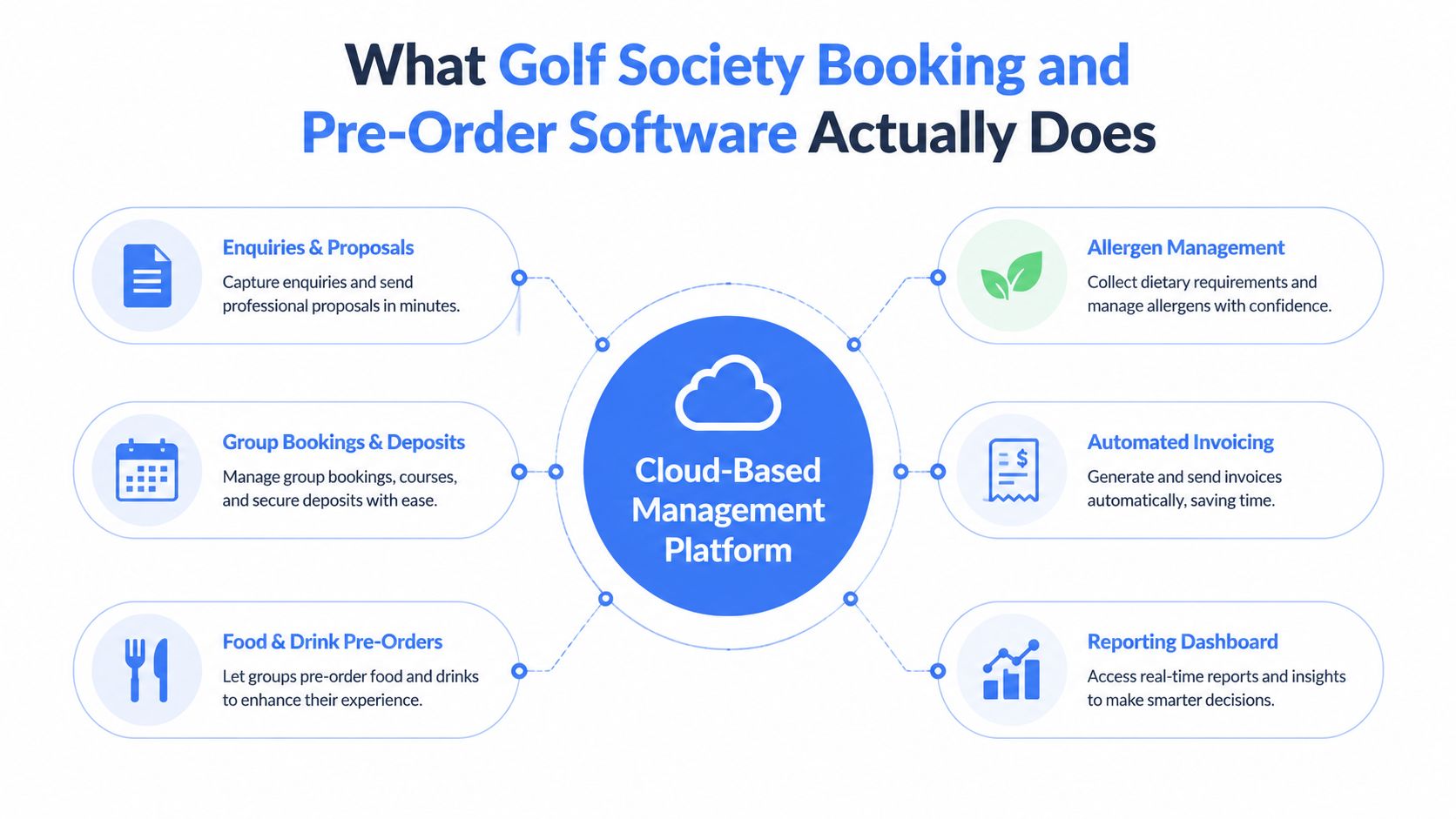
Think of the software as a hospitality operations console for the back of the club. It doesn't just take a start time and a name, it keeps the whole society event connected from the first enquiry through to the last plate leaving the kitchen and the final report on the manager's desk.
The core building blocks
A proper platform usually starts with enquiries and proposals, which is where the organiser's request becomes a structured event rather than a loose email. From there, group bookings and deposits lock the day in and stop the same reservation being handled in multiple places.
The next layer is food and drink pre-orders, because society days often hinge on what gets ordered before anyone arrives. That's where allergen management matters as much as menu choice, since the kitchen needs a clear record of dietary needs, not a handwritten note buried in someone's inbox.
Then comes the service side. Seating, place cards, and function sheets turn the booking into something the front-of-house team can use. Automated invoicing and reporting dashboards close the loop, so finance and events can see what was booked, what was paid, and what happened on the day.
For clubs that want the guest to take more control, a self-service ordering layer can sit in front of the core workflow. That's where how to collect food and drink pre-orders for events becomes relevant as a practical operational pattern, not just a form-fill exercise.
The best versions of this software don't feel like separate tools stitched together. They behave like one workflow with different views for sales, operations, kitchen, and finance.
The reason each part exists as a separate module is that each team needs different information at different moments. The organiser wants a proposal. The kitchen wants exact covers and notes. The accounts team wants payment status. A single mega-form usually fails because it gives everyone the same input, but not the right output.
Operational Benefits for Golf Clubs and Societies
The main gain is not a vague reduction in admin, it is fewer handoffs between people who used to work from partial information. When the booking record, the pre-order record, and the payment record sit together, staff spend less time reconciling mismatches and more time running the event. That has a direct margin effect, because every re-entry, correction, and missed note costs time on the day.
Pre-ordering also changes the commercial picture in practical ways. Reported outcomes include a 251% wet spend uplift from drink pre-orders at a Holiday Inn hotel, around 20% less food waste reported by a global hotel chain, and a 99.2% guest response rate to pre-order invitations. Those figures are not golf-club-specific, but they show the direction of travel. When guests commit earlier, the venue can buy, prep, and roster around real demand rather than guessing.
What changes in practice
A club with live pre-orders usually sees tighter kitchen planning, fewer unnecessary covers, and a cleaner handover between sales and service. The chef gets numbers sooner, the bar team knows what has been requested, and the events manager does not have to interpret three versions of the same menu. On society days, that matters because drinks packages, lunch timing, and post-round catering all sit inside one booking, and each part needs to be visible to the right team at the right time.
The operational shift also fits how UK customers already behave. The UK Office for National Statistics coverage of digital reservation behaviour shows 98% of adults in Great Britain were recent internet users in 2024, and the same coverage citing UK Finance notes that contactless payments accounted for 70% of all card payments in 2023, with cash used for only 12% of payments. In plain terms, most organisers are already comfortable booking and paying online, so clubs are matching existing behaviour rather than asking people to learn a new one.
That shift matters even more when the booking has to carry allergen details through to the kitchen. A handwritten note on its own is easy to miss. A structured pre-order record gives the team a clearer view of dietary needs, service notes, and what needs to be printed for the pass or prep sheet, which is where the process either holds together or starts to slip.
A useful way to judge the operational gain is to ask what gets removed. If your team no longer has to chase menu choices, rebuild seating, and manually reconcile deposits after the event, the software is doing real work. If it only changes where the form is filled in, it is not doing enough.
How a Typical Society Booking Flows Through the Software
A well-run society booking starts with the enquiry, not the menu. In a connected setup, the organiser's request becomes a proposal, the quote turns into a booking, and the deposit confirms the event without anyone copying numbers into a separate tracker. That's the job of the enquiry and proposal layer, which Creventa Flow handles in the Creventa stack.
Once the booking is live, the order stage opens. Guests choose food and drink before the day, and those selections feed straight into the core platform, where pre-orders, allergens, seating, place cards, and reports sit together. That's the point where a golf society stops being just a tee-time block and becomes a managed hospitality event.
From booking to kitchen handover
The kitchen only needs one clean view, not a bundle of forwarded emails. With the right workflow, order data can be grouped by event, table, or service run, which makes preparation much safer and much easier to execute. If the club is using a guest-facing order layer, Prinq is the part of the platform where guests can order and pay before events.
The operational detail matters here. Society days often change after confirmation, so the system has to cope with amendments without losing the original record. That's why how to collect pre-orders for group bookings is worth reading alongside the booking flow itself, because the post-confirmation stage is where the pressure usually builds.
A useful sequence looks like this:
- Enquiry and quote, the organiser sends the details, and the club replies with an event proposal.
- Deposit and confirmation, the booking is secured before catering work starts.
- Menu selection and dietary capture, each guest's order and allergen note is stored against the event.
- Seating and place cards, the front-of-house team gets a practical layout rather than a rough list.
- Check-in and service, arrival is quicker because the record is already in the system.
- Post-event review, feedback and spend data help the club judge what worked.
That sequence matters because each step owns a different risk. Sales risk sits at the quote stage, kitchen risk sits at pre-order capture, and finance risk sits at payment and reconciliation. When those steps are connected, the event feels smoother without staff having to improvise fixes behind the scenes.
Where This Software Sits Against Spreadsheets, Generic Tools and Bespoke Builds
Spreadsheets are familiar, but they're fragile once a society day has multiple guests, dietary notes, and payment stages. They can store information, but they don't control the workflow, and they don't stop two staff members from editing the wrong version at the same time. That's why they work for very small events and become unreliable when the booking starts to branch into catering, seating, and refunds.
Generic event tools are usually better than spreadsheets, but they still tend to think like admin software rather than hospitality software. They often handle the booking form and the confirmation email, yet fall short when the club needs kitchen-ready outputs, allergen capture, or a clean handoff between tee sheet, bar, and function room. For golf societies, that gap matters because the event is both a sports booking and a food service operation.
Practical rule: if the system can't tell the kitchen what to prep and finance what was actually sold, it's not really built for society days.
A bespoke build can fit a club's process closely, but it brings a different problem. Once the original developer moves on, the club owns the complexity, the maintenance, and every future change request. That can be fine for unusual workflows, but it's a poor trade-off if the club mainly needs reliable, repeatable society days with sensible reporting and integrations. For many venues, a dedicated platform is the more practical middle ground.
The compliance piece also pushes clubs away from improvised setups. UK venues still need to capture allergens, dietary needs and kitchen instructions accurately for groups, because the Food Standards Agency requires allergen information to be available and correctly communicated for non-prepacked food. That's not a nice-to-have, it's a workflow requirement, and it's one reason best event management software UK is really about operational fit, not just feature lists.
Compliance, Integrations and What to Verify Before You Buy
Start with the kitchen flow. If allergen and dietary notes are dumped into one free-text field, staff still have to interpret each order by hand, and that defeats the point of using software at all. You want structured capture that can be handed to the kitchen in a format people can work from, and the how allergen tracking systems work in event catering guide is useful because it treats allergen handling as part of the service workflow, not a compliance label.
Payments deserve the same scrutiny. Deposits, pre-orders, and final balances should sit in one payment flow the club can trust, instead of being tracked in a separate spreadsheet or across disconnected emails. If the platform offers integrated checkout, ask how refunds, partial payments, card failures, and outstanding balances are handled before you commit.
| Area | What to verify | Why it matters |
|---|---|---|
| Allergens and dietary capture | Can each guest's note be stored clearly and exported for the kitchen? | Reduces manual interpretation and supports food safety duties. |
| Payments | Are deposits, pre-payments, and refunds tracked in one place? | Prevents reconciliation gaps and missed balances. |
| Communications | Do confirmation and reminder emails actually land reliably? | Poor delivery creates no-shows and extra admin. |
| Integrations | Can it connect to major property management and POS systems, plus finance tools? | Stops staff from duplicating records across systems. |
| Ticketing and documents | Can it produce place cards, function sheets, and reports? | Keeps service aligned with the booked plan. |
For email hygiene, a practical reference is CleanMyList's step-by-step GDPR email compliance, because society workflows often depend on confirmations, reminders, and follow-ups that need to be handled properly. That also affects deliverability and list quality. Transactional email infrastructure on Creventa has reported 99.8% delivery rates for guest communications, and event sizes scale from 4 to over 2,500 guests on a single platform.
Integrations need to be specific, not vague. In the Creventa stack, connections can include Delphi, Opera Cloud, Guestline/RezLynx, Stripe, Adyen, and PlanetPay, but the core question is whether booking, payment, and guest data move cleanly between systems. If a vendor cannot explain that handoff clearly, it will add admin instead of removing it.
ROI, Transparent Pricing and What Implementation Really Costs
Pricing should be public and easy to understand before the demo even starts. Creventa's pricing is published on its website at creventa.com/pricing, which matters because society-day economics are sensitive to hidden fees and per-guest charges.
The key question is whether the price model matches how your club sells. A low monthly fee can look attractive until you add transaction charges, guest-based costs, or extras for core features you assumed were included. On a society day, that can erode margin significantly, especially when you're running smaller groups or recurring events.
If you're evaluating a new platform, use a like-for-like comparison and check the switching steps as carefully as the headline fee. The switching event software checklist is a sensible way to pressure-test data migration, onboarding, and service handover before you commit.
The cleanest commercial model is the one that lets you forecast cost per event without surprises. If you can predict what booking, pre-ordering, and payment handling will cost for a society day, you can protect margin and decide where automation pays back fastest. If you can't, the software hasn't solved enough of the operational problem.
Decision Checklist and Next Steps for UK Clubs
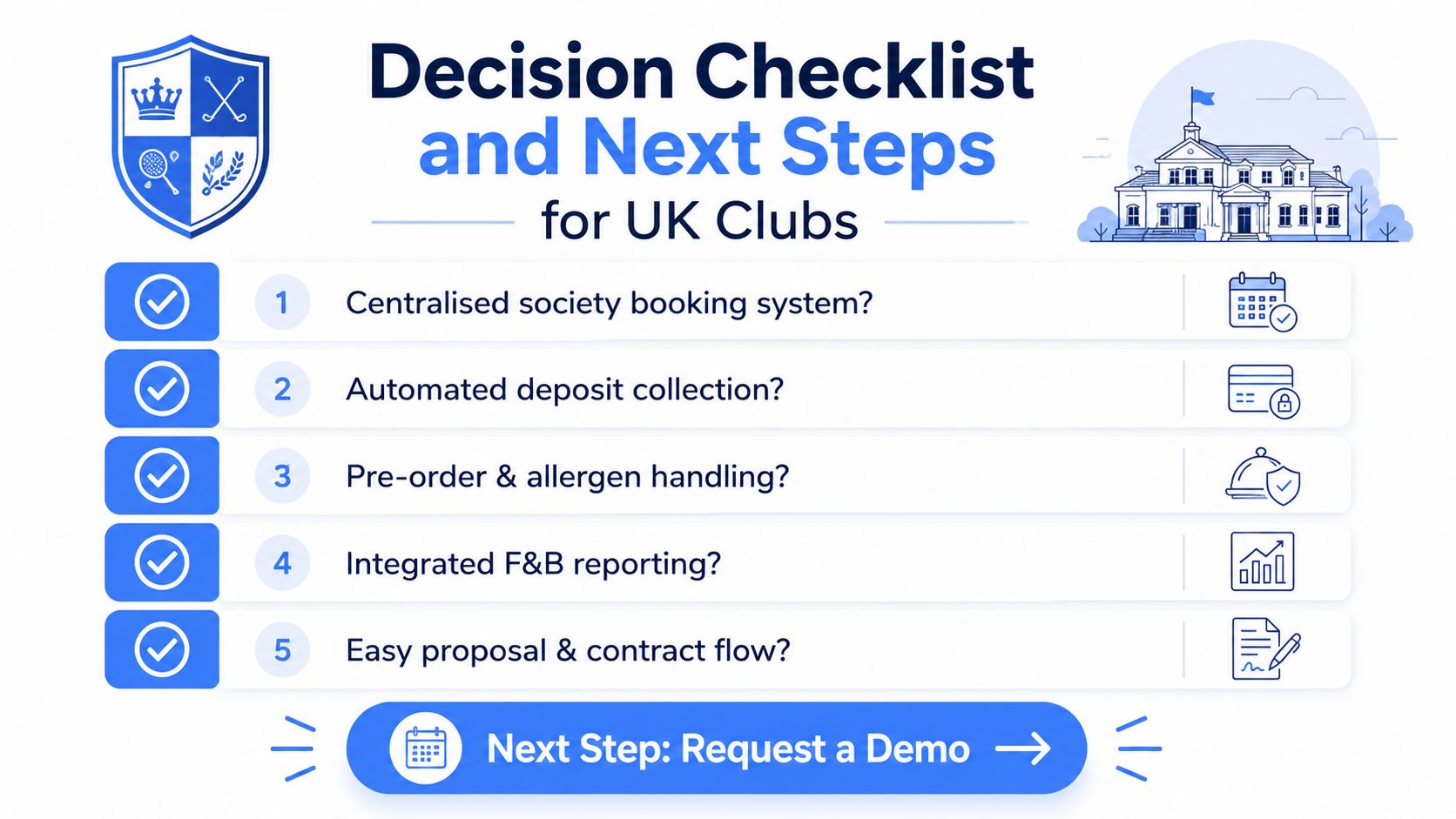
A club ready to move should be able to answer five questions quickly. Can it centralise society bookings, collect deposits, capture pre-orders and allergens, produce F&B reporting, and handle proposals without chasing spreadsheets? If the answer is yes, the platform is doing real operational work.
Start with one society day, not the whole season. That gives the team a chance to check kitchen handover, payment flow, and communication quality without changing every process at once. Once that works, expand it across the diary.
Final check: if the software saves time but creates uncertainty for the kitchen or accounts team, it's the wrong fit.
Creventa centralises pre-orders, allergen tracking, seating, payments, documents, and reporting for hospitality venues, including golf clubs running society days. If you're replacing spreadsheets and email chains with a single workflow for enquiry, pre-order, and fulfilment, take a look at Creventa and see how its event tools map onto the way your club already works.
Jake Crimmin, Hospitality Events Specialist, Creventa. Jake works with hotels and venues on event operations, focusing on how pre-orders and allergen data flow from the guest through to the kitchen.